NEW DELHI
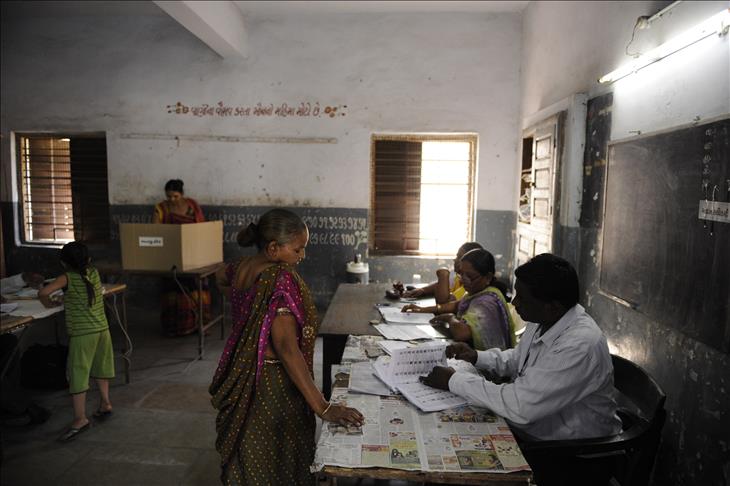
The seventh phase of voting in India's parliamentary elections saw millions turn out to elect 89 lawmakers in seven states across the country.
The average turnout across the country was 60 percent but more than 80 percent in eastern state West Bengal.
In Srinagar, the capital of Jammu & Kashmir, the turnout was only 20 percent. Opponents to Indian control of Kashmir called an election boycott and in recent days Indian police have arrested hundreds of Kashmiri youth in anticipation of protests on election day.
Telangana state, which has been carved out of Andhra Pradesh, witnessed an impressive voter turnout with the new state's residents simultaneously voting for 119 constituencies in the state assembly to be formed on June 2.
Northern Uttar Pradesh, India’s biggest and most populous state – which sends 80 lawmakers to Indian parliament – recorded 54 percent voting for 14 constituencies. Adjoining Bihar, another key state, witnessed a voter turnout of 50 percent for seven seats.
The whole of Gujarat in western India, where Bharatiya Janata Party’s prime ministerial hopeful Narendra Modi is chief minister, saw brisk polling with residents keen to make “son of the soil” Modi Prime Minister. The BJP is expected to win the majority of Gujarat's 26 constituencies.
Punjab state, where the ruling BJP is locked in a fierce electoral battle with the Congress party over anti-incumbency feelings, recorded 72 percent polling. Daman & Diu and Dadra & Nagar Haveli, two federal territories, recorded over 50 percent voting for each constituency.
Security forces opened fire on protesters in Srinagar killing one and injuring another. Minor clashes were reported between workers of Congress party and Akali Dal, a regional party in Punjab. The BJP and Congress workers also clashed in Ahmedabad city of Gujarat.
Modi, the frontrunner to be the next prime minister, voted early in Ahmedabad city. The 63-year-old right-wing politician took a ‘selfie’ of his inked finger along with the party symbol and later held a press conference. Congress party said the actions violated the electoral code of conduct and the Election Commission of India ordered Gujarat police to register a complaint against Modi. The Election Commission also directed registration of a complaint against those news channels which broadcasted Modi’s press meet.
Wednesday’s election will decide the fate of some prominent politicians including Modi and Congress president Sonia Gandhi.
According to all opinion polls, the BJP, India’s principal opposition party, is set to dislodge the ruling Congress party-led coalition government riding on a perceived “popularity wave” of its prime ministerial candidate Narendra Modi, the controversial politician and three-time chief minister of western state of Gujarat.
The ruling Congress party-led coalition, the United Progressive Alliance – which has governed India since 2004 – has come in for sharp criticism and public scrutiny after a series of corruption scandals, policy paralysis and the slowing economy.
Out of the total 543 seats in the lower house of the Indian parliament, 438 have already gone to voting in seven phases in the six-week-long national election.
The next two phases of voting will be on May 7 and 12. The election result will be declared in a single day on May 16.
By Mubasshir Mushtaq - Anadolu Agency
englishnews@aa.com.tr