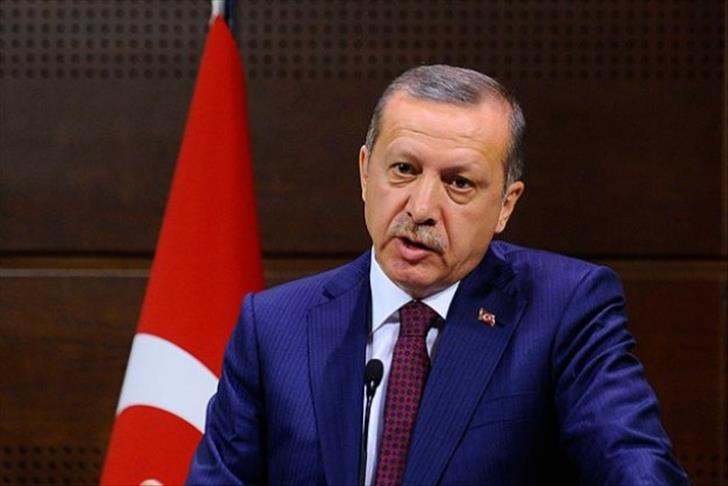
ANKARA (AA) - September 21, 2012 - Turkish Prime Minister Recep Tayyip Erdogan spoke to U.S. daily The Washington Post on Tuesday.
Erdogan replied Lally Weymouth's questions over several topics.
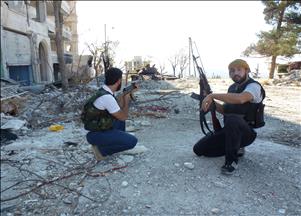
Answering a question over the future of the regime of President Assad in Syria, Erdogan said, "If we look at the history, we will see that regimes which persecute (their people) do not remain standing. In the process of the Arab Spring, we have unfortunately seen a development in Syria where the regime has been oppressing its people. Tens of thousands of young and old people and children have been killed or displaced as a result of these actions. This cruel regime continues to pursue the same policies. We have 83,000 refugees in Turkey, and the Lebanese have about the same amount, and there are about 200,000 in Jordan. These people have not fled their country because they wanted to. Also, there are currently 2.5 million people within Syria who have been displaced; close to 30,000 people have been killed in this conflict. As a result, we see the opposition gaining strength every day. So this regime will go. Bashar is politically dead. Of course, it is difficult to tell whether this will take place in a week, a month or when. This also has to do with how Russia and China approach the situation."
Regarding a question on China and Russia that voted negative on U.N. resolutions that would support the opposition, Erdogan said that China and Russia had been acting in the same way, adding that they had been talking to Russia, China and Iran and would continue to do so.
The Russians will not accept that they are arming the Assad regime, Erdogan said over a question that Russia would continue to arm the Assad regime.
"It would not be befitting for me to point a blaming finger at Russia. Iran has said it has Revolutionary Guards on the ground in Syria. We know such statements from the newspapers," said Erdogan.
Regarding a question with China, Russia and Iran would change their position and stop supporting the regime, "We see that they, too, believe that Assad will go. The question they ask is: What happens after Assad? My answer to them is that if we believe in a democratic parliamentary system, then the will of the people will be what will come to pass. We do not wish to see any external intervention in trying to form a regime in Syria. What we envision is a transitional government basing its actions on a fair constitution, a system where people are free to elect candidates and establish political parties," said Erdogan.
"Everyone inside and outside of Syria who has the ability to represent Syria has been part of this council. The members of the Muslim Brotherhood in Syria are also part of the Syrian people, and they have the right to exercise their democratic rights. Similar developments took place in Egypt. For years, the regime that existed did not allow members of the Muslim Brotherhood to exercise their political rights. In Egypt now, the people have elected the party of the Muslim Brotherhood as their government. When there was a presidential election, a member of the Muslim Brotherhood was elected as president. If we believe in a democratic system, we have to accept the will of the people," PM Erdogan said over a question if he was supportive of the Syrian National Council, and concerned about the Muslim Brotherhood's domination of it.
Answering a question over the United States was stopping Turkey from allowing anti-aircraft weapons to cross the border into Syria, "So far, the United States has been part of the process through their statements but has not had any other contribution. Support has been given to the opposition by countries in the region and Syrians who live outside of Syria. Turkey provides logistical support — food and medicine. We also provide support to those who seek refuge on our side of the border in camps. So far, the total amount of this support is more than $250 million. We will continue to provide this support to our brothers and sisters, the neighborly people of Syria," Erdogan said.
"From the region and from Syrians living outside of Syria, the opposition is getting all kinds of support. But as far as Turkey’s contribution is concerned, we provide the logistical support. It includes refugees — the 83,000 people who live in camps on the Turkish side," said Erdogan responding a question on weapon needs of Syrian opposition.
Does he have any concern about what would follow Assad family and a neat transtion, "This is not a problem. In Egypt, the Mubarak family was in power for more than 30 years, and he is gone. And the people elected someone [as president] — Mohamed Morsi — whose name was not known. The Syrian people will bring about a strong leader through their own will. If we believe in democracy, this is what we should trust in," said Erdogan.
Would he like to see the international community back the creation of a buffer zone, "The decision of the U.N. Security Council would be important in that case," said Erdogan.
Reminding him Russia and China would veto a resolution supporting the buffer zone with the help of U.N., Erdogan said, "You never know. Today that may be the case, but tomorrow things might change. We would not accept being part of what would then be a trap, doing something without the U.N. We are a member of the U.N., and its job is to establish peace in the world".
Addressing a question over former Turkish PM Mesut Yilmaz took the armed forces to the Syrian border to stop hiding PKK terrorist Abdullah Ocalan in Damascus or face a Turkish invasion, and Assad family gave up Ocalan, "There is some misinformation there. Syria sent Ocalan to Greece. He was arrested in Kenya and brought back to Turkey from there" said Erdogan.
Mentioning Turkey has a strong army, and would he not think of playing a stronger unilateral role, " That’s right, no. If there is an attack on our country, then we would do what is required. But this situation has an international dimension and a dimension that concerns the Islamic world. So the U.N. and also the Arab League should be involved with respect to Syria" said Erdogan.
Asking renewing Turkey's relationship with Israel if Israel met his terms, "As I have always said, when our conditions are met [an apology for the deaths of Turks aboard an aid flotilla headed for the Gaza Strip in 2010, compensation for their families and the lifting of the blockade of Gaza], the process of normalization can begin," Erdogan said.
"The three conditions should be met simultaneously. What we call normalization would include the embassy and other steps that could be taken," Turkish PM said over a question he would be willing to send his ambassador back to Israel if they met his conditions.
Erdogan said there would be normalization as a result of the three steps are met simultaneously by Israel.
Addressing him a question over Iran building a nuclear weapon, "I do not want to use the term “nuclear weapons” because those people in Iran who have authority say they are not building nuclear weapons. I make an appeal to the countries who do have nuclear weapons. They do not consider them a nuclear threat. But let’s say a country that does not have nuclear weapons gets involved in building them, then they are told by those that already have nuclear weapons that they oppose [such a development]. Where is the justice in that? The one difference is that none of the countries that have nuclear weapons has threatened to wipe a member state of the United Nations off the face of the Earth, as Iran has threatened to do with Israel. Israel is saying the same for Iran. They are saying they might strike to stop Iran’s nuclear program. I will tell you more. There should be no weapons in Palestine. The Israelis hit a place like Gaza for 15 days with phosphorous bombs," said Erdogan.
Reminding Erdogan that when the U.S. asked him following Arab Spring to break his relations with the Syrian regime, he pushed Assad to reform, "We have determined our own policies. We told President Assad from January 2011 onwards that we would provide support to him if he wanted to engage in reforms. I had a three-hour meeting with him myself at that time, and then I sent my envoys. And we also had telephone conversations. Syria asked for our help, and we sent that help, but nothing changed. Unfortunately, he kept killing his own people by using his tanks, artillery, helicopters and aircraft," said Erdogan.
Asking Erdogan whether he was interested in becoming president, "So far, I have not come to any of the positions that I have filled through wanting to be there. I was sought — people wanted me to come to those posts. I am talking about all my positions: mayor of Istanbul, chairman of the party, prime minister. With respect to the presidency, depending on the demand, if there is one, from the people and depending on what my political party decides, we will see. This next presidential election will be the first in Turkey when the president will be elected by popular vote," Erdogan said.
Addressing Erdogan a question over journalists who have been in jail with no charges, " I don’t know what your source of information is about this subject. I think it is sad that your publication should take these unfounded ideas and allegations as the basis of a question like that. These journalists are not journalists who have the yellow press [identification] card. There are nine of them. These are people who have been in touch with or worked with terrorist organizations. The others are people who are in prison for reasons like being a member of a terrorist organization or for carrying guns. Are you saying they should be released because they are journalists? Even if these are not people who hold the yellow press card? I was put in prison simply because I recited [an Islamic] poem," said Erdogan.
Mentioning the decision against him was wrong too, "So I know what it means to be in prison. But what these people have done has nothing to do with my action of reciting a poem. In my case, I was not involved in injuring or killing someone or carrying arms. I was the mayor of Istanbul, and I was reciting a poem that was approved by the Ministry of Education — and that is why I was jailed. Today, Turkey is very different than Turkey was 10 years ago, when we first came to government. We are now going through a period where freedom of expression is at its peak," said Erdogan.
"The deaths are very sad. So seeing the scenes that we see in Syria — the destruction of historical sites with bombs — this is very sad. Son Assad is doing what father Assad did 30 years ago. His father massacred children, and now the son is doing the same thing again," said Erdogan over a question what worries him about the future of Syria.
Erdogan said that he hoped Assad would opt for the most ideal way out for him, and so the people of Syria would be free of his persecution in the shortest time possible, over a question Assad would go down with the ship or leave.
Over a question whether there was a country Assad could go to, "There would be. Qatar and Tunisia made an offer," said Erdogan.
news_share_descriptionsubscription_contact

contact_the_ombudsman
is_there_an_error_in_this_story