ANKARA
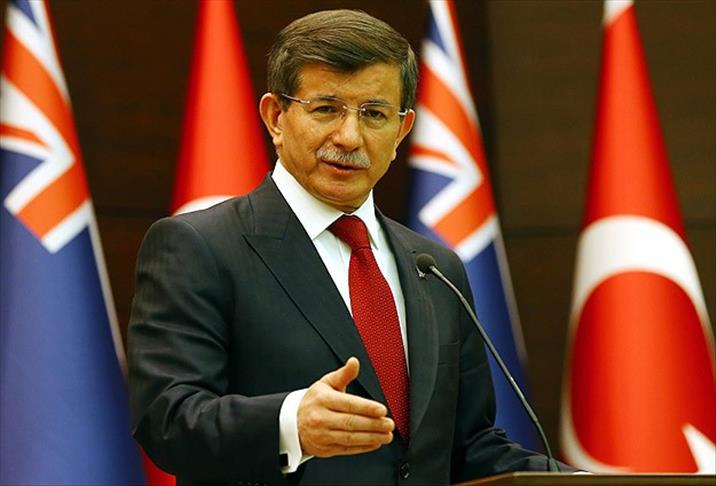
Turkey's Prime Minister Ahmet Davutoglu has said "there will be no compromise from Turkish side to political pressure without historical facts."
Davutoglu's remarks came during the joint press conference with Australian Prime Minister Tony Abbott on Wednesday in the Turkish capital, Ankara.
Referring to the 1915 incidents, the Turkish premier said: "We hope third parties will be careful dealing with this issue."
April 24 will mark the centenary of the deaths of Armenians following a rebellion against the Ottoman Empire in 1915.
Armenia and the Armenian diaspora have demanded an apology and compensation for the 1915 incidents and lobbied for the killings to be identified as "genocide."
The Turkish government has repeatedly proposed creating a joint commission to address the issue with research in all available archives.
The most significant development in normalizing Turkish-Armenian relations came in 2009 with two protocols proposing an impartial examination of the historical record, and the mutual recognition of borders. However, Armenia’s top court ruled that the protocols breached a constitutional clause which "supports the task of achieving international recognition of the 1915 Genocide."
Five years later, the protocols were withdrawn from consideration by the Armenian parliament.
In 2014, then Prime Minister Recep Tayyip Erdogan expressed his condolences to the relatives of all Ottoman citizens who lost their lives in the 1915 events, including Armenians.
In a statement released Monday, Prime Minister Ahmet Davutoglu repeated this message and announced a ceremony to be held on April 24 at the Armenian Patriarchate in Istanbul to commemorate those who died in World War 1 -- the first official ceremony of its kind to be held in Turkey.
'Daesh is a threat for Turkey more than any countries'
Davutoglu also discussed the conflict with Daesh and the issue of foreigners who seek to join Daesh.
Davutoglu said "Everybody should know that Daesh is a greater threat to Turkey than to all other countries."
"We are ready for every kind of cooperation," Davutoglu said, referring to international efforts to stop foreigners from joining Daesh. "Turkey wants no foreign fighters, not in Turkey nor in Syria."
Turkey has deported more than 1,300 people amid Daesh clampdown and issued exclusion bans against 12,800 to date as part of its efforts to prevent people joining the militant group.
Between 700 to 800 people are believed to have joined Daesh by travelling via Turkey.
The figures came after risk analysis centers were established by the government in international airports and terminals in key Turkish cities in 2014 as part of its efforts to curb the problem.
Turkey has also tightened security measures along its 800 kilometer border with Syria.
Turkey has called for more cooperation in sharing information with European states regarding those going to fight in Syria and northern Iraq.
Meanwhile prime ministers released a joint statement on Wednesday saying they "agreed to enhance bilateral cooperation to counter terrorism, tackle terrorist financing and mitigate the threats from foreign fighters."
The joint statement said that Turkey is "on the frontline in the fight against Daesh" and plays "a crucial role" in these efforts.
"Australia welcomed Turkey's renewed efforts to prevent young people from using Turkey's border as the entry point to joining DAESH and other terrorist organizations through tougher border controls and increased information sharing," the statement read.
According to the statement, both parties underlined the importance of identifying and stopping foreign terrorist fighters from traveling to conflict zones, at their country of departure.
"With over 100 Australians fighting with DAESH in Iraq and Syria, and the arrest this week in Melbourne of young men intent on bringing the violence to Australia, Australia will continue to do all it can to stop foreign fighters," the statement said.
The PMs welcomed the first interagency counter terrorism talks held in Turkey in November 2014 and agreed to hold these talks annually.
"They also welcomed closer police and operational support including the joint training conducted between the Turkish National Police and the Australian Federal Police in December 2014 and increasing liaison and cooperation between relevant agencies," the statement said. "They agreed to use all avenues to tackle the scourge of terrorism including sharing information that will lead to prosecution of terrorists, and developing an effective counter narrative to extremist ideology especially online."
Turkey has deported more than 1,300 people amid a Daesh clampdown and issued exclusion bans against 12,800 to date as part of its efforts to prevent people from joining the militant group.
Between 700 to 800 people are believed to have joined Daesh by traveling via Turkey.
The figures came after risk analysis centers were established by the government in international airports and terminals in key Turkish provinces in 2014 as part of its efforts to curb the problem.
Turkey has also tightened security measures along its 800-kilometer border with Syria and has called for more cooperation in sharing information with European states regarding those going to fight in Syria and northern Iraq.