ANKARA
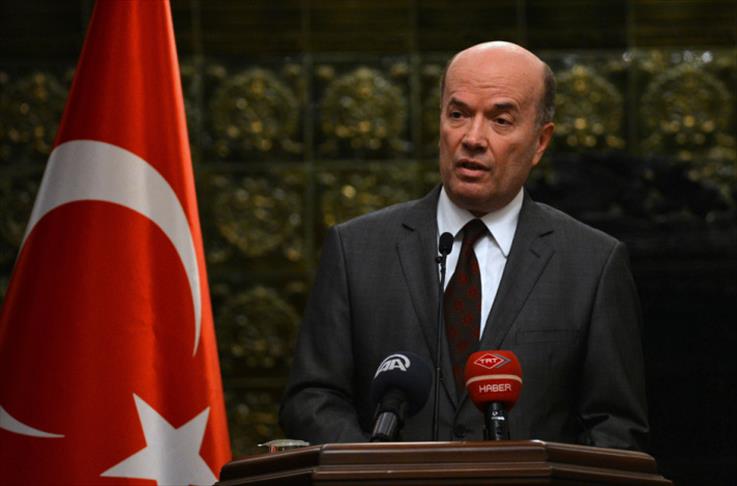
Turkish Deputy Foreign Minister Naci Koru said that Turkey pursued a proactive and multidimensional foreign policy today.
"It is apparent that Turkey has become a major player in international relations based on its geo-strategic location and growing means and capabilities," added Koru who met Turkey's honorary consuls coming from North and South America and Australia.
"In the past decade, Turkey has been actively engaged on almost every issue on the international agenda," said Koru, adding, "politically, in the last ten years Turkey has had a stable single party government with a sweeping reform agenda. Starting the accession negotiations with the EU in 2005, Turkey's reform process gained impetus transforming the country's legal and institutional setting."
"Economically too, we have seen a resurgent Turkey with an average growth rate of around 6 percent in the last ten years. As a sign of increasing confidence in the fundamentals of the Turkish economy, the amount of total foreign direct investment surpassed 110 billion USD in the same period. Today, Turkey is Europe's 6th largest economy, and according to the OECD, will be second only to Germany by 2050.," he said.
"We believe that we can lessen volatility among our neighbors by creating a higher degree of economic interdependency. This is precisely what we have done in promoting the regional trade by various policy measures. As a result, our neighbors' share in total trade volume increased 6 times in the last ten years, comprising 32 percent of our total," he said.
"We used our visa policy as a tool of increasing soft power capability, lifting visa requirements with more than 30 countries in the last 5 years. In addition to its political and cultural benefits, these agreements boosted our tourism. Today, Turkey is the 6th most popular tourist destination in the world," Koru said.
Koru noted, "meanwhile, a human tragedy is unfolding in Syria. The regime responded to the peaceful demonstrations and legitimate demands with brutal suppression. The Syrian people were forced to defend themselves. The regime therefore bears the entire responsibility for the humanitarian catastrophe in Syria. Today with more than 70,000 people killed and more than a quarter of the Syrian population in dire need of humanitarian assistance, the situation is getting worse each day."
"Sharing a 910 km-long border and deep cultural bonds, the situation in Syria is first and foremost a humanitarian issue for Turkey. The number of Syrians who fled to Turkey is above 300,000. We currently accommodate 190,000 in 17 camps and the numbers rise day by day. We have spent over 600 million USD," he said.
"Turkey is in the forefront of international efforts to alleviate the misery in Syria. We are arguing that as the international community, we should increase our efforts and assistance. Furthermore, we should also coordinate the flow of assistance inside Syria. For that, we should optimize our resources and avoid overlapping efforts and duplication," Koru said.