ANKARA
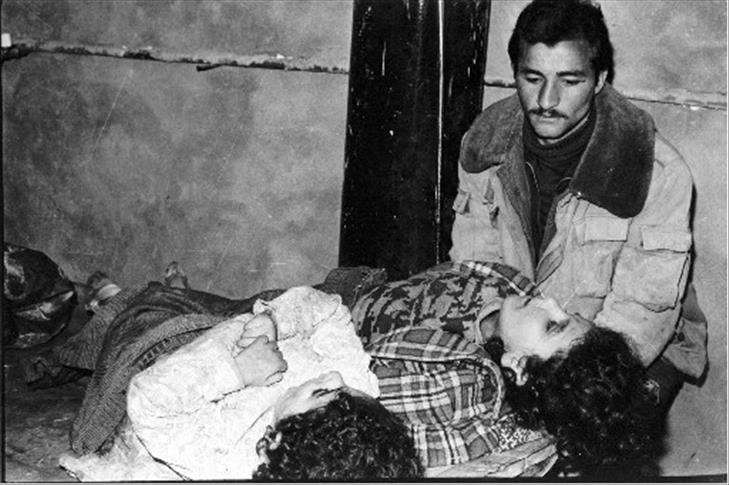
Turkey's Parliament Speaker Cemil Cicek said on Tuesday that the 1992 Khojaly Massacre, when 613 Azeri civillians were killed by Armenian armed forces during the Nagorno-Karabakh War, is a shame on human history.
On the 22nd anniversary of the massacre Cicek said Armenia, which occupies 20 per cent of the territories of Azerbaijan, including Nagorno-Karabakh, has displaced hundreds of thousands of Azeri Turks.
"The perpetrators of the massacre must be brought to justice and account before the International Court of Justice," he said.
Turkey's Prime Minister Recep Tayyip Erdogan also spoke about the event during his address to the Justice & Development (AK) Party group meeting on Tuesday.
"The children of Azerbaijan who lost their lives in Khojali massacre are our children, as well," he said.
The leader of Turkey's main opposition Republican People's Party (CHP), Kemal Kilicdaroglu, also issued a written statement condemning the Khojaly Massacre.
"22 years ago, an inhumane incident occured in our sister country Azerbaijan which still remains as a part of our memory," he said.
During a panel in Turkey's capital, Azerbaijan's Ambassador to Ankara Faig Bagirov said: "The Khojaly Massacre was the most tragic among them. A genocide was carried out in Khojaly that can be cast among crimes against humanity," he told the panel.
The Azeri Ambassador also urged that the "modern world, placing importance on the rule of law, must take the necessary steps from now on."
- What happened in Khojaly in 1992?
Taken under siege by Armenian armed forces towards the end of 1991, Khojaly was a town of 936 square kilometers where 2,605 families were living, with a total population of 11,356.
After the invasion of Khankendi in December 1991, the capital of Nagorno-Karabakh, Khojaly was the next target for Armenians for its geostrategic importance and for hosting the only airport in the region.
In 1992, Armenian armed forces took control of all the villages and roads surrounding Khojaly one-by-one and disconnected the town from other cities.
With all the roads to Khojaly blocked, helicopter was the only transport into the town but it also failed when a helicopter travelling between the Azeri cities of Shusha and Agdam was shot by Armenians on 28 January 1992, killing 44 civilians many of whom were women and children.
The power supply to Khojaly was also cut off in early January.
Khojaly town was left with local defense forces having only light weapons and a small number of national army soldiers.
On February 25, Armenian armed forces launched an offensive to capture the town and started battering it with support of hard equipment and the personnel of the Infantry Guards Regiment 366 of the former Soviet Union.
After almost two hours of artillery and tank shelling, a total of 613 civilian Azeri citizens were killed including 106 women and 83 children, according to official figures.
Armenian invaders slayed the Azeri residents of the town by burning them alive, cutting off their heads, dissecting pregnant women, skinning corpses, heads, damaging their eyes.
The massacre left 487 people critically wounded and Armenian forces took hostage 1,275 people including 150 who are still unaccounted for.
Khojaly Massacre is recognized by the parliaments of Azerbaijan, Canada, Mexico, Colombia, Peru, Pakistan, Bosnia and Herzegovina, Romania, Czech Republic, Honduras, the Kingdom of Jordan and the Parliamentary Assembly of the Organization of Islamic Cooperation (OIC).
It was also recognized by the US states Massachusetts, Texas, New Jersey, Georgia, Maine, New Mexico, Arkansas, Oklahoma, Tennessee, Pennsylvania, West Virginia, Connecticut and Florida.
Parliamentary Assembly of the Council of Europe adopted in January 2005 the PACE Resolution 1416, titled “The conflict over the Nagorno-Karabakh region dealt with by the OSCE Minsk Conference,” which was signed by 31 members of the Assembly (12 from Turkey, 8 from Azerbaijan, 3 from Britian, 2 from Albania, 1 from Bulgaria, 1 from Luxembourg, 1 from Federal Republic of Yugoslavia, 1 from Republic of Macedonia , 1 from Norway, 1 from Poland).
The Resolution says “considerable parts of the territory of Azerbaijan are still occupied by Armenian forces, and separatist forces are still in control of the Nagorno-Karabakh region,” voicing concerns about “widespread ethnic hostilities which preceded it, led to large-scale ethnic expulsion and the creation of mono-ethnic areas which resemble the terrible concept of ethnic cleansing."
Human Rights Watch said within this particular conflict of the disputed territory of Nagorno-Karabakh, it is "the largest massacre to date".
There are several monuments and a museum built in memory of the victims of the Khojaly Massacre. The monuments are in The Hague (Denmark), two in Turkish capital Ankara, one in Hungarian capital Budapest, one in Sarajevo, and one in Mexico City.
There is also a memorial museum in Turkey's Kocaeli city, the first museum in the world built in memory of the massacre.
Azerbaijan and Armenia fought a brutal three-year-war over the landlocked Nagorno-Karabakh region in 1991-1994, following the collapse of the Soviet Union.
By the end of the war in 1994, the Armenian and separatist forces occupied the territory, which held and currently control approximately 14% of Azerbaijan’s territory.
A Russian-brokered cease fire was signed in May 1994 and peace talks, mediated by the OSCE Minsk Group, have been held ever since by Armenia and Azerbaijan.
englishnews@aa.com.tr