PARIS
The French prosecutor’s office investigating the deaths of three members of the Kurdistan Workers’ Party (PKK) members in Paris in 2013 does not have any indisputable evidence showing a connection to Turkey's National Intelligence Agency, or MIT. However, the prosecutor’s office is now running after the claims of involvement of Turkey's “parallel state” or extreme nationalists in the assassination.
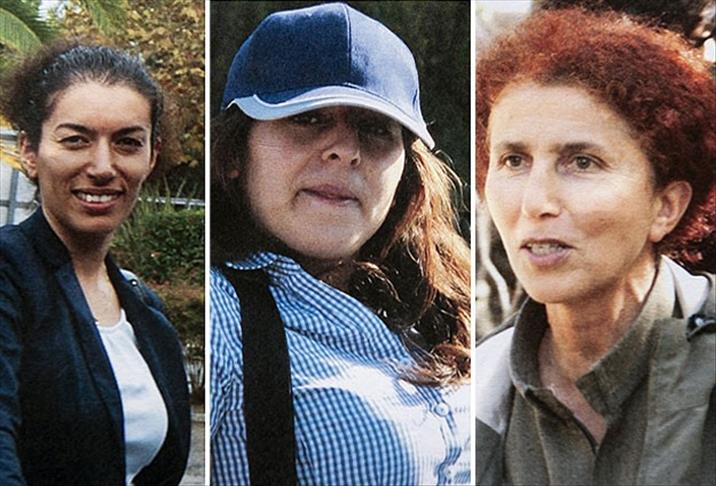
Sakine Cansiz, Leyla Soylemez and Fidan Dogan were shot dead at the Kurdistan Information Bureau in Paris on Jan. 9, 2013. Omer Guney, 30, the only suspect in the case, was arrested for "murder in connection with a terror group".
Following a two-year investigation, Paris prosecutor's office demanded Omer Guney to be judged in a high criminal court.
Agnes Thibault-Lecuivre, a spokeswoman for the Paris prosecutor's office, told Anadolu Agency that they had found indications showing the MIT might have helped Omer Guney regarding the killing of PKK members but added that the office did not possess indisputable evidence.
"We have elements that Guney might have acted on behalf of MIT, but we do not have enough evidence for it," Thibault-Lecuivre said.
She said they asked Turkish judicial authorities to provide information about the people that Guney had contacted in Turkey, "but they rejected our demand". "If Turkish judiciary does not share more intelligence with us, the process may not be completed," she said.
France investigates the role of 'parallel state'
An indictment published by the French newspaper Le Monde said: "There are a number of elements that make us suspect that the MIT was involved in the encouragement and preparation of the assassination. It was found out that Omer Guney conducted spy activities and secretly contacted more than one person in Turkey(...) However, the investigation could not make clear whether the MIT agents were involved on official order from their hierarchy or acted without their knowledge in order to either discredit the reputation of the agency [MIT] or to hurt the peace process."
The paper pointed to the “parallel state” in a caption "Possible aim: to sabotage peace process".
"On March 2014, two months after the incident [murders], a Turkish website made a claim. One of the two voices in the recording that could not be identified belonged to 'Kozanli Omer, the police imam of the Gulen movement.' Fethullah Gulen, living in exile in the U.S. first supported [now President Recep Tayyip] Erdogan, and later continued to be very active in state institutions although he [Gulen] broke his connections with [Erdogan],” Le Monde writes.
The paper focused on the following questions:
"Who ordered the murder of three Kurdish activists in Paris on January 9, 2013? Is it the Turkish Government who wanted to stop the peace process, which the government started itself, or fractions of the Gulen movement that infiltrated the MIT, or the MHP [Nationalist Movement Party] which is close to the army and indeed the party that Omer Guney feels close to?"
The role of German intelligence
The prosecution in the criminal complaint that was sent to the investigating judge, also hinted that Guney might have received assistance from a person that “he met many times” in Germany. In the criminal complaint, it is also said that German authorities permitted the raid of that person’s home but did not allow him to be tried in France.
Le Monde columnist Soren Seelow, who has been reporting on the case, told the Anadolu Agency that the person in Germany might have been working for the German Intelligence as an outside informant. “The fact that the German police first allow the search but later stand against the trial, raises suspicion that the aforementioned person may be beneficial for Germany,” he said.
Prosecution spokeswoman Agnes Thibault-Lecuivre, relating the claims of a possible German intelligence role in the process, said: “Our criminal complaint refers to this case, but this is not one of the possibilities we have [investigated the most].”
According to another detail from the criminal complaint, one day before killing the PKK members, Guney took the pictures of 300 people in the Kurdish Information Bureau and shared them with a source abroad. But Thibault-Lecuivre said they would not comment on this matter at this stage of the proceedings.
The criminal complaint prepared by the prosecutor's office in Paris, represents the first time that the French judicial system uses the expression that a foreign intelligence service may have had role in an assassination carried out on French soil.
The French judge’s query is expected to respond to the prosecution’s request within two months.
MIT announced that it has nothing to do with the incident
MIT, in a statement made on Jan. 14, 2014, has rejected the claims that the organization had a role in the killing of PKK members in Paris.
In the statement, MIT said that it had “absolutely nothing to do” with the killings. The statement said: “The publications are considered to be an operation to diminish our organization that has taken an active role in the solution process and to incapacitate personnel that has had an active role in this process by revealing their identities.”