Anadolu Ajansı © 2026


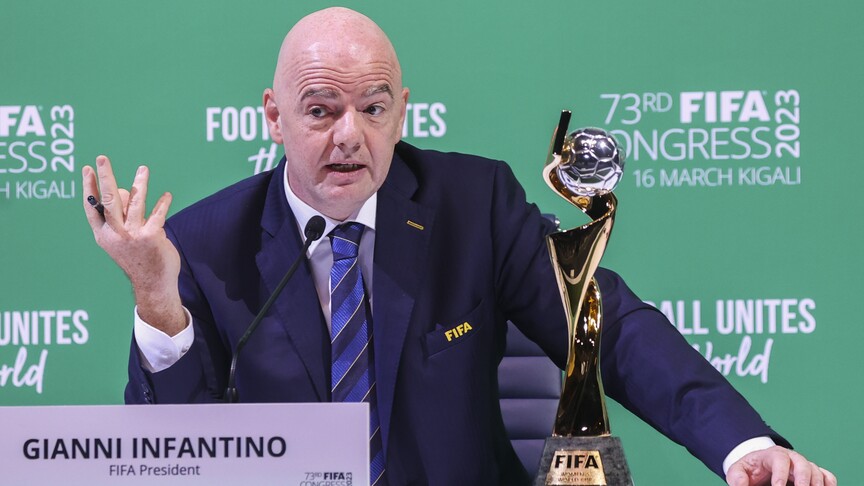
FIFA President Gianni Infantino is facing the most serious political challenge of his decade-long leadership after a controversial proposal to sell a stake in the governing body's commercial operations triggered an unprecedented backlash from football federations around the world.
The crisis erupted just weeks after the conclusion of the 2026 FIFA World Cup, a tournament widely regarded as a commercial success and one that appeared to strengthen Infantino's position ahead of his expected bid for a fourth term in office.
Before the controversy, more than 200 of FIFA's 211 member associations had reportedly signed letters supporting his re-election.
That political capital quickly evaporated after FIFA announced plans in late July to sell up to a 20% stake in a newly created commercial subsidiary, FIFA Forward Enterprise (FFE), in a deal that could have valued the entity at around $20 billion.
The proposed investor group included Thrive Eternal, an investment fund linked to Josh Kushner, alongside Bann Ventures Chief Executive Greg Maffei. JPMorgan and OpenEconomics were also involved in identifying prospective investors.
Thrive Eternal is linked to investor Josh Kushner, the brother of Jared Kushner, US President Donald Trump's son-in-law and former senior White House adviser.
The proposal immediately drew criticism from several continental confederations, which argued FIFA had failed to properly consult its members over one of the most significant commercial decisions in its history.
Faced with mounting opposition, Infantino abandoned the proposal on Aug. 1.
The reversal was not enough to ease tensions.
UEFA and other regional bodies such as CONCACAF directly questioned Infantino's leadership, while several national football associations, including Finland, Wales and Serbia, have formally withdrawn support for Infantino's re-election. The dispute has become the biggest governance challenge FIFA has faced since Infantino replaced Sepp Blatter in 2016.
Although political pressure has intensified, removing a FIFA president before the end of a mandate remains difficult.
Under FIFA statutes, the president could resign voluntarily, although Infantino has given no indication he intends to do so.
Member associations representing at least 20% of FIFA's membership, 43 of the governing body's 211 associations, may also request an extraordinary FIFA Congress that must be convened within three months and could include a vote on the president's future.
UEFA's 55 member associations alone exceed that threshold, although the confederation has not formally requested such a meeting.
Any attempt to remove Infantino would still require support from a majority of FIFA's global membership, with each national association holding one vote regardless of its size.
Another possibility would be disciplinary action through FIFA's independent Ethics Committee, which has the authority to investigate alleged breaches of the FIFA Code of Ethics and impose sanctions, including lengthy bans.
That mechanism ultimately ended Blatter's presidency in 2015, although no formal ethics investigation has been announced in the current dispute.
The next FIFA presidential election is scheduled to take place during the 77th FIFA Congress in Rabat, Morocco, on March 18, 2027 with a nomination deadline of November 18.
Should no president be able to continue in office before then, FIFA's Governance Regulations provide that the longest-serving FIFA vice president would temporarily assume presidential responsibilities until Congress elects a successor.
The controversy has exposed significant divisions among FIFA's six continental confederations.
UEFA has emerged as the strongest critic, describing the proposed commercial restructuring as an opaque process that contradicted FIFA's commitments to transparency.
The confederation has discussed possible legal options while several of its member associations have publicly distanced themselves from Infantino.
CONCACAF, the governing body for football in North America, Central America and the Caribbean, also criticized the proposal, calling for a "comprehensive reckoning" of FIFA's governance.
Initially silent, the Asian Football Confederation later joined criticism of FIFA's consultation process, although it stopped short of threatening any boycott of competitions.
By contrast, Africa's CAF has largely avoided direct confrontation. President Patrice Motsepe has advocated reviewing the proposal rather than rejecting it outright and has continued to praise Infantino's support for African football.
South America's CONMEBOL has remained one of Infantino's strongest allies. President Alejandro Dominguez has urged member associations to evaluate the proposal objectively and previously became one of the first confederation leaders to publicly endorse Infantino's prospective fourth term.
The controversy has also prompted criticism from national federations and senior football officials.
The Football Association of Wales cited failures in leadership, transparency and communication when withdrawing its support for Infantino.
Germany's Football Association reiterated earlier concerns that FIFA had acted without sufficient consultation, while La Liga President Javier Tebas called on Infantino to resign.
Inside FIFA, senior adviser Carlos Cordeiro resigned in protest, and Chief Operating Officer Kevin Lamour publicly criticized the handling of the project, saying staff had not been properly informed.
Although no challenger has formally entered the presidential race, several names have emerged in media reports.
Among them is Paris Saint-Germain chairman and European Club Association President Nasser Al-Khelaifi, although his representatives have repeatedly denied any interest in the position.
CONCACAF President Victor Montagliani has also been mentioned as a possible candidate, as has Asian Football Confederation President Sheikh Salman bin Ebrahim Al Khalifa, who lost to Infantino in the 2016 FIFA presidential election.
Other names linked with a potential campaign include UEFA President Aleksander Ceferin, Legia Warsaw owner Dariusz Mioduski and FIFA Secretary General Mattias Grafstrom.
Despite the backlash, Infantino's continued support from Africa and South America means that any effort to remove him before the 2027 election would require a coalition extending beyond Europe.
news_share_descriptionsubscription_contact