Asiye Latife Yilmaz
19 January 2026•Update: 19 January 2026
ISTANBUL
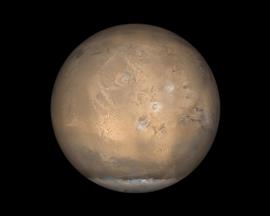
Mars, despite being tens of millions of miles away, may play a larger role in Earth’s long-term climate cycles than previously thought, according to research published Sunday.
The study, which appeared in the scientific journal Publications of the Astronomical Society of the Pacific, used new international simulations to show that Mars influences Earth’s Milankovitch cycles — slow orbital variations that drive long-term climate patterns.
Milankovitch cycles arise from gravitational interactions among planets that gradually alter Earth’s orbit and axial tilt, affecting how solar energy is distributed across the planet.
Researchers examined how changes in Mars’ mass would affect these key elements of Earth’s orbit, known as its eccentricity, perihelion, ascending node and obliquity.
They found that the 405,000-year eccentricity cycle, driven mainly by Venus and Jupiter, remains stable regardless of Mars’ mass.
Shorter eccentricity cycles of about 100,000 years linked to Mars, however, became longer and stronger as the red planet’s mass increased, pointing to tighter gravitational interactions among the inner planets.
The team also found that the 2.4-million-year grand eccentricity cycle disappeared when Mars’ mass approached zero, indicating the cycle depends directly on the planet’s gravitational influence.
Researchers said the findings suggest Mars plays a significant role in shaping Earth’s climate-forcing patterns and that similar orbital signatures on Earth-like planets could help scientists estimate the masses of nearby worlds.