CAIRO
America's top diplomat and his deputy as well as EU's highest foreign policy official had all avoided describing the military ouster of Egypt's elected president as a military coup, in what is seen as a tactical support for the new roadmap in the country.
They all sufficed with calls to speed up elections and halt politically-motivated arrests of Muslim Brotherhood leaders and sympathizers.
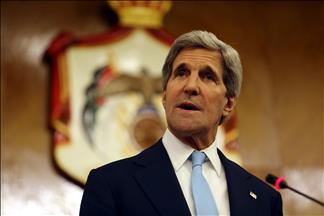
"Well, on the issue of a coup, this is obviously an extremely complex and difficult situation," US Secretary of State John F. Kerry told a press conference Wednesday in the Jordanian capital of Amman where he met members of the Arab League and Palestinian President Mahmoud Abbas as part of efforts to relaunch Israeli-Palestinian peace talks.
"We need to take the time necessary, because of the complexity of this situation, to evaluate what has taken place, to review all of our requirements under the law, and to make it consistent with our policy objectives as is appropriate with that appropriate interpretation under the law," Kerry said.
The powerful Egyptian army, which has longstanding strategic relations with the US, ousted Mohammed Morsi, Egypt’s first democratically elected president, on July 3 following mass street protests against his regime.
The army also suspended the constitution and installed Adly Mansour, the head of the constitutional court, as interim president.
While countries like Turkey and Tunisia have described Morsi's ouster as a military coup, Washington has avoided using the term because under US law this would mean the automatic halt of the $1.3 billion Egypt gets every year in US military aid.
Kerry's deputy, William Burns, had held talks earlier this week with Mansour, Prime Minister Hazem al-Beblawi and chief of the military and Defense Minister Gen. Abdel Fattah al-Sisi during the first visit to Egypt by a senior US official since Morsi's ouster.
In an implicit show of support for the army's political roadmap, Burns said Washington was committed to helping Egypt succeed in its "second chance" at democracy.
The same message was reinforced by Kerry yesterday.
"We were very pleased to see the increasing commitment day to day to making sure that Egypt will move rapidly to the constitutional process that will guarantee the democracy for all of its citizens," he said.
EU's High Representative for Foreign Affairs and Security Policy Catherine Ashton also avoided referring to Morsi's ouster and seemed to focus only on the future.
“We want to see Egypt move forward in its democratic future and we want to see that happen swiftly,” she said in a press statement at the end of her visit to Egypt and talks with the new regime representatives.
She also met with leaders of the Tamarod protest group, which spearheaded the campaign to ouster Morsi, and representatives of the Muslim Brotherhood’s Freedom and Justice Party.
"We've talked with a lot of people about the prospect of elections taking place in the next few months, and the role the European Union can play in helping to monitor and observe these elections."
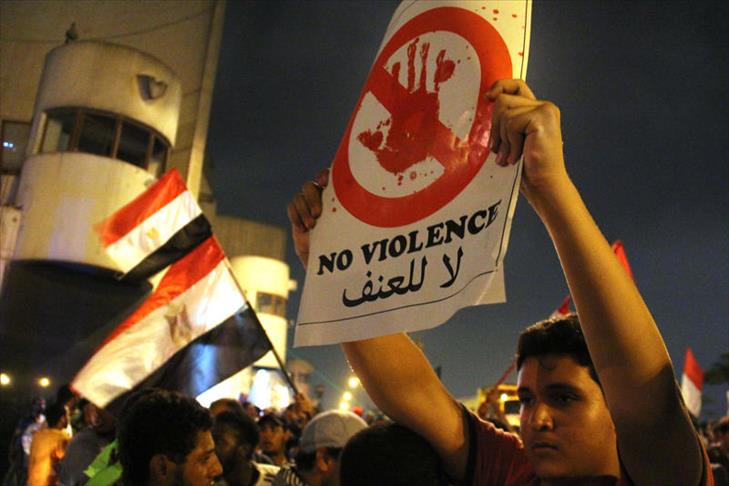
But the message fell flat for hundreds of thousands of Morsi supporters who have been staging daily demonstrations, rallies and marches nationwide to defend his constitutional legitimacy and demand his reinstatement.