KUALA LUMPUR
There can be no science where there is no freedom, Turkish Prime Minister Recep Tayyip Erdogan said on Friday in Malaysian capital Kuala Lumpur, adding, "No results can be achieved for the sake of humanity, if there is no freedom."
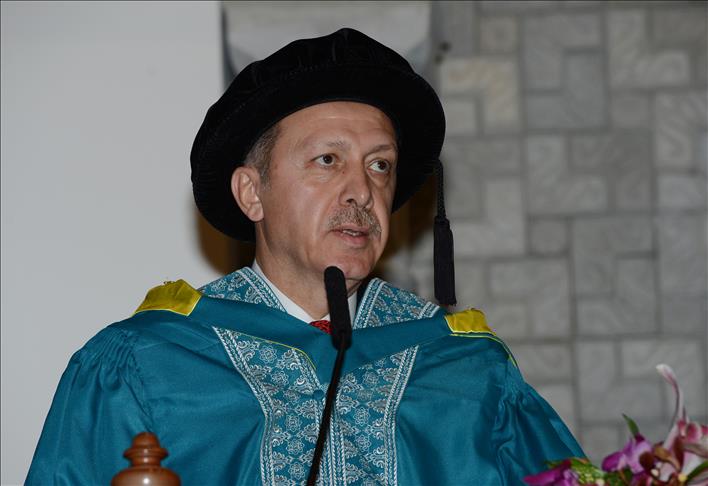
During his visit to Malaysia, Erdogan attended a ceremony at International Islamic University Malaysia where he received an honorary PhD. Underlining that Malaysia and Turkey have mutual elements in their goals, Erdogan reminded that Malaysia has visions for 2020, as Turkey does for 2023.
"We aim to be a country that produces its own warplanes, manufacture its own satellites and then to be able to send these satellites to space on our own," the Turkish PM said. "I strongly believe that we will achieve this goal by 2023."
Following the ceremony, Erdogan attended the "Transforming Eastern Asia - Pacific Region and Turkey" conference. During his speech at the conference, Erdogan emphasized the importance of world peace and also underlined the importance of mutual respect and cooperation among world countries.
"Winning people’s hearts is our priority both in our domestic and international politics," Erdogan said, adding that justice is the starting point for Turkish politics.
Stressing that Turkey and Malaysia are on opposite ends of Asia, Erdogan said, "Mutual efforts against terrorism, racism and Islamophobia, will be a great assistance to regional and global peace."
The Turkish prime minister made his first overseas trip in 2014 to South Asia in a tour that also covered Japan and Singapore.
Turkish PM says Malaysia supported Turkey during hard times
Malaysia and Malaysian universities have sided by Turkey during its hard times, said Turkish Erdogan in Malaysian capital Kuala Lumpur.
Attending a ceremony hosted in his honour, PM Erdogan was presented with an honorary doctorate title by Malaysia's International Islamic University.
Referring to Turkey's February 28 post-modern coup process, Erdogan said a large number of Turkish students have studied in Malaysian universities while retaining their values and beliefs.
The February 28 military memorandum was a host of decisions issued by the Turkish military in 1997 in response to what it saw as rising Islamist ideology.
Turkish students suffered pressures, prohibitions and restrictions at that time, said the Turkish PM in reference to the headscarf ban on female Turkish students during and after the February 28 process.
"Malaysian universities were the universities where Turkish students freely studied at that time," he added.
Erdogan stressed that the government has lifted the "meaningless" prohibitions and restrictions in Turkish universities.
The headscarf issue has been on the agenda of Turkish politics for more than three decades since it was banned in Turkish universities in 1984. Since then many attempts to abolish the ban on wearing headscarves in state institutions and universities have failed.
The ruling AK Party from which Erdogan hails has placed the headscarf issue at the top of its agenda since its establishment and rise to power in 2002.
The concluding attempt by the AK Party concerning the headscarf issue came with Erdogan's declaration on September 30 of the Democratization Package, which opened the gates of state institutions to women wearing headscarves. It also introduced a number of reforms regarding political rights.