By Mubasshir Mushtaq
MUMBAI, India
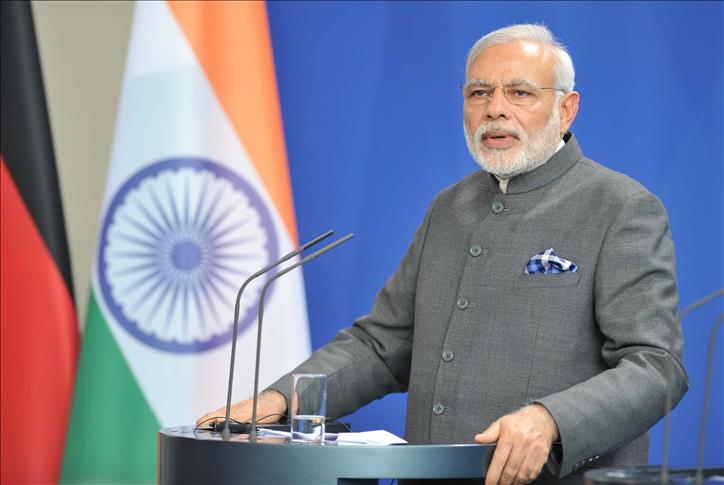
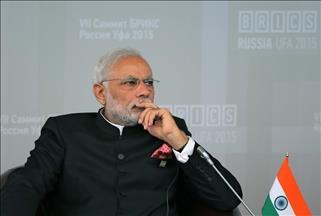
With a trade-boosting mission and hopes to resolve longstanding border and political disputes, India’s Prime Minister Narendra Modi arrives in China on Thursday.
“I was waiting for a long time for the China trip,” Modi said on Wednesday.
“The 21st century belongs to Asia,” Modi told a group of Chinese journalists on Tuesday, adding that the trip will “set a new milestone for the relations between developing countries in Asia as well as around the world.”
Modi, who next week marks a year in office, will spend three days in China before setting off for Mongolia and South Korea; whose economic model is an inspiration for Modi.
He will be welcomed on Thursday by Chinese President Xi Jinping in the city of Xi’an, where they will visit the Wild Goose Pagoda, a place where classical Chinese Buddhist cleric Xuanzang is believed to have returned to after 17 years in India with Buddhist scriptures.
Modi’s entourage will consist of 50 Indian businessmen, all eager to make a breakthrough in the Chinese market as well as entice Chinese investment.
Trade, he hopes, will help put the regional rivalry with China on the back-burner, a goal Modi emphasized on Tuesday, tweeting that Asia must ensure “a century free from war.”
“I think Modi is seeking to re-orient Indo-Chinese relations and make it a more commerce-driven one,” Harish Nambiar, a senior journalist told Anadolu Agency.
Nambiar suggests, however, that shifting the relationship towards trade could put India at a disadvantage.
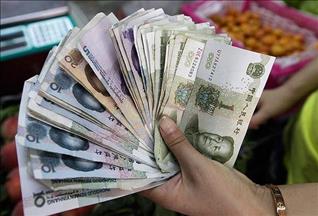
“Our $40 billion plus trade deficit is set to balloon to $60 billion in the next two years. Compare that with the $46 billion that China committed as investment to Pakistan, and one gets the size of the skew,” Nambiar said.
Up for discussion between the two countries will be a working boundary along India’s northern state of Arunachal Pradesh, whose borders have been disputed since territory was annexed by China in the 1962 Sino-Indian war.
Pratinav Anil, a scholar on Europe and Asia at Sciences Po, Paris, told Anadolu Agency that India and China have long been vocal about border disputes, to harness domestic support, but ignore them during bilateral discussions.
Anil said Modi has adopted a “contradictory dualism” in portraying himself as a hardliner within India, while using softer diplomacy when directly engaged with China.
“India never had military parity with China. This makes a ‘hardline’ stand with China quite impractical, and a softer approach through Memorandum of Understandings, communiqués and the encouragement of trade makes more sense,” he said.
President Xi visited India in September for a similar visit focused on investment but since then there have been major deals signed – between the U.S. and India and, more recently, Pakistan and China – that suggested both are still engaged in a regional strategic struggle.
Anil said that India should pursue trade and military ties with countries surrounding China “to strategically encircle China the way China has encircled India with its ‘string of pearls’ - a series of naval outposts in the Indian Ocean.”
“Modi needs to play this larger geopolitical game rather than getting bogged down by border clashes which are a recurring reality,” Anil said.
Modi’s caution ahead of the trip has been clear, excluding China’s rival Japan from upcoming naval exercises in the Bay of Bengal and calling off a meeting with the Tibetan Buddhist spiritual leader the Dalai Lama, who is exiled from China.
“The seeming distancing from the Dalai Lama is a tactical move. I suspect that as the Modi administration calculates it, it can be reversed easily without much fallout. It is a kind of carrot first, stick later kind of a move,” Nambiar said.
Science Po’s Anil said: “China holds a genuine paranoia about Indian activities vis-a-vis the Dalai Lama and the Karmapa - both of whom are seen by it as Indian agents spreading dissent in the unstable Tibet Autonomous Region.”
India and China are also likely to sign an agreement to modernize India’s British-era railway network. China is already looking at the feasibility of a 1,050 mile (1,700 kilometer) high-speed rail link between New Delhi, the national capital, and southern city Chennai.
Modi’s biggest challenge may be reversing a growing trade imbalance between the countries and some experts believe he will not succeed.
“There is a structural imbalance in the trade between the two countries, especially in the energy and manufacturing sector,” said Anil. “Modi’s trip or even his larger rhetoric of ‘Make in India’ is going to do little to change these existing realities.”
Retired professor and political analyst Mustafa Khan said that reversing the trade deficit was “unthinkable.”
“Our markets are inundated with Chinese goods with easily buyable price tags for ordinary Indians,” Khan said.