SAO PAULO
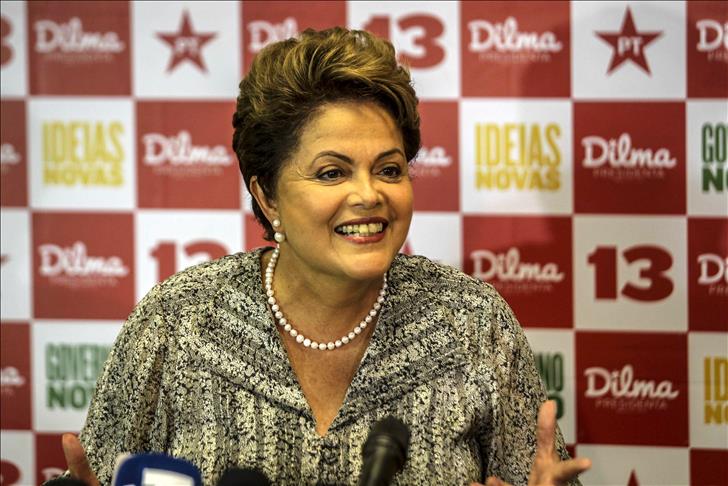
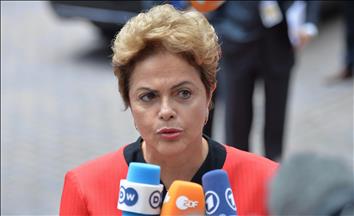
President Dilma Rousseff promised she will announce steps to kickstart the country's economy "by the end of the year."
Rousseff made the comments Monday night on the Globo network's flagship nightly news program, Jornal Nacional, and followed a turbulent day for the country's Bovespa stock and currency, the Brazilian real, after the incumbent secured a second term in Sunday's presidential elections.
The Bovespa initially slumped 6 percent when it opened Monday morning, and ended the day 2.77 percent down; the real depreciated 3 percent against the dollar to its weakest against the American currency since April 2005. Both were seen as the markets' verdict on the left-leaning Workers' Party candidate's re-election.
The Bovespa and real, however, appeared to be buoyed by comments made by the president in her Globo interview, in which she vowed to reach out to all financial sectors and establish a way forward for the stagnated economy.
Rousseff said she would "not wait until my first mandate is over before starting to take steps towards transforming and improving growth in our economy. I will open up dialogue with all areas ... business, finance, market, to discuss what paths Brazil will take."
"I will set out the steps to be taken in a very clear way," Rousseff said, adding the timeframe for her new economic plans should happen "by the end of the year," and when pressed, narrowed it down to November.
As a result, both markets clawed back some of Monday's lost territory on Tuesday. At 4 p.m. in São Paulo (1800 GMT) the Bovespa was up 2.7 percent, and the real had strengthened by 1.8 percent.
Rousseff did not say who would be replacing outgoing finance minister Guido Mantega. His removal, officially for personal reasons, was seen as an olive branch to the markets during her re-election campaign.
The markets, which see Rousseff as overly interventionist in her fiscal policy, showed its displeasure repeatedly during the election campaign, siding with rival Aécio Neves and responding to any positive news for Rousseff with slides on the Bovespa or the real.
The economy is set to grow 0.3 percent, according to market forecasts, although the government says this is overly pessimistic, and that 0.9 percent growth is more likely. In addition, Brazil technically entered a recession earlier this year after two consecutive quarters of negative growth in the first half of the year. Inflation is also currently beyond the government's 6.5 percent upper limit.
Neil Shearing, chief emerging markets economist at London-based Capital Economics, told The Anadolu Agency that Rousseff needs to signal changes that aim to improve growth and inflation with a concrete "statement of intent.”
"The immediate focus for the markets is to reverse the steady deterioration seen in Brazil's fiscal position, which has been acutely felt in the past three months. Inflation has been above the central bank target of 4.5 percent every month of her first term in office," he said.
"We now need to see a statement of intent on inflation, potentially with a lower target, with the central bank given a mandate to meet that goal," Shearing explained, but expressed doubt the central bank would be given the autonomy to do just that.
"Brazil cannot give itself the luxury of avoiding the global tendency toward reform while international competition for capital and investments grow so intensely," Jorge Mariscal, Chief Investment Officer for Emerging Markets at UBS Wealth Management, told the Folha de S.Paulo newspaper.
According to Mariscal, the markets are looking for clear signals that the government is planning something "transformatory" in nature. Other financial experts say the markets want to see a reduction in public spending and less political interference.
To this end, Shearing believes Mantega's exit presents the government with an opportunity to fill the finance minister roll with a more market-friendly figure and perhaps not linked to the ruling Workers' Party, to win over more confidence from investors.
It is thought unlikely, however, that Rousseff will consider major reforms to pensions, welfare programs or the tax system, the emerging markets specialist added.
Although the economy was central to the recent presidential elections, accusations of corruption often drowned out concrete proposals. The elections divided the country, and Rousseff was re-elected with a thin margin, with 51.6 percent of votes.
Rousseff will now govern until the end of 2018, leading her Workers' Party to 16 consecutive years in power -- the most of any party since democracy returned to the country at the end of the 1980s.
www.aa.com.tr/en