BEIJING
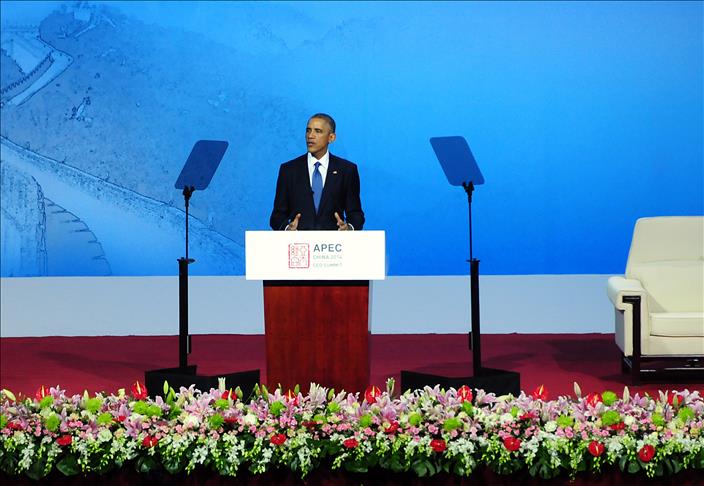
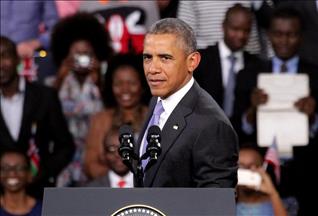
In a further sign of U.S. focus on the Asia-Pacific region, President Barack Obama told a meeting of regional leaders Monday how he wants to strengthen economic ties.
“America is a thoroughly Pacific nation,” Obama told leaders at the Asia-Pacific Economic Cooperation meeting in Beijing. “We’ve always had a history with Asia. And our future - our security and our prosperity - is inextricably intertwined with Asia.”
He added: “There should be no doubt that the United States of America remains entirely committed when it comes to Asia. America is a Pacific power and we are leading to promote shared security and shared economic growth this century, just as we did in the last.”
Much of Obama’s speech focused on U.S. relations with China. The world’s two largest economies are often viewed as rivals and America’s shift in emphasis from Europe to Asia potentially threatens China’s role in the region.
“One country's prosperity doesn't have to come at the expense of another,” Obama said. “If we work together and act together, strengthening the economic ties between our nations will benefit all of our nations.
“That's true for the nations of APEC and I believe it's particularly true for the relationship between the United States and China.”
Obama noted that the 21 APEC nations account for nearly 60 percent of the world’s gross domestic product and that “nearly half of all economic growth outside the United States” is projected to come from Asia in the next five years.
On U.S.-China relations, he said the U.S. “welcomes the rise of a prosperous, peaceful and stable China.”
Pointing to increasing economic ties between American and Chinese companies, the president announced new visa arrangements between the two countries that extend business and tourist visas to 10 years and student visas to five years.
“We've worked hard to achieve this outcome because it clearly serves the mutual interest of both of our countries,” he said to applause.
Addressing issues for which China has been criticized, Obama called for “a more level playing field” for non-Chinese companies, the protection of intellectual rights and a clampdown on the “cybertheft of trade secrets,” as well as guarantees for human rights and press freedom.
“We suggest that China do these things for the sake of sustainable growth in China and the stability of the Asia-Pacific region,” he added.
Obama also touched on the Trans-Pacific Partnership between the U.S. and 11 other nations that will bring 40 percent of the world’s economy under a trade agreement.
Outlining a vision for the region, he called for a future “defined less by armies and less by bureaucrats, and more by entrepreneurs and innovators, by dreamers and doers, by business leaders who focus as much on the workers they empower as the prosperity that they create.”
Obama arrived in Beijing earlier Monday for a week-long trip to the region that will also take in Myanmar and Australia.
He also held separate meetings Monday with Indonesian President Joko Widodo and Australian Prime Minister Tony Abbott.
Obama will meet with Chinese President Xi Jinping on Wednesday, when the two leaders are likely to tackle issues such as human rights, Hong Kong's pro-democracy protests, climate change and territorial disputes between China and Japan.
Meanwhile, China and South Korea finalized negotiations on a free trade agreement Monday, Chinese state media reported.
Xi and South Korean President Park Geun-hye signed the agreement to remove tariffs on more than 90 percent of goods over 20 years.
*Anadolu Agency correspondent Izabela Kuczynska contributed to this story from Ankara.
www.aa.com.tr/en