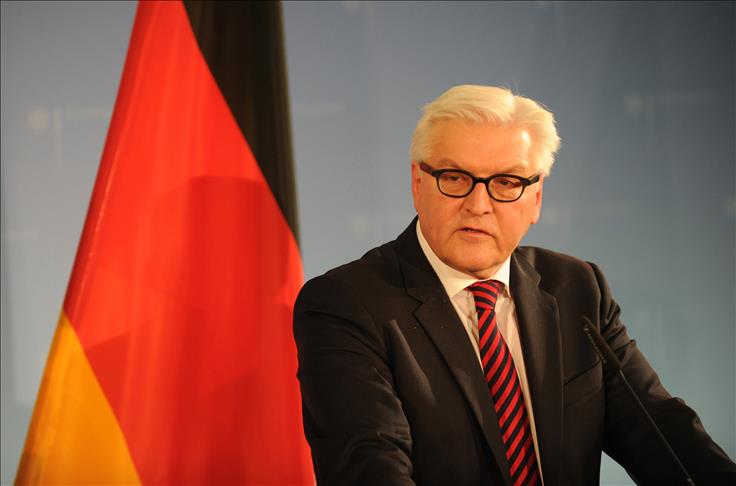
German Foreign Minister Frank-Walter Steinmeier said Tuesday that he hoped the Gaza-based Hamas movement would accept an Egyptian ceasefire proposal as a crippling Israeli air campaign against the Gaza Strip entered its second week.
"We believe an armistice will provide the basis for a political solution," Steinmeier said at a joint press conference with Palestinian counterpart Riyad al-Maliki in Ramallah.
Steinmeier said Israel's initial approval of the Egyptian proposal had come after hours of "brainstorming" with Israeli officials in Jerusalem before arriving in Ramallah earlier Tuesday as part of a regional tour.
He pledged 500 million euros to the recently-unveiled Palestinian unity government for distribution in Gaza in the form of emergency aid.
For his part, al-Maliki said his meeting with Steinmeier had tackled deteriorating humanitarian conditions in the Gaza Strip – home to some 1.8 million Palestinians – which had been made worse by the fresh Israeli offensive.
He went on to call for an international conference to rebuild the blockaded enclave, which has seen three major Israeli onslaughts within the past six years.
Earlier Tuesday, the Israeli army staged several airstrikes on the Gaza Strip hours after the Israeli government accepted Cairo's ceasefire offer, which entails a halt to Israel's air offensive.
According to the Israeli army, the airstrikes followed the launch of 47 rockets by Hamas since 6am GMT, when Egypt's ceasefire proposal was supposed to go into effect.
Hamas, Gaza's most prominent resistance faction, said on Tuesday that it was still mulling Egypt's proposal.
However, the statement comes one day after the Ezzeddin al-Qassam Brigades, Hamas' armed wing, dismissed the proposal as one of "submission," going on to claim responsibility for a fresh volley of rockets fired at Israel.
Cairo's initiative calls on the self-proclaimed Jewish state to cease all hostilities in the Gaza Strip, halt all ground operations and refrain from targeting civilians, according to an Egyptian Foreign Ministry statement.
It also calls on Gaza-based resistance factions to cease all hostilities against Israel, halt rocket fire and cross-border attacks and stop targeting civilians.
The proposal further calls for reopening Gaza's closed border crossings and facilitating the movement of persons and goods in and out of the embattled coastal territory.
Almost 200 Palestinians have been killed and more than 1400 others injured in unrelenting Israeli airstrikes on the embattled Gaza Strip since Monday of last week.
Gaza-based resistance factions, meanwhile, have continued to fire rockets at Israeli cities in response to ongoing Israeli bombardments.
No Israeli fatalities have been reported thus far as a result of rocket fire from Gaza.
In 2012, Israel carried out an eight-day offensive against the Gaza Strip – dubbed "Pillar of Defense" – in which at least 43 Palestinian civilians were killed.
Human Rights Watch had described Israel's 2012 offensive as a "violation of the laws of war."
The head of Hamas' military wing, Ahmed al-Jabari, was killed in the 2012 offensive, which only ended after Cairo – under then-president Mohamed Morsi – successfully brokered a ceasefire between Hamas and Israel.
"Pillar of Defense" came less than three years after Israel's watershed "Operation Cast Lead," which involved both air strikes and extensive ground operations over a three-week period.
At least 1400 Palestinian civilians were killed in that operation, which also shattered much of the Gaza Strip's vital infrastructure – large swathes of which has yet to be rebuilt.
By Qais Abu Samra
englishnews@aa.com.tr
www.aa.com.tr/en