By Ben Tavener
SAO PAULO
Brazil heads to the polls October 5 for the first round of the presidential election. The 143 million-strong electorate will choose from among 11 candidates, the top three of which are representing broad party coalitions.
If no candidate receives 50 percent in the compulsory vote a second-round runoff will be held October 26 between the top two vote-getters.
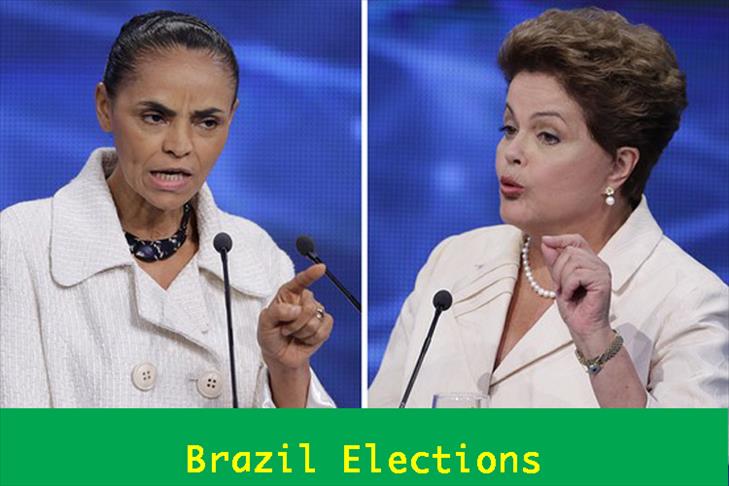
The Anadolu Agency profiles the highest-polling candidates, including Brazil's incumbent President Dilma Rousseff and latecomer environmentalist Marina Silva.

- Dilma Rousseff
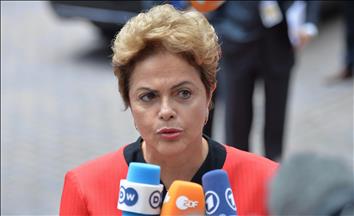
The president is seeking a maximum permissible second term in office. Candidate for the leftist Workers' Party, Rousseff took the reins from her political mentor, Luiz Inácio Lula da Silva, who held office from 2003 to 2010, and is featured heavily in Rousseff's campaign.
She cut her political teeth as a Socialist activist and was famously jailed and tortured during the country's 1964-1985 military dictatorship.
Now president, her government has continued with much-lauded social programs that have lifted more than 35 million people out of poverty, and the nation's first female president remains popular in poorer parts of the country, particularly the north and northeast regions.
She has struggled, however, in the more affluent, economically- and politically-influential areas of southeastern Brazil, including São Paulo and Rio de Janeiro. Rousseff was handed an economy booming at 7.5 percent in 2010, but which has since dwindled dramatically. She is also accused of mismanaging the country's biggest company, the state-run oil giant Petrobras, the affairs of which have only soured since her election.
As a result, she remains out of favor with the markets that deem her fiscal policy as interventionist and oppressive for the economy. Polls suggesting good news for her re-election campaign have repeatedly been followed by turbulence for the country's Bovespa stock exchange and the real, the national currency.
Rousseff's re-election seemed safe until Marina Silva's entry upended the presidential race. But in the days leading up to the first round Rousseff's performance has improved and polls suggest she will lead the field comfortably in the first round, although a highly-likely runoff is widely considered too close to call, although tilts in Rousseff's favor.
At 66, she is the oldest of the top-polling candidates, and younger only to 75-year-old José Maria Eymael, of the Christian Social Democratic Party, who has received less than 1 percent of support in the polls.

- Marina Silva
Slight and almost frail to the eye, the 56-year-old wasn't even a contender for the presidency two months ago.
Her complex political journey has seen her join and quit a number of parties whose politics no longer sat well with her pro-environmental and anti-establishment beliefs. Now a devout evangelical Christian, Silva was born into poverty, growing up in a family of illiterate rubber-tappers in the Amazonian state of Acre.
Through environmental activism, Silva rose through the political ranks to become environment minister under Lula as part of the Workers' Party. The love did not last, however, and Silva left the party in 2009 and ran for president in 2010 on a Green Party ticket, placing third with 19 percent of the vote.
In 2014, after failing to get her own Sustainability Network party registered for the elections, Silva agreed to play second vice-presidential fiddle to the Brazilian Socialist Party's candidate, Eduardo Campos. But fate was to intervene, and August 13, a plane crash killed Campos, leaving Silva to step up as the party's only viable option. Hers was a face more familiar to Brazilians than Campos' ever was. Her dramatic entry into the race saw her skyrocket in the polls. Where Campos was barely breaking into double figures, Silva soon put Rousseff's re-election in doubt -- and continues to do so.
Silva has both courted the markets and supported policies that have helped alleviate crippling poverty and inequality. This unique promise, along with her anti-corruption platform and vow for a "new way" of doing politics has lured voters, particularly those younger than 30, many of whom took to the streets in the hundreds of thousands in anti-government protests last year to demand political reform.
But casting herself simultaneously as pro-business and in line with leftist social policies has been a risky strategy. Silva has endured constant attacks from Rousseff about being in league with the banks and insinuations she would cut successful social programs installed under the last government -- both of which Silva has denied.
These accusations, and an overall take of exposure on television and radio which is allocated by congressional representation, have all taken their toll on the first-round polls. A projected second round between Rousseff and Silva remains too close to call -- and access on those crucial national broadcasts will be equal to her rival's. It is also believed that the majority of those siding with Aécio Neves will likely flock Silva's way.
If she wins, Silva will be Brazil's first non-white president and her journey from such impoverished beginnings would have been a remarkable one.

- Aécio Neves
Smart and mild-mannered, 54-year-old Aécio Neves is the pro-business candidate for the center-right Social Democracy Party that had been gearing up for the traditional electoral tug-of-war with Rousseff's Workers' Party.
Neves has made much of his success as the youngest-ever governor of Minas Gerais state, where he introduced sweeping reforms, reduced spending and boosted investment -- strategies he has vowed to take to the Planalto, including slashing the number of ministries by half.
Silva joining the race complicated matters and Neves was soon registering third in the polls. Rather toothless attacks on Rousseff, including the recent corruption scandal embroiling Petrobras -- surely a gift for any rival candidate given Rousseff was on the Petrobras board of directors -- and TV performances that seemed to lack virility and substance, have failed to galvanize support for the former governor.
Neves is also seen as somewhat elitist and over-privileged by the many who desire political change.
He has been consistent, and after falling back to a distant third, he has managed to claw back votes in recent weeks, mainly to Silva's detriment. He is also boosted in those economic heartlands by sharing a party with the successful governor of São Paulo, Geraldo Alckmin, but is distrusted in poorer parts of the country.
There is presidential blood in his past, too. Neves’ political career began alongside his grandfather, Tancredo Neves, who was famously elected president in 1985 but died before taking office.
- Eduardo, Luciana, Everaldo
The next three candidates have all polled just 1 percent in recent weeks but have punched well above their weight in the race, bringing hot-button issues to the fore and stealing the limelight in televised debates, where they have enjoyed equal exposure.
Eduardo Jorge, a 64-year-old doctor running for the Green Party for which Silva ran in 2010, has injected environmental issues and his own brand of slightly hippie levity to proceedings. He is popular among younger voters, and is known for his progressive stances, including advocating for the legalization of cannabis and abortion. He joined the party in 2003 after leaving the Workers' Party as Lula took office.
Luciana Genro, the youngest candidate at 43, is running for the left-wing Socialism and Freedom Party, and has LGBT rights front and center in her campaign. She has argued that nationwide laws to criminalize homophobia and transphobia are required to combat crimes against this demographic, which includes 216 homophobia-associated murders in Brazil so far in 2014. Genro, another former Workers' Party member who left in 2003, is also calling for greater personal freedoms, including on cannabis and abortion.
Everaldo Dias Pereira, 58, better known as Pastor Everaldo in the elections, is standing for the conservative Social Christian Party and has drawn attention due to his calls for mass privatization, including of Petrobras, the country's sacrosanct state-run oil company. His staunch "pro-family" stance has put him at odds with campaigns demanding greater rights for the LGBT community and those calling for abortion to be legalized, but he has denied accusations of prejudice.

contact_the_ombudsman
is_there_an_error_in_this_story