With just over three months to go to the October general elections, four final Brazilian political parties are holding conferences Monday to launch presidential candidates and announce official party alliances.
According to Brazilian election laws, parties must officially register their intention to participate in this year's general elections between June 10 and June 30. The first round of elections will take place on October 5 and 141.8 million people are eligible to vote.
Some 32 parties are set to participate in the elections, but due to cross-party alliances there will only be 11 presidential pairs to choose from.
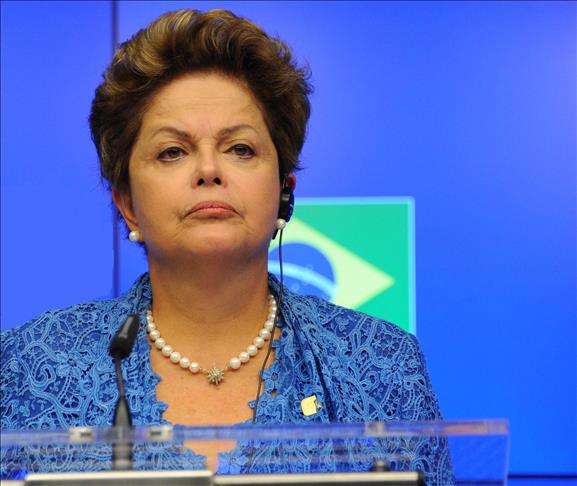
Incumbent Brazilian president, Dilma Rousseff, is running for a second four-year term for her leftist Workers' Party, after fighting off calls for her popular predecessor, Luiz Inacio Lula da Silva - who served as president from 2003 to 2010 - to run as the party's presidential candidate.
Lula has insisted he will back Rousseff, and is set to coordinate and feature heavily in her re-election campaign. Seven other parties have now announced their support for Rousseff's candidacy.
The final four parties holding conferences Monday are all relatively small, and it was already known that the right-leaning Democrats Party is set to support the center-right Brazilian Social Democracy Party candidate, Aecio Neves - Rousseff's nearest rival and biggest threat to her re-election.
After much speculation, Neves used Monday's final day of party registrations to announce that his vice presidential running mate will be Sao Paulo senator Aloysio Nunes, whom he described as "a man ready to lead the country in any ineventuality," according to the G1 news portal.
Neves's Social Democracy Party already has the backing of seven other parties.
Rousseff announced she would again run alongside Michel Temer, Brazil's current vice president and member of the allied PMDB party.
Eduardo Campos, of the Brazil Socialist Party, who has the support of four other parties, had already confirmed his vice president will be divisive environmental activist Marina Silva, who famously served as a minister under former President Lula who she fell out with.
- No first-round guarantee for Rousseff
Commentators say that although Rousseff remains the favorite, she is unlikely to win without a runoff. A survey of voters' intentions conducted by pollsters IBOPE on June 13-15 gave Rousseff a 39-percent share of the tally.
Support for Neves stood at 21 percent in the IBOPE poll and has been relatively stable. Campos took third place, with 10 percent. Other candidates polled just three percent or less.
Rousseff's performance in this latest poll was up on a Datafolha poll in early June, carried out before the beginning of the FIFA World Cup, in which she garnered 34 percent of the vote. This in turn was considerably lower than the 44 percent seen in a Datafolha poll conducted in February - a result which would likely have handed Rousseff a first-round win.
However, all recent poll results have featured a large proportion of voters yet to decide on a candidate, or who intended to spoil their ballot.
"Those undecided voters will end up picking a candidate in the final stages ahead of the elections, particularly once candidates start airing their TV campaigns," political scientist from the Federal University of Sao Carlos Maria do Socorro Braga told the Anadolu Agency (AA).
The vote, which also elects deputies and senators of the National Congress, state governors and state legislatures, is compulsory for most Brazilians between 18 and 70 years of age, and is optional for those aged 16 or 17, the over-70s, and for those who are illiterate.
If no one candidate gains 50 percent of the vote on October 5, a second round will be held on October 26.
Election campaigns are allowed from July 6, and national broadcasters are banned from favoring one candidate over another in their daily coverage. A new law means that, as long as parties have registered, candidates can be changed up to 20 days before the first round of voting.
www.aa.com.tr/en