By Handan Kazanci
ISTANBUL
A tiny textile factory, noisy with the sound of machinery, sits on the third-floor of a building in Istanbul’s working class Rami neighborhood.
The seemingly everyday workplace has one important difference - there is no boss overseeing the workers.
“Everybody is equal and there is no boss here,” 33-year-old Aynur Aydemir told Anadolu Agency.
Two years ago, Aydemir was among the workforce at Kazova, an Istanbul-based textile company that had operated for nearly 50 years, who were owed four months’ wages when they were suddenly sacked without severance pay.
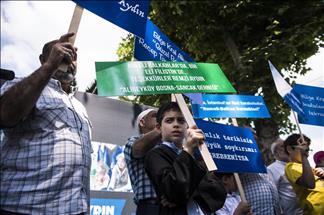
Rather than accept the injustice, the workers picketed the factory for more than two months before occupying the premises and, using the machinery left behind by their bankrupt employer, began manufacturing and selling clothes under their own initiative.
Their action was all the more remarkable as none were members of a union or had ever taken part in a protest or industrial action before.
“I would never thought of going a demonstration or protesting anything,” Serkan Gonus, 42, said.
The father-of-three, who had worked at Kazova for more than three years, was the first person to set up a tent in front of their old work site in Istanbul’s busy Sisli district in 2013.
After picketing the factory, the workers drew attention to their plight, and raised vital funds, by organizing a fashion show that attracted around 2,500 Istanbulites.
A second show earlier this year helped them to gather the money to finally pay for the machines they acquired from their former employer as well as help fund a move to new premises after the old factory was bought up.
Four of the original workers were joined by two new recruits, who became known as the “Free Kazova” group - Aydemir, Gonus, Muzaffer Yigit, 43, Senay Yamak, 38, Yasar Gulay, 47, and his 21-year-old son Yunus - to begin full production.
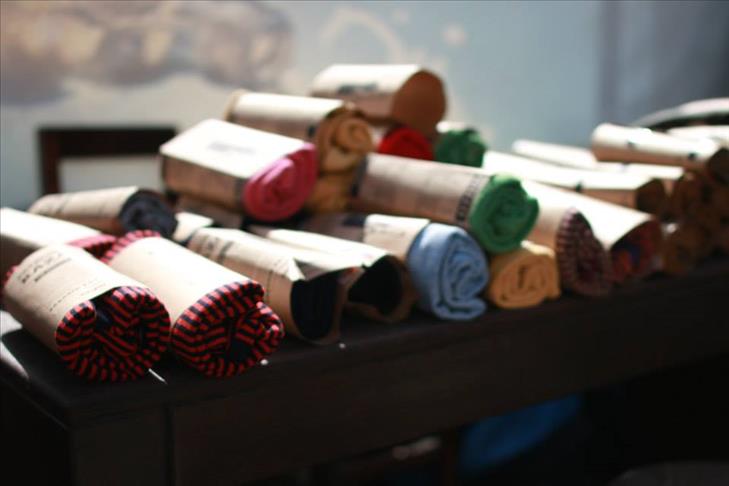
The workers have been producing and selling their own clothing line over the Internet and in seven shops across Turkey ever since.
Aydemir explains the differences between working life under her former employer and now. “There is no loading time,” she said, referring to the busy working conditions of ordinary textile factories.
“[Before] if you couldn’t complete the job in time, you would get a scolding from everyone. Not here.”
Turkey is one of the world’s biggest textile producers but the country’s one million-plus registered garment workers face conditions of long hours and poor pay.
Neset Erdogan, of the Textile, Knitting and Clothing Industry Workers’ Union, known by its Turkish acronym TEKSIF, said informal employment conditions within the industry lent themselves to substandard working conditions.
When informal workers are included, the number of people employed by the industry is more than doubled, he told Anadolu Agency.
These informal workers receive no health or holiday benefits and most earn the minimum monthly wage of 949 Turkish liras ($352). According to Erdogan, most of Turkey’s unregistered textile workers are women.
But poor conditions were not the only reason the Kazova workers were unhappy with their previous employment.
“In the past, I was just told what to do,” Gonus said. “If black and yellow were chosen for the production, even if I didn’t like it, I had to make it as it was ordered.
“But today we choose colors together and we work with whatever color we want.”
The Kazova premises are today decorated with graffiti and banners, many proclaiming the new company’s motto “Jumpers Without Master”. Their clothing lines carry labels reading “100% cotton, 100 % wool, 100 % free work.”
The factory is busy with supporters of this workers’ experiment. The leader of Peoples’ Democratic Party, Selahattin Demirtas, paid a visit recently.
As well as selling to the Turkish market, the Kazova workers have branched out internationally, thanks to the quality and affordability of their goods.
“We sell our products at the most affordable price, 50 Turkish lira,” Gonus said, adding that the same garments could be sold for ten times the price if they carried a designer tag.
In February, the company produced the jerseys for a friendly football match between Cuba and Spain’s Basque region.
Although the company has the potential to produce more than 800 jumpers a month they manufacture an average of 300 to 400.
“Maybe none of us earn enough here, as we are in debt because we had to make the payments for our former employer’s machineries… but this process has taught us a lot - we are more conscious now,” Aydemir said.
“All of us own this place.”