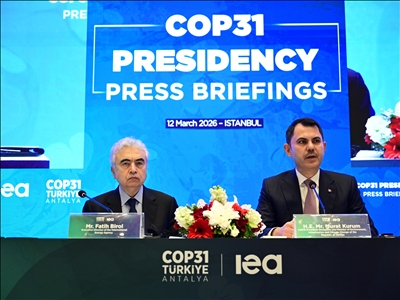
IEA pledges full support for Türkiye's COP31 summit in Antalya



Because of these conveniences, plastic has become a part of almost everything we use in our daily lives. From toothbrushes to white goods, from shoes to bicycles, plastic has a very wide range of uses.
At the same time, due to its lightness, low cost, and hygienic concerns, it is increasingly being used in disposable products.
With the impact of the COVID-19 pandemic, plastic has become even more widespread in use, particularly in disposable kitchen products, disinfectant bottles, face shields, and most notably, surgical masks.
Why we should not use plastic?
All this may sound convenient — easy shaping, lightness, low cost… However, it takes plastic an extremely long time to decompose in nature. For instance, it takes at least a thousand years for a plastic bag to decompose in nature.
Therefore, every piece of plastic we use causes massive environmental pollution, disrupting the natural balance of agricultural lands, seas, and oceans. As it decomposes, plastic breaks down into smaller fragments known as macroplastics, microplastics, and nanoplastics, which are ingested or inhaled by many living organisms.
Recent studies have found traces of microplastics not only in many marine creatures but also in the human body — even in fetuses and human blood.
Recycling of plastic
In the broadest sense, plastic recycling refers to the process of collecting unused or end-of-life plastic products, subjecting them to specific treatments, and converting them back into raw plastic material so that new products can be manufactured.
Recycling is known as the best way to prevent the environmental pollution caused by plastic. Although this is widely accepted, only about 9% of the plastic waste produced today is recycled.
On the other hand, while it may seem like the most reasonable option to prevent environmental pollution, recycling is not the most innocent choice.
This is because the quality of recycled materials decreases with each recycling process. In other words, even in an ideal scenario where we manage to recycle all plastic materials, we would still end up producing low-quality plastic waste that can no longer be reused or recycled.
Moreover, plastic recycling processes cause toxic pollution that is extremely harmful to both nature and human health.
Therefore, the best way to deal with plastic waste is to avoid producing waste in the first place, that is, to not use plastic at all.
The “zero waste” principle is based on preventing the generation of all kinds of waste, including plastic, and aims to send no waste to landfills, incinerators, or the oceans.