Ola Attalah
GAZA
Palestinian resistance movement Hamas may have to negotiate directly with Israel if the latter refuses to ease its years-long blockade of the Gaza Strip in line with the terms of a recent cease-fire agreement, a senior Hamas leader has said.
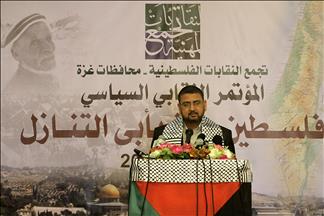
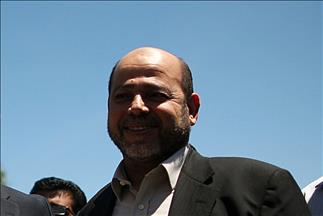
Moussa Abu Marzouq, a Cairo-based member of Hamas' political office, told the pro-Hamas Al-Quds satellite channel late Wednesday that the group "would not veto political negotiations with Israel if it was deemed necessary."
It was the first time for the group – which does not recognize Israel and is listed by the latter as a "terrorist" organization – to voice its readiness to negotiate with the self-proclaimed Jewish state.
"Hamas may have no other option, as the natural rights of the people of Gaza appear to be too heavy a responsibility for the [Palestinian] unity government," Abu Marzouq said.
An August 26 cease-fire deal between Israel and Palestinian resistance factions calls for the transfer of power in Gaza from Hamas (which has been in de facto control of the Gaza Strip since 2007) to a recently-unveiled unity government led by the Palestinian Authority (PA).
In return, Israel is expected to open all of its border crossings with the blockaded Gaza Strip.
The cease-fire deal, a product of indirect talks in Egypt between Palestinian and Israeli negotiators, was celebrated as a victory by Hamas over Israel following a devastating 51-day Israeli offensive on the Gaza Strip.
Abu Marzouq's statements, however, appeared to call PA President Mahmoud Abbas's bluff after the latter threatened earlier this month to pull out of the April reconciliation deal with Hamas that yielded the current unity government.
He went on to accuse Hamas of hindering the handover process.
"Everyone should realize that negotiating with Israel, although it is against our policy, is not forbidden," Abu Marzouq said. "Quite honestly, the current state of affairs has almost made the idea a popular demand by Gazans."
Tensions have mounted between Hamas and Abbas, who heads up the rival Fatah movement, in the wake of Israel's recent onslaught on the blockaded Palestinian enclave.
Abbas accused Hamas of forming a shadow government to manage the affairs of the Gaza Strip, despite the formation of a national unity government earlier this year – the result of a previous reconciliation agreement.
Hamas, for its part, accused Fatah of "defaming the movement [Hamas] and demonizing its methods and its momentous victory over Israel in the recent war" – claims Abbas' Fatah movement denies.
Hamas and Fatah signed a reconciliation deal in April, ending divisions that had persisted since 2007. The agreement opened the door for the formation of a national unity government and simultaneous legislative and presidential elections.
On June 2, a unity government was unveiled and ministers were sworn in in front of Abbas in the presidential residence in Ramallah. The new government, however, has yet to assume actual control over the Gaza Strip.
Israel's recent 51-day onslaught on the Gaza Strip left some 2,147 Gazans dead and 11,000 others injured – many critically – while partially or completely destroying thousands of buildings across the coastal enclave.
According to Israeli figures, 67 Israeli soldiers were killed – mostly during ground battles with Palestinian fighters - and five civilians were killed with rocket fire from Gaza over the course of the operation.
www.aa.com.tr/en