- International activists intercepted in international waters say they were beaten, shocked with tasers, and subjected to degrading treatment during detention
Activists from the Global Sumud Flotilla, who were detained by Israel in international waters, said the violence and mistreatment they experienced at the hands of Israeli soldiers could not be compared to what Palestinians endure.
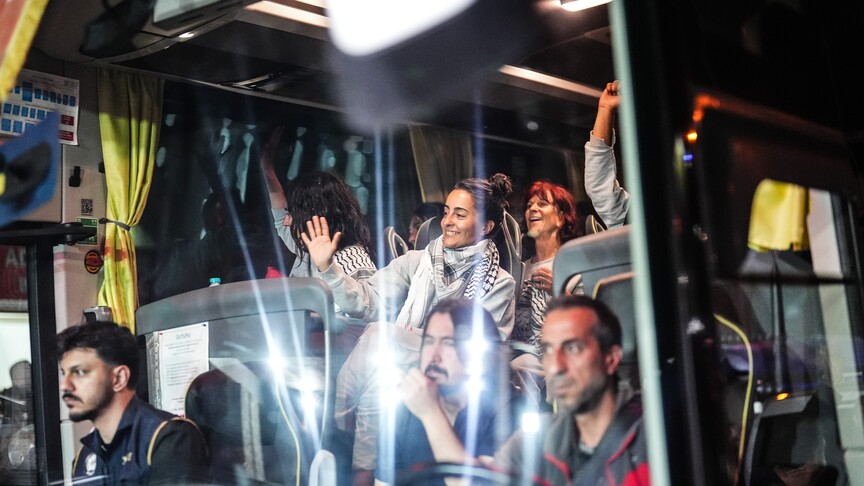
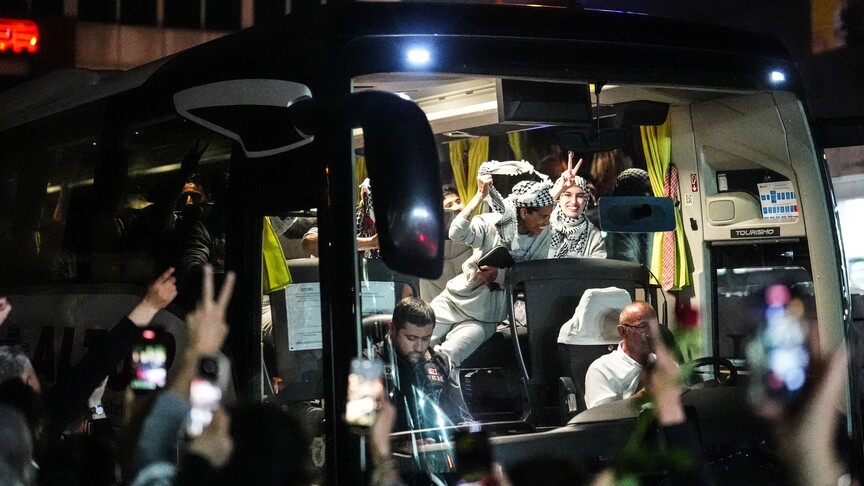
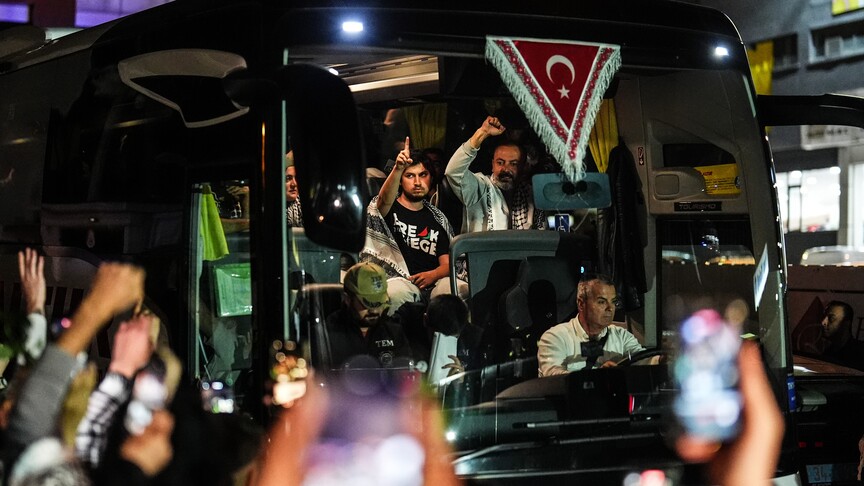
The activists, who were brought to Istanbul Airport aboard three Turkish Airlines flights after being intercepted and detained by Israel in international waters, spoke to Anadolu about their experiences during detention.
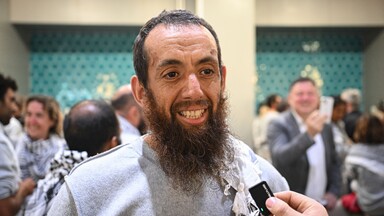
Canadian activist Ehab Lotayef showed his bandaged hand while recounting the incident.
Lotayef said one Israeli soldier had asked him for help with translation while another soldier “did not like” that he was assisting others.
“But one Israeli soldier didn't like that I was giving water to people. So he came and stabbed me in my hand,” Lotayef said.
He said he had lost sensation in the injured hand and added that activists were subjected to severe violence, with some suffering broken ribs.
“We were beaten real bad, real, real bad. It wasn't beating as self-defense. It was beating as punishment. They were punishing us,” he said.
‘Attention needs to turn to Palestine’
Another Canadian activist, Michael France from Vancouver, said he joined the mission as part of a humanitarian aid effort for Gaza.
“It’s part of a humanitarian aid going to Gaza, where humanity is trying to do what humans do when there’s a humanitarian crisis,” France said.
France said he was held with around 160 people inside a shipping container on one of two boats converted into prison vessels.
“We were on these newly developed jail boats. There was two of them, 160 on mine. And it was three containers, shipping containers that we slept in. Bare metal floors,” he said.
France said that Israeli forces used electroshock devices and flashbang grenades against detainees.
“We were welcomed by tasers. We had flashbangs every two or three hours through the night, waking us up,” he said.
He said the injuries on his face and head were caused by repeated beatings and added that Israeli soldiers stomped on his bare feet with military boots.
“The number of times I was beaten into the ground with my head. Through my toes, I had no shoes, and people would stamp on them with their military feet,” France said.
He added that he suffered bruises around both knees, where he had previously undergone surgery, as well as injuries across his body after being thrown around.
“I’ve got bruises all over. And that’s just the handling,” he said.
France stressed, however, that the treatment they endured could not be compared to the suffering of Palestinians.
“It’s also important to say that we have nothing of the treatment that the people of Palestine do. And that’s why we are here, to try and do something about this crisis of humanity,” he said.
He urged international attention to remain focused on Palestine.
“We are not heroes. We are humans trying to do a human act in a crisis,” France said.
“Yes, we will talk about our wounds, but only in the context that Palestine is what matters,” he added.
‘My pain is little compared to theirs’
Hahona Ormsby, a Maori activist from New Zealand, said they were detained during Israel’s raid on their boat and later transferred to a vessel converted into a prison ship.
Ormsby said he was subjected to violence until the activists were brought to Ashdod Port, where they were held.
Ormsby reported being kicked in the private parts, tied to a chair, and punched, adding that a soldier threatened him during their time together.
He said he was assaulted despite remaining silent during the detention and suggested that his appearance and Indigenous tattoos may have played a role in the abuse.
“Because of the mission, because of my indigenous look. My tattoos are indigenous to my country, and he didn’t like them,” Ormsby said.
He added that injuries to his hands and lips were caused after he was slammed into a wall.
“From smashing me into the wall to knock me out,” he said.
Ormsby said he was still in pain but emphasized that his suffering could not be compared to that of Palestinians in Gaza.
“It’s been (since) last night, and today has been sore, but not as much pain as what our Palestinians in Gaza will be going through. So my pain is little compared to theirs,” he said.
He also called on governments around the world to take action for Palestinians.
“Governments need to get off their hands and actually stand up for the indigenous Palestinians. They need to fight the genocide that Israel is committing,” Ormsby said.
*Writing by Gizem Nisa Demir