Senhan Bolelli
07 July 2026•Update: 07 July 2026
Spain reiterated its opposition to proposals for NATO member states to increase defense spending to 5% of their gross domestic product (GDP) ahead of the alliance's summit this week in the Turkish capital Ankara.
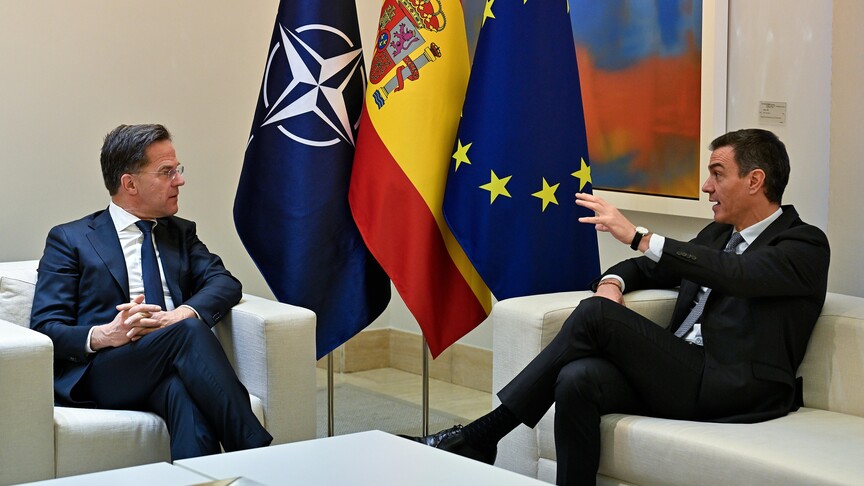
Government sources said Monday that Prime Minister Pedro Sanchez will use the meeting to restate Spain's position in response to calls from NATO Secretary General Mark Rutte and US President Donald Trump for allies to adopt the higher spending target.
Spain argues that a blanket commitment to spend 5% of GDP on defense would not be compatible with maintaining its welfare state and ensuring sustainable public finances.
Instead, the government says NATO members should focus on strengthening security while balancing broader economic and social priorities.
Officials say Spain has already significantly increased its defense budget, tripling military investment since 2018 to reach NATO's existing benchmark of 2% of GDP.
They also argue that Spain is making substantial operational contributions to the alliance beyond its spending levels.
According to the government, Spain ranks seventh among NATO's 32 members in military capabilities, third in the number of troops deployed on peacekeeping missions, and first in troop contributions to NATO's eastern flank.
The government also highlighted Spain's support for Ukraine since Russia's full-scale invasion, saying it has committed €3.7 billion ($4.2 billion) in assistance and trained more than 9,000 Ukrainian military personnel.
As of June 2026, Spanish officials say the country has the largest military deployment outside its own borders on NATO's eastern flank and is among the few allies leading major alliance missions, including the maritime component of the NATO Response Force and the multinational brigade in Slovakia.
Government sources also questioned whether many countries that have pledged to meet the proposed 5% target would ultimately be able to do so.
Officials rejected suggestions that Spain is failing to meet its NATO responsibilities, arguing that alliance documents recognize the country's contributions and describing Sanchez as attending the Ankara summit "having fulfilled Spain's obligations."
Spain has also consistently described Russia as a significant long-term security threat.
At the same time, the government says it supports building a stronger European defense capability that is less dependent on the US, with greater investment in European security and closer military cooperation, including support for the long-term development of a European army.
The debate over defense spending is expected to be one of the central issues at the NATO summit as allies seek to respond to growing security challenges while balancing domestic economic pressures.
NATO heads of state and government are meeting in Ankara on July 7-8 for the alliance's 2026 summit, hosted by Türkiye. The two-day summit will focus on implementing the defense spending commitments agreed at the 2025 summit, sustaining military support for Ukraine and expanding defense industrial production.