Anadolu staff
12 June 2026•Update: 12 June 2026
Türkiye’s economic program remains on track despite recent geopolitical and energy-related shocks, with fiscal and monetary policies set to continue supporting disinflation, Treasury and Finance Minister Mehmet Simsek and Central Bank Governor Fatih Karahan said Friday.
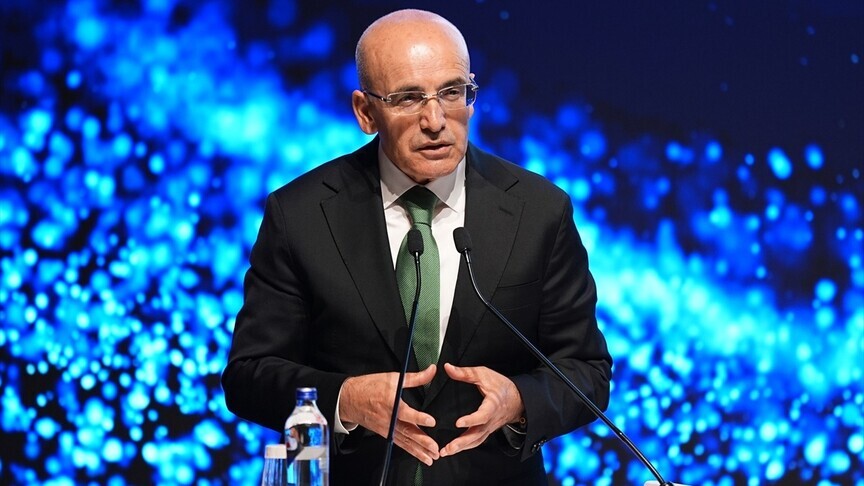
Speaking at the 69th General Assembly of the Banks Association of Türkiye (TBB) at the Istanbul Finance Center, Simsek said price stability remains the government’s core priority in its economic program, while fiscal discipline and structural reforms will continue to support efforts to bring inflation permanently down to single digits.
“Despite shocks, what matters is progress. What matters to us is the direction of travel,” Simsek said. “From that perspective, with a delay of a few months, the disinflation process will continue again and get back on track.”
Simsek said there was currently no concern over fiscal discipline despite earthquake-related spending, adding that Türkiye has a stronger fiscal position than many comparable countries.
Türkiye’s budget deficit target stands at 3.5% of gross domestic product (GDP), but actual performance will “very likely” be better than that, he said.
Simsek also said the current account deficit, long seen as one of Türkiye’s main vulnerabilities, is now manageable.
“We may close the year with a current account deficit of 3% or below,” he said. “I see this area, which was viewed as the biggest vulnerability, as very comfortably manageable today.”
He said the deterioration in the annual foreign trade deficit since December has remained below $1.5 billion despite the oil shock, while tourism and other key areas has not experienced significant deterioration.
On external financing, Simsek said Türkiye’s gross external financing need is expected to stand at around 17% of GDP this year despite the war-related shock, below its long-term average of around 20%.
He added that there was “no room for concern” over reserves, noting that nearly 40% of the recent reserve decline after the war stemmed from changes in gold prices.
Central Bank Governor Fatih Karahan said the bank would continue to use all policy tools decisively to protect price stability and financial stability.
“At the point we have reached today, we assess that the necessary conditions for the continuation of the disinflation process have been preserved thanks to our policy tools, strong reserve position and macroeconomic rebalancing,” Karahan said.
Karahan said geopolitical developments and energy market volatility had created short-term risks for inflation and the external balance, but were not expected to reverse the disinflation process if the correct policy steps were maintained.
He said the central bank’s tight monetary policy stance would continue, and future decisions would consider the effects of geopolitical developments on inflation through cost, economic activity and expectations channels.
He said rebalancing in domestic demand, a healthy current account outlook and a strong reserve position provide support the continuation of disinflation.
“The path to healthy and sustainable growth in the banking sector runs through low and stable inflation,” Karahan said.
“During periods of increased global volatility, we see that our markets continue to function healthily,” he noted.
Karahan said long-term external financing inflows continued, confirming the resilience of the banking sector, and added that the central bank would continue working closely with the banking sector.