MOSCOW
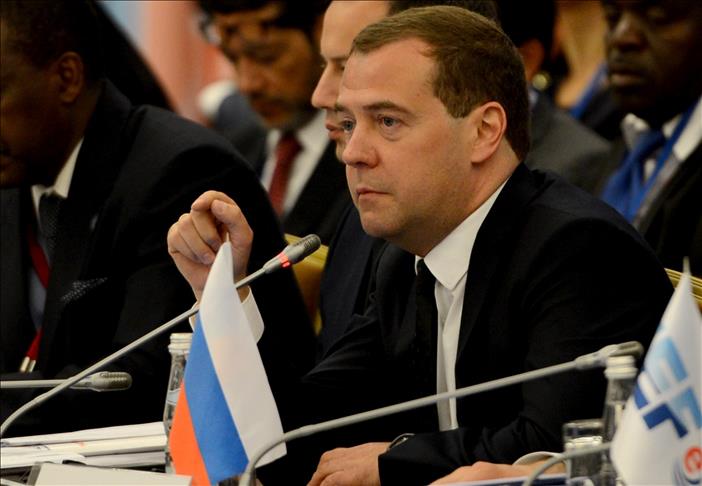
Russian prime minister Dmitry Medvedev has said that the ruble will remain a freely convertible currency and that the country's central bank policies have been "correct."
"The authorities will not abandon the free convertibility of the ruble," the prime minister said in a speech covered by the TASS news agency at Wednesday's Gaidar economic forum in Moscow.
"You can certainly freeze the rate and thereby revive the 'black market' in currency, give it over to importers and bureaucrats or people who have friendly relations with them, but that means the destruction of a consistent market."
Medvedev admitted that "now many are betting against the ruble, oil prices and sanctions." According to him, the ruble exchange rate fluctuations affected "companies, banks, and, of course, ordinary people."
"Nevertheless, I think that the policy of the central bank, which it is following at the moment, is correct," said the prime minister. "We're not going to spend all our currency reserves and we have enough economic mechanisms to ensure the stability of the ruble. Moreover, even in poor market conditions we are left with a positive balance of payments, which is the main foundation for establishing a balanced national currency."
The prime minister admitted that Russia's current economic woes are as much internal as external.
"Over the past year, much has happened. The world has really changed – it is not a figure of speech, it is true. Politics interfered with the economy."
The prime minister stressed that Russia "did not manage to overcome the" crisis of 2008.
"Some countries still cannot get out of stagnation. According to the International Monetary Fund, the GDP of the eurozone has still not reached pre-crisis levels of 2007. Others, including major emerging economies, have experienced the slowing growth rates. For example, GDP growth in Brazil 2014 declined," Medvedev said.
The prime minister added that "Russia is in this sense, is no exception."
"We, like the rest of the world, pay for globalization. In fact, our country is now at the intersection of several crises provoked by three groups of reasons."
Medvedev named the crisis of 2008 as the first reason, external factors such as international sanctions against Russia as the second, and "internal problems and constraints" which have not yet been overcome, according to him, as the third set of factors behind Russia's economic struggle.