Participation finance gaining global traction: Turkish vice president
Türkiye ranked 23rd among 82 countries in Islamic Finance Development Index in 2012, rising to 10th place among 140 countries by 2025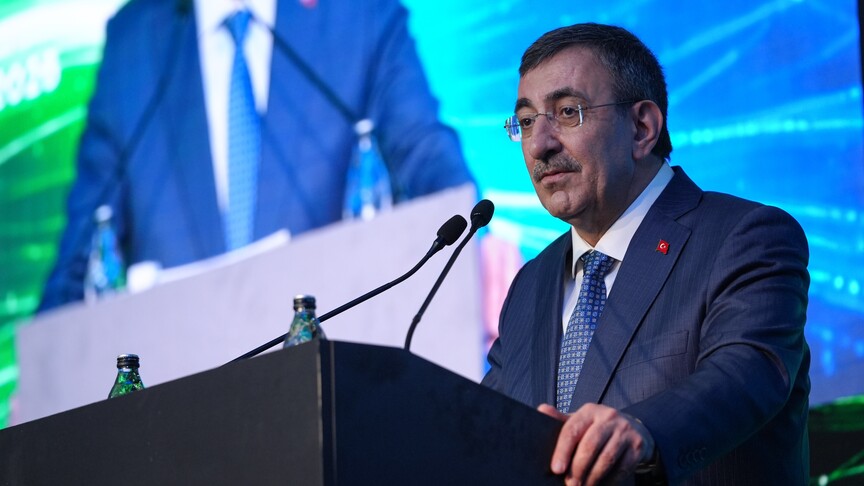
With its structure based on the fair sharing of risk, supporting production, and making a direct contribution to the real economy, participation finance represents an approach that evaluates economic activities within the framework of social benefit and equity, the Turkish vice president said on Thursday.
Participation finance has moved beyond being a practice limited to specific regions and has become a rapidly growing field on a global scale, Cevdet Yilmaz said.
Speaking on Thursday at the opening ceremony of the Participation Finance Summit, organized by Anadolu at the Istanbul Financial Center, Yilmaz said special regulations implemented and market infrastructures developed in key financial centers -- including the Gulf countries, Malaysia, and Indonesia, as well as the United Kingdom, Luxembourg, Hong Kong, and Singapore -- are supporting the international expansion of the participation finance ecosystem.
The summit features panels on the future strategies of participation banks and Türkiye’s participation economy, participation-based investment products, and the role of digitalization in participation finance’s future.
The summit was organized through a collaboration between Anadolu and the Participation Banks Association of Türkiye, with contributions from Turkish participation lenders Vakif Katilim, Kuveyt Turk, Ziraat Katilim, Emlak Katilim, Albaraka, Turkiye Finans, Dunya Katilim, Hayat Finans, TOM Bank, and Adil Katilim.
“In terms of financial size, Islamic finance assets, which stood at $2.5 trillion in 2018, rose to $6 trillion in 2024, and are expected to reach $9.7 trillion by 2029,” he stated.
Noting that Türkiye ranked 23rd among 82 countries in the Islamic Finance Development Index in 2012 and rose to 10th place among 140 countries by 2025, he added, “With approximately $127 billion in Islamic finance assets, our country ranks 9th globally.”
Stressing that participation finance encompasses many elements both within and outside the banking sector, he said: "The first domestic lease certificate issuance was launched in 2012, and we have continued these issuances on a regular basis."
Sustainable balance sheet structure
Mehmet Ali Akben, head of TKBB, said participation banking in Türkiye is led by 11 lenders and as of March 2026, they serve their customers through a total of 1,506 branches and 22,733 employees.
The total assets of participation banks reached 4.3 trillion liras ($95 billion), and the net profit of participation banks reached 86 billion liras ($1.9 billion) by the end of 2025, he stressed.
Along with this strong financial backdrop, participation banks’ sustainable balance sheet structure, customer-centric service approach, and investments in digital infrastructure support the scaling of participation banking, Akben said.
He said that the development of lease certificates -- which serve as a significant example of increasing the variety of instruments aligned with participatory finance principles within the financial ecosystem -- has drawn attention.
Akben stated that, alongside public and participation banks, the private sector has also assumed an important role as an issuer in the deepening of the participation finance ecosystem, adding: “Lease certificates have become one of the fundamental tools for liquidity management, particularly for participation banks.”
Ahmet Burak Daglioglu, head of Türkiye’s Investment Office, said the global participation finance sector is estimated to be worth $4 trillion, but unfortunately, this accounts for only about 1% of the world’s total financial system.
"We will grow the participation finance sector in Türkiye, but we believe that by expanding this sector globally through international cooperation opportunities, we can also grow the market share in Türkiye," he said.
Sector expands in Türkiye
Ambassador Sohail Mahmood, secretary-general of the Developing-8 Organization for Economic Cooperation (D8), said the summit included very insightful speeches and statements.
Speaking to Anadolu, Mahmood said: "Of course, the vice president was there also and then the Anadolu Agency head was there and the Association Banks Association head spoke as well."
"And they highlighted how this sector is growing in Türkiye."
There were recently new statistics and in the ranking of global economies, Türkiye has inched up, he said, adding that Türkiye, already a G-20 economy, is playing an important role where participation banking is growing by leaps and bounds.
This summit's main focus is to not only focus on this growth within Türkiye but also to highlight its role in the global economy and to make it part of the narrative that is taking place right now, he underlined.
He said: "It was emphasized clearly that besides the facts and figures or the data, storytelling is very important."
"So I think Anadolu Agency is deserving of our commendation that it has organized this summit."
Alain Nounke, the manager for Central Asia and Türkiye at the International Finance Corporation (IFC) of the World Bank Group, said: "We are very pleased to see this massive participation into this event."
"We, from the World Bank Group and especially the International Finance Corporation, support the growth of the participation banking in Türkiye," Nounke added.
He said IFC is engaging with a number of participating banks like Albaraka into its Global Trade Finance Program and it is looking to grow its interventions into the sector and it is also pleased to see that the sector is also moving towards greater modernization.
High-level government representation, including the vice president of the republic, underscored the national priority placed on Islamic finance, he stressed.