Ali Canberk Ozbugutu and Emir Yildirim
07 July 2026•Update: 07 July 2026
Global markets are on a mixed trend due to concerns that the reconciliation efforts in the Middle East could be disrupted after Tehran reportedly fired at commercial ships in the Strait of Hormuz.
The hopes of peace in the region that came to the fore following the US-Iran deal signed on June 18 have been replaced by renewed anxieties, as Iran fired at least two missiles at commercial vessels through the strait, while the US is expected to retaliate, according to Axios.
The fragility of the Middle East peace talks came to the fore, as oil started to climb again, rising 0.7% to $72.60 per barrel, albeit below prewar levels.
Rising oil prices, in turn, triggered inflation risks with no major changes in expectations over central banks’ monetary policy pathway. Markets strongly expect the Fed to hike rates once by year-end.
The Fed’s meeting minutes to be released on Wednesday may shed some light on the future actions of the bank, analysts say.
Fed board member Christopher Waller said inflation and employment risks reversed versus a year ago with the US labor market apparently stabilizing, but rising inflation is prompting the bank to reassess its policy approach.
The US nonfarm payrolls data last week came in below estimates and reinforced the expectations that the Fed may not hike rates anytime soon while all eyes turned to the developments in the tech and chipmaking sectors.
New deals signed among leading chipmakers continued to support growth expectations despite persisting concerns over rising chip costs that are ultimately passed onto the consumer, which may affect demand.
Broadcom shares rose nearly 4% after it agreed to extend its partnership with Apple to develop and supply custom chips through 2031.
Meanwhile, the US’ Institute for Supply Management (ISM) services Purchasing Managers’ Index (PMI) fell to 54 in June, below estimates.
The S&P Global services PMI rose 0.5 points month-on-month to 51.2 in June, while the composite PMI covering both manufacturing and services rose 0.4 points on a monthly basis to 51.9.
The US 10-Year Treasury yield is trading flat at 4.48 and the US Dollar Index is down slightly at 100.8.
Gold came under pressure, falling 0.2% on Monday to $4,165 per ounce, ending its three-day rally amid expectations that rising energy prices stoking inflationary pressures due to the geopolitical risks in the Middle East could prompt central banks to adopt tighter monetary policies.
Gold is trading down 1% at $4,123 per ounce in early trading on Tuesday.
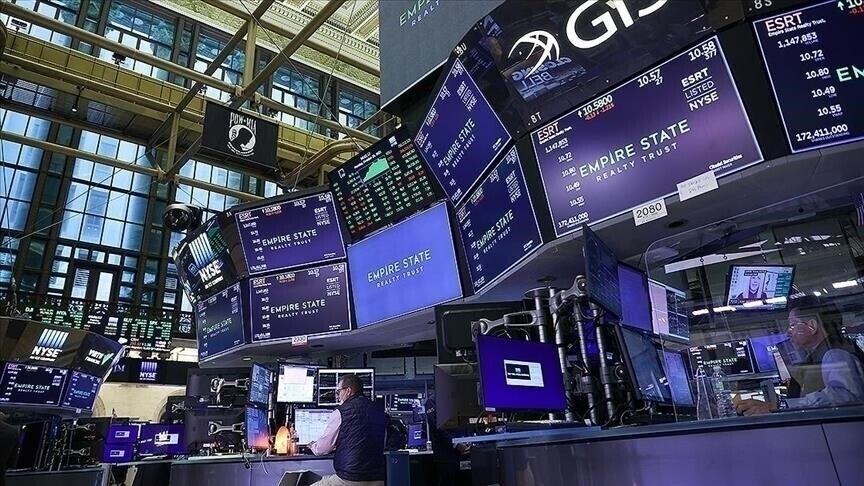
The S&P 500 rose 0.72%, the Nasdaq 1.12%, and the Dow Jones 0.29% on Monday. The Dow closed at a new record.
American indexes started Tuesday on a negative trend.
Meanwhile, European stock markets traded mixed on Monday amid the macroeconomic data releases in the bloc.
The eurozone’s investor confidence climbed this month, while its Producer Price Index (PPI) rose 0.2% month-on-month and 5.9% on an annual basis in May.
At the same time, US President Donald Trump said the talks to be held between Ukraine and Russia at the NATO Ankara Summit on Tuesday will yield fruits.
European Commission President Ursula von der Leyen said the summit will also address Ukraine’s air defense needs.
Following these developments, the UK’s FTSE 100 fell 0.26% and France’s CAC 40 0.33%, while Germany’s DAX 40 climbed 0.15% and Italy’s FTSE MIB 30 0.27%.
Amid rising oil prices and chipmaker valuation concerns, a selloff came to the fore in Asian stock markets.
Samsung Electronics reported that its operating profits rose to around $58.5 billion but concerns over whether the growth momentum following massive data center investments for artificial intelligence (AI) can sustain current valuations dampened investor appetite, driving down the tech giant’s shares.
Japan’s yearly household spending declined 0.4% in May, below estimates, according to data released on Tuesday, signaling that while the country’s spending is not slowing down as expected, the Bank of Japan (BoJ) is increasingly likely to maintain its hawkish stance.
Near the close on Tuesday, Japan’s Nikkei 225 fell 2.4%, South Korea’s Kospi Index 8%, China’s Shanghai Composite Index 1.6%, and Hong Kong’s Hang Seng Index 0.7%.