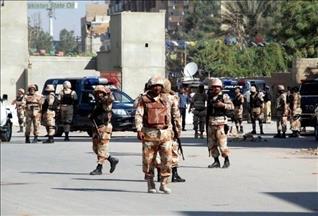
- Since Taliban returned to power in Kabul in August 2021, tensions between Pakistan and Afghanistan have simmered, driven by disputes over cross-border militancy, border which Afghanistan does not recognize
ISTANBUL
An exchange of cross-border strikes and clashes between Pakistan and Afghanistan this week marks the most serious escalation between the two in recent times amid concerns of worsening relations.
On Thursday night, Afghan forces launched border attacks in response to Sunday’s Pakistani airstrikes inside Afghanistan. In response to the border attacks, Pakistan launched extensive air and ground operations, targeting what it described as military positions across Afghanistan.
Since the Taliban returned to power in Kabul in August 2021, tensions between Pakistan and Afghanistan have simmered, driven by disputes over cross-border militancy and the border, which Afghanistan does not formally recognize.
Islamabad accuses the Tehreek-e-Taliban Pakistan (TTP) of operating from Afghan soil and carrying out terrorist attacks across the country, a claim Kabul rejects.
Tensions have also emerged over the contested Durand Line – the de facto border region that Afghanistan does not recognize on the grounds that it was created by a British colonial regime “to divide ethnic Pashtuns.” Islamabad, however, insists the Durand Line is a permanent border between the neighbors.
Here is a timeline of key developments and border clashes between the two countries.
2021–2022: Rising skirmishes after Taliban takeover
Tensions between Pakistan and the Taliban-led government first arose in December 2021 when Pakistan said that it soldiers were stopped from installing a security fence in the eastern province of Nangarhar.
The following year, on February 6, 2022, the Pakistani army said that five soldiers were killed in an attack in the northern Kurram district by terrorists “from inside Afghanistan."
Few days later, clashes between Pakistani security forces and Afghan Taliban were reported at the Wesh–Chaman border crossing, the major crossing between the two countries along the disputed Durand Line.
2023: Border closures and refugee tensions
In February 2023, fighting broke out near the Torkham border crossing with Pakistani and Afghan Taliban forces exchanging heavy gunfire. The tensions led to the closure of the border for several days, with trade and travel suspended.
The firing took place after Afghanistan’s Taliban government unilaterally shut down the northwestern Torkham crossing for all kinds of movement, accusing Islamabad of not "honoring its commitments."
The Torkham border, which connects Pakistan's northwestern Khyber Pakhtunkhwa province to Afghanistan's eastern Nangarhar province, is one of the two main crossings between Islamabad and Kabul.
In September, heavy skirmishes were reported between border security forces of the two countries at the Torkham border, with casualties reported among security forces and civilians. The border was again closed, for at least 10 days.
Between October and November, tensions surged after Islamabad launched a crackdown against illegal foreigners, mostly Afghan refugees, announcing to send them back to their countries. Protests erupted near the Chaman-Spin Boldak crossing, with cross-border firing incidents reported, forcing the border to shut several times.
2024: Cross-border airstrikes
On March 18, 2024, Pakistan launched pre-dawn airstrikes on “militant hideouts” inside Afghanistan, killing at least eight people.
The airstrikes, Islamabad said, were in response to a series of suicide bombings on a security check post in North Waziristan tribal district, which killed seven army troops.
Kabul, however, asserted that the airstrikes, which targeted southeastern Paktika and Khost provinces, killed three children and five women.
In September, Pakistani and Afghan security forces clashed at the border, after the Afghan Taliban attempted to build a check post, according to the Afghan media. Pakistan claimed that at least eight Afghan troops were killed in the border clashes.
On Dec. 24, Pakistan said it carried out airstrikes inside Afghanistan, killing "terrorists," saying that the security forces carried out an operation on the "basis of solid evidence."
The Taliban administration in Kabul claimed that the Pakistani military carried out airstrikes, the second such cross-border action by Islamabad since March, in the Barmal district of eastern Paktika province.
Afghanistan's deputy spokesman Mullah Hamdullah Fitrat said the bombing by Pakistani jets killed 46 people, including women and children, and injured six others, with Pakistan rejecting it had targeted children and women.
2025: Renewed hostilities and ceasefire efforts
In March, Pakistan and Afghanistan engaged in several days of hostilities, with at least one person killed and several injured while hundreds of families were displaced from both sides due to intense exchanges of gunfire.
In August, the interim Taliban government in Kabul protested to Pakistan over alleged strikes inside Afghanistan that killed three people and injured seven more, with no immediate reaction from Islamabad to Kabul's accusations.
In October 2025, deadly clashes erupted between Pakistani and Afghan troops, with dozens of soldiers killed.
Zabihullah Mujahid, Afghanistan’s interim government spokesperson, said that nine Afghan soldiers were killed, while claiming 58 Pakistani soldiers were killed and another 30 were injured in the clashes.
However, the Pakistan army said that 23 of its soldiers were killed, while another 29 were injured in the clashes, some of the deadliest since the Taliban recaptured Afghanistan in 2021.
On Oct. 18, the interim administration in Kabul claimed that Pakistan carried out late-night airstrikes in Afghanistan’s border province of Paktika.
The hostilities ended after Pakistan and Afghanistan on Oct. 19 agreed to an immediate ceasefire during talks in Doha, mediated by Qatar and Türkiye.
2026: Escalation resumes
On Feb. 16, Pakistani officials said 11 security personnel and a child were killed when a suicide bomber detonated an explosive-laden vehicle before ramming it into a security checkpoint in Bajaur.
Following the incident on Feb. 22, Pakistani jets carried out airstrikes in eastern and southeastern Afghanistan early Sunday, targeting what Islamabad described as militant hideouts, while Afghan officials said civilians were killed and vowed retaliation.
Afghan broadcaster Tolo News reported that the airstrikes struck the Khogyani, Ghani Khel, and Behsud districts of the Nangarhar province, as well as the Barmal and Urgun districts in the Paktika province. Citing local sources, it said civilians were among those targeted, with women and children amongst the dead and injured. Two days later, Pakistani and Afghan forces exchanged heavy fire along the border area.
Since Thursday night, Pakistan and Afghanistan have seen fierce clashes.
At least 29 people have been killed, including four civilians, 12 Pakistani soldiers, and 13 Afghan troops across the border.
Kabul on Thursday announced it launched border attacks against Pakistan over airstrikes on Sunday by Islamabad inside Afghanistan, which left many dead.
Pakistan responded with heavy fire and fresh airstrikes in Kabul, Kandahar, and Paktia provinces early Friday.