- Putin’s visit – his first since 2021 and the start of the Ukraine war – comes amid US pressure on India over Russian oil, new tariffs and Ukraine peace talks
- Experts emphasize that neither India nor Russia aims to frame the visit as a challenge to the West
ISTANBUL
Russian President Vladimir Putin’s visit to India this week is emerging as a key moment in New Delhi’s diplomacy, as both sides seek to reinforce defense and energy ties at a time of shifting global alignments and growing pressure from the West.
Putin arrives Thursday for the 23rd India-Russia Annual Summit, his first visit since 2021 and the start of the Ukraine war. Analysts say the two-day trip will test India’s efforts to balance its long-standing partnership with Moscow against intensifying demands from Washington under US President Donald Trump.
The two sides are expected to discuss an “ambitious agenda” spanning defense, energy, nuclear cooperation, payment mechanisms, BRICS, and the Shanghai Cooperation Organization.
“This visit is the most important for India in 2025,” defense analyst Pravin Sawhney told Anadolu. “It is a well-rounded trip by a country which has traditionally been India’s friend, and at a time like this when the world is going through changes that are extremely significant.”
Praveen Donthi, a political analyst, said the visit allows both sides to “reaffirm their special relationship amid intense pressure on India from President Trump with punitive tariffs.”
Akriti Vasudeva Kalyankar, a fellow at the Stimson Center’s South Asia Program, said the visit signals a more settled phase in India’s policy toward Moscow.
“Putin’s first visit to India in four years indicates that the debate in Indian foreign policy on Russia has largely been settled, with Moscow emerging as a new economic partner and a convenient defense collaborator that is more willing to transfer technology even if it is not the most advanced,” she told Anadolu.
Defense and strategic agreements
Defense is expected to dominate the summit, with India seeking to advance procurement of systems such as the S-400 mobile surface-to-air missile system and potentially the Sukhoi Su-57 fighter jets.
Sawhney said defense is an extremely important issue for India at the moment “because a lot of lessons have been learned” in its recent brief armed conflict with Pakistan in May.
Moscow, he added, has offered fifth-generation aircraft, production lines, technology transfers and additional joint projects.
Ahead of the summit, Moscow ratified the Reciprocal Exchange of Logistics Agreement (RELOS), which will also be discussed. Under the pact, the two countries will grant each other access to military facilities for refueling, repairs and supplies.
Analysts say it signals Russia’s growing focus on the Indian Ocean and could give New Delhi a foothold in Russia’s Arctic and Northern Sea Route operations.
Energy, nuclear cooperation and trade
India’s energy ties with Russia also remain central to the summit, as New Delhi faces mounting pressure from Trump to halt purchases of Russian oil.
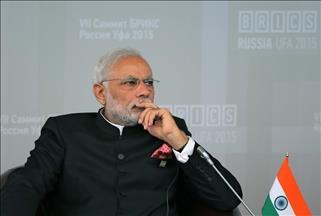
The visit also follows Trump’s assertion in October that Prime Minister Narendra Modi had “assured” him India would stop buying Russian oil “within a short period of time” – remarks Delhi did not confirm.
An Indian government spokesperson later said discussions were ongoing, stressing that import decisions “are guided entirely by the need to safeguard the interests of the Indian consumer in a volatile energy scenario.”
Russia is currently India’s largest oil supplier, though volumes have declined following US sanctions on Russian firms.
Oleg Ignatov of the International Crisis Group said India cannot easily replace Russian crude.
“India relies on discounted Russian oil for both domestic consumption and exports,” he told Anadolu. “It cannot find an alternative at this scale.”
Nuclear cooperation is also expected to feature prominently. Russia is constructing multiple units of the Kudankulam nuclear power plant in the southern state of Tamil Nadu.
“Russia is doing a lot of civil nuclear work in India,” Sawhney said. “We are now moving into the next phase of small modular nuclear reactors.”
Trade will also be a key focus, with both countries aiming for $100 billion in bilateral trade by 2030.
Bilateral trade reached a record $68.7 billion in the 2024-25 fiscal year – nearly six times higher than pre-pandemic levels.
Sawhney said discussions on a possible free trade agreement with the Russia-led Eurasian Economic Union are expected.
Cooperation on technology and artificial intelligence is also on the agenda.
Global signaling to the West
Analysts say the visit also carries a message about India’s foreign policy independence.
“For India, it’s important to show strategic autonomy,” Ignatov said.
He said Moscow views its relationship with India as an equal one, and the visit signals to Europe and the US that – despite pressure – New Delhi and Moscow intend to continue cooperation in security, energy and multilateral forums.
“Putin is also interested to show that Russia is continuing its economic relationship, including on energy, with India despite sanctions pressure,” he added.
Experts emphasize, however, that neither India nor Russia aims to frame the visit as a challenge to the West.
“They would like to show that their cooperation, like their relationships, are not against the West, not against the US. It is based on mutual interest and economic interest, and it’s not against any power,” said Ignatov.
Sawhney noted that India recently signed a 10-year defense framework with the US, binding it more closely to Washington on long-term strategy.
“As far as foreign policy and strategic role is concerned, India is definitely now committed to America and not to Russia.”
However, with India set to hold the BRICS presidency in 2026, it will require constructive relations with both Russia and China.
“Russia remains a reliable partner,” Sawhney said. “In 2026, relations between India and America may remain frosty, but India’s commitment to America will not waver. At the same time, the Russians want the relationship to prosper.”
Putin’s visit also comes as US-Russia negotiations on a Ukraine peace plan intensify – a context analysts say Modi and Putin cannot ignore.
“Those dynamics are likely to color Putin-Modi interactions, and both sides are likely to exchange views on these important developments,” said Kalyankar.
Ignatov said India views Washington’s proposals positively. “I think India is interested in stopping this war, because it’s interested in trade with Russia and interested in (avoiding) secondary sanctions.”