By Ainur Rohmah
JAKARTA, Indonesia
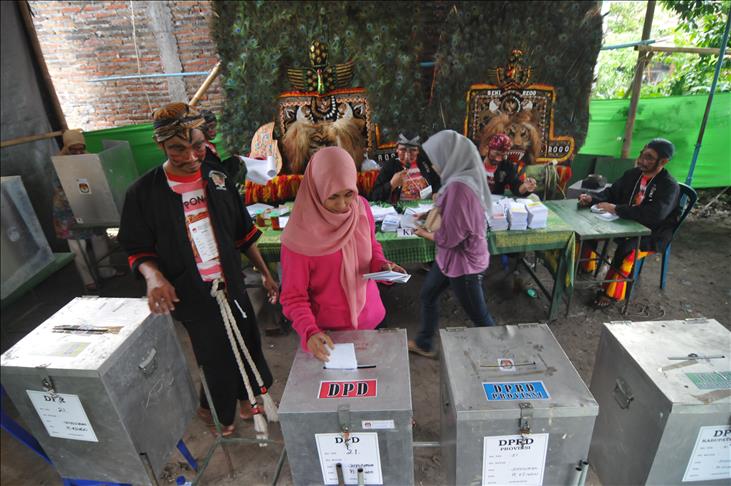
Indonesia’s largest opposition party – the Indonesian Democratic Party of Struggle (PDI-P) - has won the 2014 legislative elections, the country’s General Elections Commission announced Friday evening.
Based on the official vote count, the PDI-P won 18.95 percent of the votes in the April 9 elections in which around 186 million voters participated.
It has appointed popular Jakarta Governor Joko "Jokowi" Widodo as its presidential candidate, but has fallen short of the 27 percent it aimed for, leaving it with no choice but to side with other parties to pursue its ultimate goal of the presidency in July.
The ruling Democratic Party finished fourth with just 10.19 percent after several high-profile corruption cases, a disappointing drop from the 20.81 percent it had secured in 2009.
The PDI-P’s main contenders - predominantly secular and nationalist - trailed not far behind, as Golkar ranked second with 14.75 percent of votes and the Great Indonesia Movement Party (Gerindra) third with 11.81 percent.
While nationalist parties gathered 68.59 percent of the total vote, the country’s Islamic parties – which the PDI-P may now turn to for a coalition - displayed a surprising performance by securing about 31.41 percent.
Among the Islamic parties, the National Awakening Party (PKB) led with 9.04 percent, taking the place of the Prosperous Justice Party (PKS), which only managed to gather 6.79 percent after facing many corruption cases.
To nominate a presidential candidate, a party must win 20 percent of the House of Representatives, or 25 percent of the popular vote. If unable to do so, it can form a coalition with other parties to hit either threshold.
The three leading parties - the PDI-P, Golkar and Gerindra - are likely to run candidates in July's presidential election, whose exact date will be determined by the election commission in the near future.
If no candidate secures an absolute majority in the first round, a second round between the two candidates with the most votes will be held in September.
According to Indonesian media, the PDI-P has already approached several other parties about forming a coalition and Jokowi is already considering who to name as his running partner - not just an important choice for the PDI-P but also in widening its appeal to those who remain loyal to their respective parties.
The 560-seat parliament, however, is now more splintered than ever before, which could severely complicate any government trying to modernize the county’s combative, messy, and highly decentralized democracy, along with its rampant corruption, and poor infrastructure.
The popularity of Jokowi, a former little-known furniture retailer with a reputation for incorruptibility, lies in his ability to walk among the masses. A large part of his success can be attributed to his blusukans, or “unscheduled visits.” He arrives unannounced, in different parts of the capital to talk with local people about issues affecting them.
Indonesia - the world's most populous Muslim nation and world’s third largest democracy - was a military dictatorship until 15 years ago, governed by Suharto.
englishnews@aa.com.tr