HOUSTON, United States
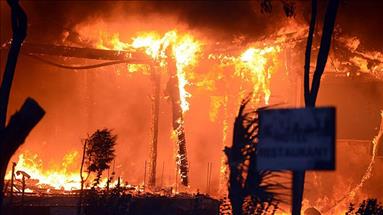
A local group is teaming up with Maui businesses in Hawaii to help victims of the destructive wildfires get back on their feet after the deadly tragedy.
“Cleaning up Lahaina is a massive job,” longtime Maui resident and advocate Chris Norberg told Anadolu.
“We need to find and remove the remains of victims first, assess how this happened exactly, then begin cleaning up the toxic area.”
The cost of rebuilding is estimated to be between $4 billion and $6 billion, according to estimates from several agencies.
Norberg expects the rebuilding process to take a long time based on his 18 years of experience living in Maui, after relocating there from California.
“When it comes to any projects, Hawaii is notoriously slow in the first place,” he said.
“Once it’s cleaned up, infrastructure needs to be laid all over again before rebuilding can begin.”
Even though federal and state aid has already been pledged to the rebuilding efforts, Norberg is volunteering along with other members of his company, Hawaii Web Group, to help survivors of the wildfires.
During the initial stages of relief and recovery, Norberg said his group ran supplies to the affected areas by boats before the roads opened up, and delivered water and other essentials to shelters until displaced residents were given temporary housing.
“And thank God for that. In the first weeks of this disaster, we had close to zero outside help,” said Norberg.
“The majority of relief efforts came from local businesses and volunteers from the community.”
‘Everyone on Maui has stepped up to help’
Norberg said his company was one of many local businesses that donated everything they possibly could, knowing that immediate supplies were crucial to help victims.
“We donated clothing, food, pet food, propane, canopy tents, and more supplies, offered our home to multiple displaced families, made food day after day with Havens Maui (a local restaurant) making 500 to 1,000 meals every day for survivors, and donated thousands of dollars to local organizations and individuals that have lost everything,” said Norberg.
“Everyone on Maui has stepped up to help. It’s unbelievable to see. If this had happened on the mainland, I don’t think we’d see the same response from the people. We have a special brand of island loyalty and ‘aloha’ that can’t be stopped.”
While Norberg emphasized the spirit shown by his fellow volunteers, he also acknowledged that the death toll of at least 115 people so far has weighed heavily on everyone’s minds.
“It’s heartbreaking. It feels like a nightmare that isn’t real,” he said.
“It took visiting Lahaina on a supply run to truly have it sink in.”
Maui officials last week released a list of 388 people still missing after the wildfires. Even though about 100 people have since been accounted for, Norberg said it has taken a toll on the community.
“Due to the homeless population, and a few foreign governments not disclosing their tourists, the number is likely much higher,” he explained.
“I personally don’t know anyone that is missing, but I know many good friends who have lost their homes, pets, businesses, vehicles, and everything they own.”
‘The anger on our island is palpable’
Norberg recounted the early days of the wildfires, which began on Aug. 8, and told Anadolu that at the beginning it did not seem like a big deal.
“Mid-day, the fires had been reported as being 100% contained,” he recalled.
“Schools sent kids home and many people left work. Once it was assumed to be contained, many people went back to work.”
However, shortly thereafter, panic and chaos ensued.
“The winds from the hurricane (Dora) were intense at up to 80 miles per hour (128 kilometers per hour). This pulled the fire out of containment and burned almost everything in Lahaina in a flash,” he said.
“Due to supposed downed power lines, the police had blocked off both sides of town. People couldn’t get out of town, and many people died in their cars throughout the town.”
Norberg also spoke about the issue of the Maui Emergency Management Agency (MEMA) not sounding the warning sirens during the emergency.
Herman Andaya, the agency’s chief, said they were primarily used for tsunami warnings and feared that they would have made coastal residents flee inland toward the blaze.
Andaya later resigned after making those statements.
“I don’t know why he didn’t sound the sirens. I wonder if that was really why he didn’t? I don’t know,” said Norberg.
“All I do know is that the majority of rational human beings would hear the siren, look outside, and see smoke and fire, and then they would leave their homes away from the fires. I don’t think any logical human would hear the tsunami siren and run into the fires thinking a tsunami was coming.”
“The town was clearly on fire.”
Norberg told Anadolu that he did some research and found literature on the sirens that mentioned they could be used for other reasons than tsunamis, including being sounded for fires.
“Official communication during the crisis was broken at best,” said Norberg.
“So many things went wrong and hundreds of people died because of it. The anger on our island is palpable.”
Maui County has filed a lawsuit against Hawaiian Electric, blaming the utility company for failing to shut off power despite the extreme high winds and dry conditions.
The company fired back, placing blame on county firefighters for declaring the blaze contained and leaving the scene only to have a second fire break out and become the deadliest in US history.
No matter who is to blame, Norberg said the damage has been done.
“This is something that could have been prevented,” he said.
“If a lawsuit forces them to take action and have better systems in place, then it may remedy future problems. I don’t know why they didn’t de-energize the power lines. It could possibly be due to pumps needing the power to put out fires. But, if the power had been off on downed lines, we could have gotten people out of Lahaina.”
The bottom line, he stressed, is that everyone needs to come together to assist the victims of the Hawaii wildfires and help them rebuild their lives, from the local, state, federal and global level.
“Whether you’ve lost a loved one, your home, your business, or you know someone that has, everyone on the island is feeling the pain. It’s tragic,” he said.
Norberg said most local businesses on Maui are primarily funded by tourism and that the wildfires and their aftermath have deterred people from visiting the unaffected areas of the island, which is crucial to Maui’s economy.
“It’s a ghost town here. No one is visiting, and we’re already seeing locals move away. We can’t have that,” he said.
“Without visitors ... businesses will fail soon.”
Norberg said that Hawaii’s tourism industry is asking that people around the world come back and visit, and officials are promoting what Maui has to offer.
In addition, Norberg said fundraising efforts are crucial in helping survivors to get back on their feet and start rebuilding their lives.
“Right now, the most crucial first step is taking care of our people,” he emphasized.
“Once our people are safe, we can look towards rebuilding.”