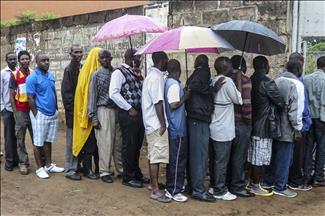
- Elections are scheduled in Benin, Uganda, Republic of Congo, Ethiopia, Zambia, Gambia, South Sudan, Cape Verde, Djibouti, Sao Tome and Principe, and Cameroon, with some dates still unconfirmed
ISTANBUL
With elections already underway in parts of Sub-Saharan Africa, the region is emerging as an early testing ground in what promises to be a closely watched electoral year.
In the coming months, a wave of polls will sweep across the continent, with several countries set to choose new legislatures and leaders amid heightened political and economic pressures.
Uganda
Uganda is holding general elections on Thursday to elect a president and members of parliament.
President Yoweri Museveni, 81, who has ruled the country since 1986, is seeking a seventh term under the National Resistance Movement and is being challenged by seven candidates, including opposition leader Robert Kyagulanyi, known as Bobi Wine, who placed second in the 2021 election.
The Electoral Commission has registered about 21.6 million voters, up from 18.1 million in 2021, and authorities say security measures are in place amid a campaign period that has included restrictions on rallies and media coverage, in an election being closely followed across the region.
Republic of Congo
The Republic of Congo is set to hold a presidential election on March 22, to choose a head of state for a five-year term under a two-round system, with a runoff scheduled if no candidate secures an outright majority.
Incumbent President Denis Sassou Nguesso, 82, who has been in power since 1997, was nominated by the ruling Congolese Party of Labour at its congress in December.
Opposition groups, including the Alliance for Democratic Alternation in 2026, have begun positioning candidates ahead of a contest that follows a 2021 election with 2.6 million registered voters and turnout of about 67%.
Benin
The West African country of Benin will hold its presidential election on April 12, with a runoff set for May 10 if no ticket wins an outright majority.
About 6.6 million voters are registered, and the electoral system requires all presidential candidates to compete along with a vice presidential running mate and meet minimum sponsorship thresholds.
Incumbent President Patrice Talon will not seek reelection, and the country’s electoral commission and Constitutional Court have validated two tickets.
Romuald Wadagni, currently finance minister, is running with vice presidential contender Mariam Chabi Talata for the ruling Progressive Union for Renewal and Republican Bloc coalition. Paul Hounkpe is running with Rock Judicael Hounwanou for the Cowry Forces for an Emerging Benin.
Other potential candidates, including those from The Democrats, were rejected over procedural issues or insufficient endorsements.
Ethiopia
Ethiopia is scheduled to hold general elections on June 1 to elect members of the lower house of parliament.
This round will fill 473 of the chamber’s 547 seats, with members serving five-year terms under a first-past-the-post system in single-member constituencies. The prime minister is selected from the party or coalition holding a majority in the House.
The vote comes after the delayed 2021 elections held amid the Tigray conflict and represents the first adjustment to term lengths since federalism was established in 1995.
Incumbent Premier Abiy Ahmed, in office since 2018, leads the ruling Prosperity Party, which holds nearly all seats in parliament.
The election takes place amid ongoing security challenges, including the aftermath of the 2020-2022 Tigray war and persistent violence in Oromia and Amhara, in a country of roughly 130 million people governed under ethnic federalism.
Zambia
The Southern African nation of Zambia is set to hold general elections on Aug. 13 to elect the president, members of the National Assembly, and local government officials.
The president is chosen through a two-round system, with a runoff if no candidate wins an outright majority.
The National Assembly has 167 seats, including 156 directly elected in single-member constituencies.
Incumbent President Hakainde Hichilema of the United Party for National Development, in office since 2021 after defeating Edgar Lungu, is seeking reelection.
Potential challengers include Fred M’mbembe of the Socialist Party, running under the People’s Pact alliance.
The country has over 7 million registered voters, and the elections follow 2021 polls, which were widely seen as peaceful and credible.
Gambia
The West African country of Gambia will hold a presidential election on Dec. 5 for a five-year term. The vote uses a single-round, first-past-the-post system, with the candidate receiving the most votes declared the winner.
Incumbent President Adama Barrow, in office since 2017 after defeating long-time ruler Yahya Jammeh, is seeking a third term under the ruling National People’s Party. His bid has drawn criticism following a failed 2020 draft constitution that would have imposed term limits, including a contentious retroactive two-term clause.
Gambian elections use a distinctive marble voting system, in which voters drop a marble into a colored, sealed drum corresponding to their chosen candidate.
South Sudan
In its first general elections since its 2011 declaration of independence, South Sudan on Dec. 22 is expected to vote to elect the president and members of the National Legislative Assembly.
The president will be chosen through a two-round system requiring an absolute majority, while 102 assembly seats will be elected from geographical constituencies based on 2010 boundaries.
The vote comes after multiple postponements since the original 2015 target, caused by civil war, security concerns, funding shortfalls, and incomplete prerequisites such as a permanent constitution and census.
The transitional government extended its mandate to February 2027, and last December political parties agreed to proceed with elections despite unfinished reforms.
Incumbent President Salva Kiir Mayardit, in office since independence in 2011, is expected to seek reelection, amid tensions with suspended First Vice President Riek Machar and criticism from opposition groups.
Many more elections to come, with dates still uncertain
Several other countries in the region are also preparing for elections this year, though exact dates have yet to be confirmed.
The island nation of Cape Verde is expected to hold parliamentary elections in April to renew its 72-seat National Assembly, followed by a presidential vote in October. The ruling Movement for Democracy currently holds a narrow parliamentary majority, while opposition leader Jose Maria Neves is eligible for reelection.
Djibouti is planning a presidential election by April, with 77-year-old incumbent Ismail Omar Guelleh seeking a sixth term after a constitutional amendment removed the age limit. Opposition space remains limited, and former advisor Alexis Mohamed has announced a bid to challenge the long-serving president.
Sao Tome and Principe, an island country off West Africa, is expected to hold presidential elections by July and parliamentary elections by September to renew its 55-seat National Assembly. Political tensions remain following President Carlos Vila Nova’s dismissal of Prime Minister Patrice Trovoada last year.
Cameroon’s parliamentary elections are expected by May, following a one-year extension after President Paul Biya’s reelection last October. The ruling Cameroon People’s Democratic Movement holds a dominant majority, with criticism from opposition parties over delays.