NEW YORK
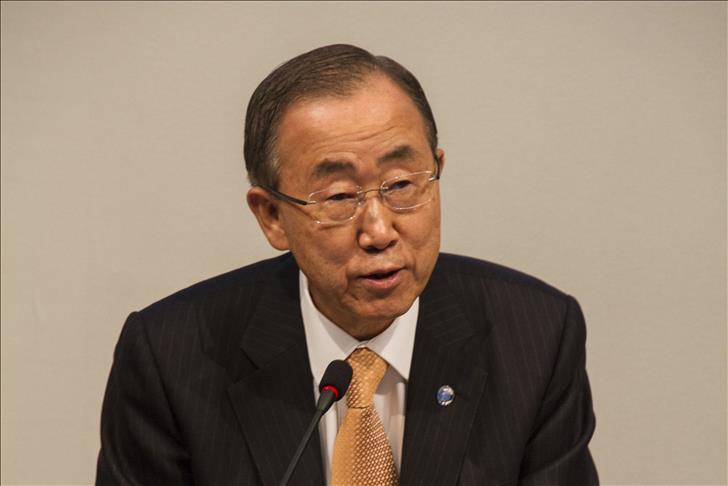
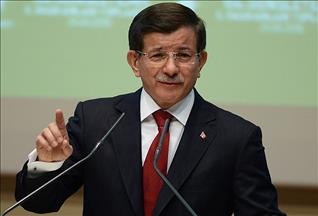
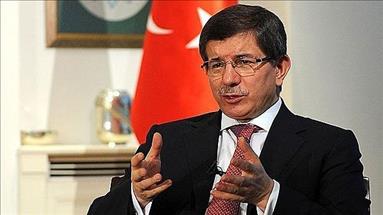
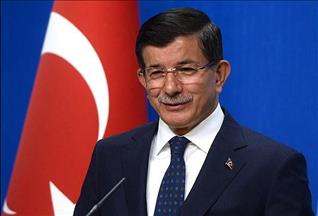
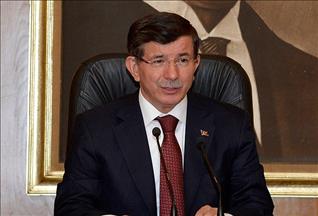
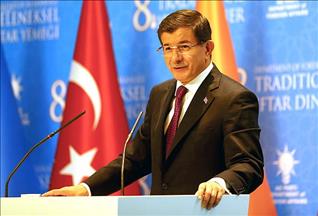
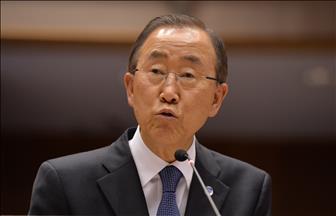
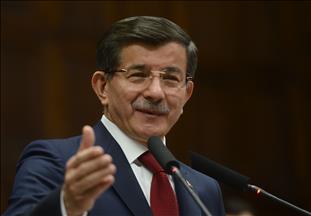
UN Secretary-General Ban Ki-moon on Wednesday acknowledged a "forward-looking" statement by Turkish Prime Minister Ahmet Davutoglu, in which he paid tribute to Armenians who died in 1915.
In a statement issued Monday, the Turkish premier said the deaths of Ottoman Armenians would be commemorated April 24 in Turkey in a religious ceremony to be organized by the Armenian Patriarchate.
"During the last years of the Ottoman Empire, a very large number of Ottoman citizens from different ethnic and religious backgrounds endured great suffering, leaving deep scars in their memories. They had all lived together for centuries in peace and harmony," said Davutoglu.
"We remember with respect the innocent Ottoman Armenians who lost their lives and offer our deep condolences to their descendants," he added.
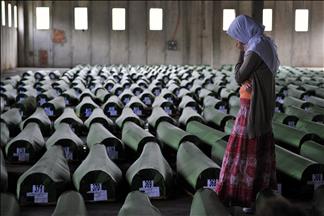
The 1915 events took place during World War I when a portion of the Armenian population living in the Ottoman Empire sided with the invading Russians and revolted.
The relocation by the Ottomans of Armenians in eastern Anatolia following the revolts resulted in numerous casualties. Turkey does not dispute that there were casualties on both sides, but rejects the definition of "genocide."
At a daily briefing at the UN headquarters, UN spokesperson Stephane Dujarric said, "the Secretary-General acknowledges the forward-looking statement made by the prime minister of Turkey, Mr. Davutoglu, yesterday."
"[Ban] also encourages both Turkey and Armenia to make all possible efforts to normalize relations between their countries in line with a 2009 protocol on the development of relations between Armenia and Turkey," Dujarric added.
The most significant development in the normalization of relations between the two countries occurred in October 2009, when two protocols were signed to rebuild diplomatic relations and improve bilateral relations.
The protocols proposed an impartial scientific examination of the historical records and archives and the mutual recognition of boundaries in order to restore confidence between the two nations and find solutions to existing problems.
The protocols also included cooperation on a wide range of areas including tourism, economy, transport, communication, energy, environment, high-level political consultations and student exchange programs, which could all help in normalizing relations.
The Turkish government sent the protocols directly to parliament for approval, while the Armenian government submitted the protocols to the constitutional court, which ruled that the documents did not abide by the nature and wording of the country’s constitution.
In January 2010, the Armenian government announced that it froze the approval process for the protocols. Five years later, the protocols were withdrawn from the Armenian parliament.
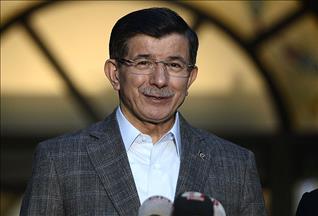
Turkey's then foreign minister and current Prime Minister Ahmet Davutoglu said in December 2013, following his visit to Armenia, that one-sided approaches and conjectural evaluations should be avoided in order to find a solution.
Dujarric also reiterated the UN chief's April 13 statement about the upcoming 100th anniversary of the 1915 incidents.
"The Secretary-General is mindful that, on April 24 this year, the Armenian nation and others around the world commemorate the centenary of the tragic events of 1915. He is also fully aware of the sensitivities related to the characterization of what happened in 1915," the spokesperson said.
“Commemorating and remembering the tragic events of 1915 and continuing to cooperate with a view to establishing the facts about what happened should strengthen our collective determination to prevent similar atrocity crimes from happening in the future," he said.
"The United Nations remains committed to strengthening the capacity of the international community to prevent such atrocity crimes from ever occurring again," he added.
He said the designation of genocide in the UN context needs to be made by a legal body.
Turkey has called for the establishment of a joint commission of historians and the opening of archives to study and uncover what happened between the Ottoman Empire and its Armenian citizens.
In 2014, when current President Recep Tayyip Erdogan served as prime minister, he expressed his condolences for the first time to Ottoman citizens who lost their lives during the 1915 events, including Armenians.
"I offered a hand of friendship in 2014 to Armenia, but, unfortunately, it came to nothing," Erdogan said in a recent speech.