- Former Chilean president says developing countries should not have to choose between economic growth, climate action
- COP31 in Türkiye can help turn climate commitments into concrete action, advance climate justice, she says
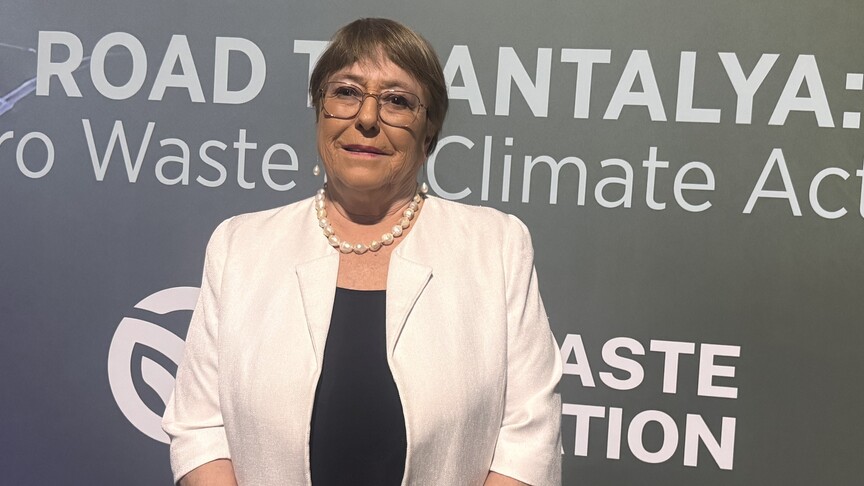
Former Chilean President Michelle Bachelet said governments can no longer treat climate action as a choice, arguing that scientific evidence has already made clear both the causes of climate change and the steps needed to confront it.
Bachelet, a candidate to succeed UN Secretary-General Antonio Guterres when his term ends in 2026, told Anadolu that stronger political leadership and international cooperation are needed to help vulnerable countries pursue development while responding to a crisis already affecting millions worldwide.
"This is not an option, it's an obligation," she said.
Bachelet said scientific uncertainty over climate change is largely a thing of the past and that the challenge now is convincing governments to act on what is already known.
"Now everybody knows why it's produced, what you can do to stop it and what is necessary," she said. "What we need now is political will from member states."
She stressed that climate change cannot be addressed by countries acting alone and said international agreements remain essential to delivering meaningful progress.
"No country by itself will solve the problem. We need international cooperation, so we need agreements," she said.
Climate justice and development
Bachelet said climate change has exposed deep inequalities, with countries that have contributed the least to global emissions often facing the harshest consequences.
At the same time, she argued that developing countries should not be forced to choose between economic growth and environmental protection.
"Should we choose development because small countries, less developed countries, they also need to develop? So should we do it without thinking about protecting the planet, or how do we do that?" she said.
According to Bachelet, sustainable development is possible if governments pursue policies that promote economic growth while investing in clean energy, renewable power and sustainable transport.
She pointed to efforts in countries across the Global South as evidence that climate action is not limited to wealthy economies.
"It’s interesting that the Global South has started with a lot of changes in terms of energy," she said. “It didn’t come from the North.”
Bachelet noted that countries such as Chile, Brazil and Mexico rely mainly on renewable energy to generate electricity and argued that long-term state policies can attract investment and accelerate the transition away from fossil fuels.
"What I mean is you don't need to be a rich country to do what needs to be done," she said.
COP31 opportunity
Bachelet said the UN COP31 climate summit, which Türkiye is set to host in Antalya later this year, would provide an important opportunity to strengthen international cooperation and advance climate justice.
“COP31 in Antalya will be an opportunity for this, because it will be to make decisions that will support not only each country itself, but the community of countries,” she said.
“That is also climate justice – to bring to people, on one hand, the growth they need, the development they need, but also protecting them from all the burdens of climate change,” she added.
She said discussions on the renewable energy transition would be among the summit's key issues, as well as the importance of zero-waste policies and the circular economy in reducing methane emissions.
"Putting zero waste and circular economy also as a central part of COP31 is really important because one of the biggest pollutants is methane and waste," she said.
Organic waste accounts for around 70% of methane emissions, she said. Methane is one of the most potent greenhouse gases and the second-largest contributor to global warming.
Bachelet expressed hope that the Antalya summit would help countries move beyond commitments and adopt policies that support both development and climate resilience.
"The planet belongs to all of us — big countries, small countries, powerful countries, powerless countries," she said. "We know what has to be done. So let's walk the talk."
Vision for the United Nations
The climate priorities outlined by Bachelet also feature prominently in her vision statement as a candidate for UN secretary-general.
In the document, she describes sustainable development not only as a goal but as a tool for preventing conflict, reducing inequality and strengthening global stability.
The statement calls for greater access to climate finance, stronger support for climate-vulnerable countries and renewed confidence in multilateral institutions.
Bachelet also argues that dialogue and international cooperation are essential to addressing the world's most pressing challenges.
"Dialogue, even with those who think differently, is not an option but a necessity for building lasting peace and an international community based on respect, international law and cooperation," the statement says.
She acknowledged criticism of the UN system, but said it is mostly related to “the wars that are not stopping and a Security Council that seems paralyzed.”
However, Bachelet said the organization continues to play a vital role in addressing climate change by bringing together governments, scientists and local authorities around common goals.
"Either we do this together, or we will all suffer the consequences," she said.