BANGKOK
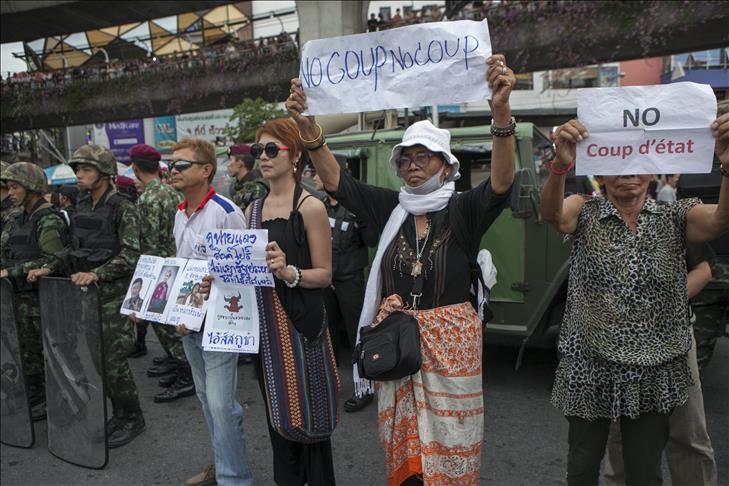
After seizing power in a May 22 coup, the Thai military has initiated an aggressive campaign against those criticizing the monarchy through extensive use of a law that penalizes offenses against the Thai king or royal family.
General Prayuth Chan-ocha, a staunch royalist heading the junta’s National Council for Peace and Order, has declared that he will do whatever it takes for the monarchy “not to be dragged into politics.”
The junta has summoned and detained some academics belonging to a group named “enlightened jurists,” which had called for reform of the country’s harsh lese-majeste law - under which offenders can face jail sentences of 3 to 15 years.
Last week, more than 20 suspects - some living abroad – were summoned by the junta with the warning that they would be tried by military courts - without access to counsel or right of appeal - if they failed to report in.
Among the suspects were Chatwadee Amornpat, a London-based hair dresser who posted videos critical of the monarchy on the Internet, and Thai academic Ji Ungpakorn, who wrote a book accusing the royal family of being behind a 2006 coup. Ungpakorn has been based in the U.K. since 2009 when he had to flee Thailand after being charged with lese-majeste.
An online petition initiated by Thai people living overseas asks Facebook founder and CEO Mark Zuckerberg to shut down Amornpat’s page, claiming it “contains highly offensive materials that are false and fabricated about the Thai monarchy.” It has gathered around 55,000 signatures.
Colonel Yongyuth Mayalarp, a spokesman for the junta, said efforts to stamp out illegal discussions on the monarchy aimed to “get the country in good order and to move forward.”
Some Thai citizens have applauded the military’s zeal and even contributed to the campaign. Website Prachatai reported that an academic had filed a complaint against a taxi driver after recording his critical comments about the monarchy.
Nevertheless, several analysts consider the junta’s campaign to not be based on facts.
A Thailand-based sociologist who did not want to be identified for fear of reprisal told the Anadolu Agency, “There is no movement against the monarchy. It is just the imagination of the military.”
“They focus on a few things which are quite small. Many people would say there is no threat to the throne,” he added.
Lese-majeste cases have increased drastically since the 2006 coup against Prime Minister Thaksin Shinawatra. The number has jumped from 33 cases in 2005 to nearly 500 in 2010.
But Thaksin himself and the government of his younger sister Yingluck, dismissed May 7 for abuse of power, have also not been averse to using the law against their own adversaries.
The law, among the most severe of its kind in the world, permits anyone to file a case against another person - unlike similar rulings in European monarchies that grant the right only to royal family members or in some cases palace officials.
The interests of the Thai military and royal family have been intertwined since the end of the 1950s, when dictator Sarit Thanarat pushed the young king, Bhumibol Adulyadej, to take a more public role - apparently aware that his regime would benefit through association with a widely revered institution.
"The King shall be enthroned in a position of revered worship and shall not be violated. No person shall expose the King to any sort of accusation or action," the 2007 Constitution of Thailand reads, with all 17 versions since 1932 containing the clause.
Although this formula - promoted by a formidable propaganda machine - worked wonders for decades, some now say it is running out of steam.
David Streckfuss, a prominent analyst and historian, told AA, “Since those close to the palace have played a role in determining the direction of Thai politics since the 2006 coup, there has been growing awareness and criticism of the monarchy.”
Extensive use of lese-majeste by coup makers, however, could even seem contrary to Chan-ocha’s emphasis on the royal family not being “dragged into politics.”
“It is quite detrimental to the monarchy itself,” added Streckfuss. “It makes the monarchy a clear tool in the military’s attempt to justify the coup, which tarnishes the monarchy even more.”
Furthermore, in a famous 2005 speech King Bhumibol himself had said: “if you say that the King cannot be criticized, it suggests that the King is not human.”
www.aa.com.tr/en