BANGKOK
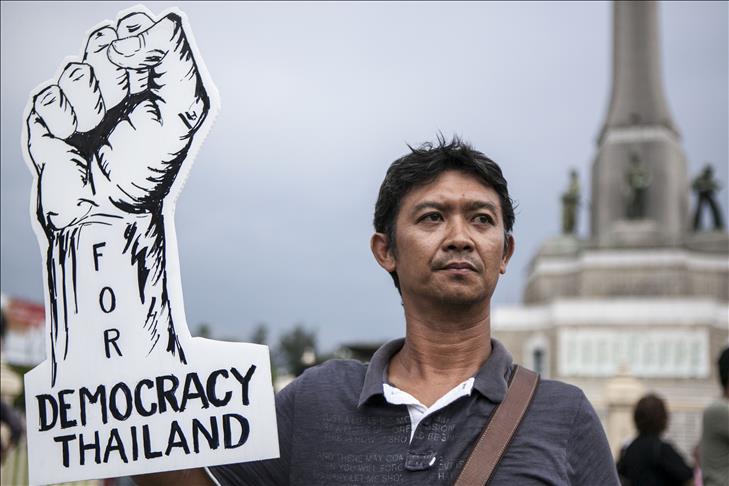
One week after Thailand's embattled government was overthrown in a coup, the country's new military rulers used the continued presence of anti-coup protesters on the streets as its reason for holding onto power.
Lt. Gen. Chatchalerm Chalermsukh told media Thursday that it was "impossible to hold an election at the moment" as protests continued.
On Thursday, however, demonstrations against military rule appeared to have been brought to a halt - the day after hundreds of protesters gathered at a monument on a major Bangkok thoroughfare troops blocked all incoming roads.
Shops in the area - not more than 5 minutes walk from the city's backpacker haven Khao San road - were forced to close amid fears of a violent crackdown, bottles were flown at soldiers, and a large army truck was sprayed with the slogan "NO COUP. GET OUT."
Meanwhile, the junta said it did not intend holding onto power, but gave no idea when it will allow elections to be held.
"[This] will take some time, but it's difficult to answer if you ask me how long," said Chalermsukh.
The military took control May 22 after seven months of political deadlock that has seen protesters take to the streets, voters bullied, elections annulled and 28 people killed.
It has said that it had to act to restore order, in the process overthrowing a government that had won a 2011 landslide election victory.
Army Chief Prayuth Chan-ocha has appointed himself prime minister, his military dissolving the Thai Senate, shutting down some news outlets and exerting censorship on those permitted to resume.
The military has also said it will clamp down on any online speech it considers inflammatory. Facebook in Thailand appeared to have been briefly shut down Wednesday, although the military later denied it played any role. It has, however, begun targeting websites it deems threatening and asked media not to interview “anyone who doesn’t hold an official position.”
Chan-ocha received the King’s official endorsement Monday to head the country’s junta.
Human Rights Watch on Thursday called for the junta to immediately revoke an order to prosecute civilians in military courts.
"The military should end its arrests of individuals engaged in peaceful protest or criticism of the May 22, 2014 military coup or the imposition of martial law," it said in a statement.
Education Minister Chaturon Chaisaeng was arrested on the afternoon of May 27 after giving a press briefing at a Bangkok journalist club on the coup.
Chaisaeng is expected to be tried this week for defying a summons to report to the military junta and for violating article 116 (2) of the Penal Code.
Human Rights Watch underlined that the rolling crackdown on civil and political rights in Bangkok and other provinces raised deep concerns.
On Thursday, its website was blocked in Thailand.
Thailand's political crisis began in November when then Prime Minister Yingluck Shinawatra faced a wave of opposition protests after her government pushed through an amnesty that would have lifted the 2008 corruption conviction against her brother Thaksin, a divisive figure and ex-premier deposed in a 2006 coup.
Confronted by massive demonstrations, the government withdrew the bill, but the opposition alleged corruption by the government and Shinawatra family.
Yingluck dissolved the parliament December 9 and called February 2 elections, which were disrupted by the People Democratic Reform Committee, who want an unelected "people’s council" to run Thailand until the political system is reformed.
She was then herself removed by the Constitutional Court on May 7 in relation to the transfer of a high-ranking civil servant in 2011. The May 22 coup removed the remaining ministers and dissolved the Senate, the only standing legislative assembly.
www.aa.com.tr/en