MUMBAI, India
Myanmar is denying that Indian forces entered its territory Tuesday to attack rebel camps, despite claims from its neighbor to the contrary.
The incident is reported to have happened almost one week after 18 Indian soldiers were killed in a suspected ambush by the rebels on an army convoy.
Reports in Indian media on Wednesday claim that Tuesday's 45-minute operation -- which the Times of India said led to the death of as many as 100 militants -- took place at least 4 kilometers (3 miles) inside Myanmar’s border.
But later Wednesday, Zaw Htay, the director of Myanmar's presidential office, denied there had been any such raid on its soil.
"According to the information sent by Tatmadaw [Myanmar army] battalions on the ground, we have learned that the military operation was performed on the Indian side at [the] India-Myanmar border," he wrote in a Facebook post.
"Myanmar will not accept any foreigner who attacks neighboring countries in the back and creates problems by using our own territory," he added.
Tuesday’s raid is being reported as revenge for the June 4 attack on troops in the Chandel district of the state of Manipur, in which the 18 soldiers were killed and another 15 injured.
The ambush was allegedly carried out by members of the Nationalist Socialist Council of Nagaland (NSCN) and the Kanglei Yawol Kanna Lup (KYKL) -- two separatist groups active in the northeast state, which shares a porous border with Myanmar.
The Indian government has not said that its special forces struck inside Myanmar but the Indian Express reported Information Minister Rajyavardhan Singh Rathore as confirming that Indian forces had crossed into its neighbor's territory.
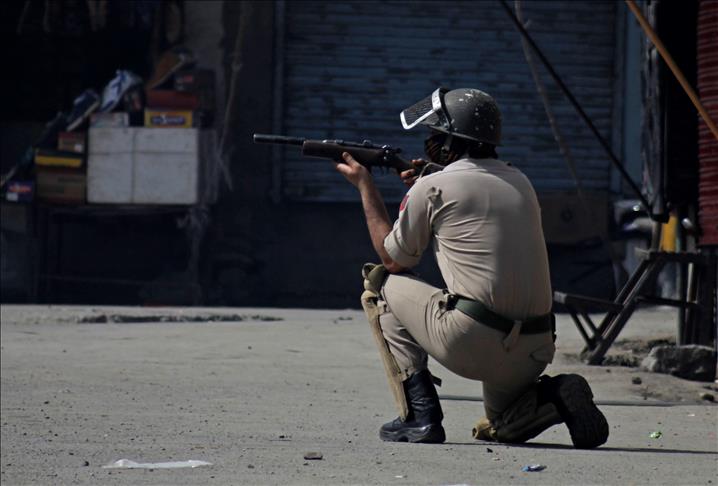
The government had only said that its forces had engaged insurgents along the border.
“The Indian army engaged two separate groups of insurgents along the Indo-Myanmar border at two locations along the Nagaland [state] and Manipur [state] borders,” the army said in a statement.
It added that in view of an “imminent threat” an immediate response had been necessary.
India’s northeast is home to a number of separatists groups that have taken up arms against the state, claiming the government neglects local problems while exploiting natural resources.
The NSCN, which ended a 14-year ceasefire agreement with India in March, aims to establish a sovereign state for the Naga indigenous tribes in northeastern India.
The KYKL, meanwhile, is a banned revolutionary organization whose purpose is to rebuild Manipur state by getting rid of immoral activities such as the drug trade and corruption.
Since 2010, Myanmar has agreed to let Indian forces enter its territory to hunt down militants.
A 2014 agreement on border cooperation also encourages the exchange of information on insurgents, drugs and human trafficking.
“We are in communication with the Myanmar authorities on this matter. There is a history of close cooperation between our two militaries. We look forward to working with them to combat such terrorism,” the Indian army said on Tuesday.
Late Wednesday, the Press Trust of India reported that Ajit Doval, India's national security advisor, would travel to Myanmar to discuss further action against insurgents.