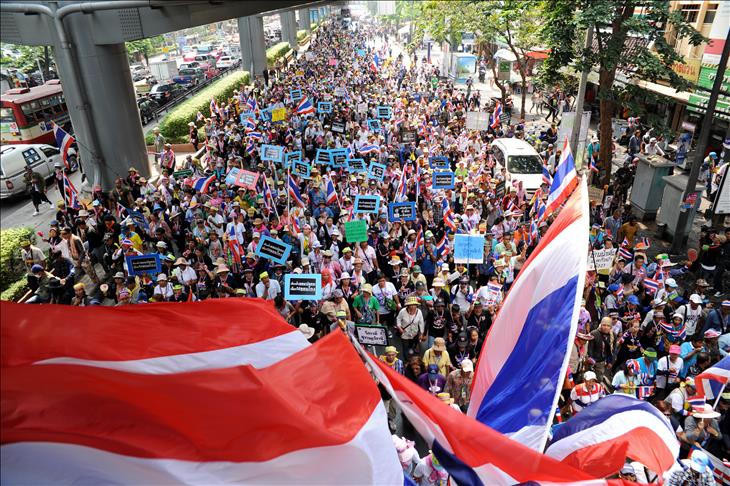
Gunmen shot dead an anti-government protester and injured three others on a Bangkok expressway Tuesday, raising the heat just one week before a massive pro-government gathering is expected to descend on the Thai capital.
Protesters from the People's Democratic Reform Committee were returning to their main site in a downtown public park after attending an anti-government rally in Bangkok's north when their convoy was ambushed Tuesday afternoon. A protest guard was badly wounded and died later in hospital, according to officials.
The incident was the latest in a series of gunfire and grenade attacks which have killed 24 people and injured several hundred since the beginning of the anti-government campaign in early November. The protesters want Prime Minister Yingluck Shinawatra, who they accuse of corruption and of being under the influence of her brother, former Prime Minister Thaksin, to resign.
Analysts have warned that Saturday's expected mass gathering of Red shirts – supporters of the government and Thaksin – could lead to confrontation between the two opposing groups. The Supreme Commander of the armed forces, General Tanasak Patimapragorn, hastily convened an exceptional meeting of the country's top military leaders Tuesday to discuss ways out of the political crisis.
The meeting was held closed-door, but The Nation newspaper quoted a military source as saying that a coup was not on the cards as the “military has learned lessons from the past.”
Outside of street tensions, pressure is also increasing on the prime minister at legal level. Yingluck presented her defense Monday in a financial scandal case in front of the Anti-Corruption Commission. She is accused of neglecting her duties in relation to a rice-subsidies scheme, which has been criticized for its inefficiency and for opening the door to massive corruption. Yingluck has requested more time from the commission to gather witnesses and documents in order to build her case.
A Thai expert on corruption interviewed Tuesday by the Anadolu Agency said that the case is strong and would likely to lead to her impeachment.
“The problem is that in this subsidies scheme there has been no transparency whatsoever," said Nipon Poapongsakorn, a distinguished fellow at the Thailand Development Research Institute, a think-tank focusing on economic and social issues.
"There is sufficient evidence and enough witnesses to build a case which will make it credible in the eyes of the public," he added.
The rice subsidies scheme was initiated soon after Yingluck's Puea Thai (For the Thais) party won 2011 elections. Under the scheme, the government buys rice directly from farmers at a price which is 50 percent higher than the market price. At first, the program was popular with farmers, but ran quickly into hundreds of billions of baht (billions of euros) in financial losses. It was also heavily criticized for opening the door to corruption.
Yingluck has been accused of knowing about the corruption and doing nothing to prevent it, and of not stopping the scheme when it began to run into trouble. She has proclaimed her innocence, her lawyers highlighting that corruption and political violence charges against her predecessor - the leader of the opposition - have come to a standstill while her's appear to have been rushed through in record time.
“I have no alternative but to conclude that as far as the examination of evidence and witnesses in this case is concerned, I have not been treated fairly or received any justice,” she wrote in a Facebook post Friday.
On Monday, the commissioners rebuked her criticism, saying that they had been looking into the rice subsidies scheme for almost two years, ever since a commerce minister from her government was accused of corruption.
The commission will decide whether to indict her in coming weeks. If they choose to do so, she will be suspended from her duties and an impeachment process will begin in front of the Thai Senate.
Analysts, however, have highlighted another legal case that could also lead to her downfall. In September 2011, Yingluck transferred, in controversial circumstances, the then secretary general of theNational Security Council, Thawil Pliensri, to an inactive position.
On March 7 this year, the Supreme administrative court ruled that the removal was unlawful. Two senators were quoted by the Bangkok Post online Tuesday as saying that according to the constitution - as there had already been a ruling in the case - the prime minister and her cabinet could be out as early as mid-April.
In this gloomy context, one of the few bright spots in the clandestine complex world that is Thai politics, is that the senatorial elections, organized Sunday, proceeded with little violent incident.
The results, announced Monday, confirmed the regional divisions of the country which have emerged in the wake of the political crisis. Anti-Thaksin candidates, such as former auditor-general Jaruvan Maintaka, won seats in Bangkok and in the south of the country - fiefdoms of the opposition Democrat Party.
Meanwhile, pro-government and Red Shirt candidates were victorious in the north and the northeast, Thaksin’s heartland.
To complicate matters further for Yingluck, half of the senate is appointed by judges - generally opposed to the government - meaning that the senate, which has a key role in the impeachment process, is now dominated by pro-PDRC and opposition members.
englishnews@aa.com.tr