By Kaamil Ahmed
DHAKA, Bangladesh
By Kaamil Ahmed
DHAKA, Bangladesh (AA) – Three people were killed in sporadic clashes across Bangladesh Monday as the country’s prime minister and opposition leader traded barbs on the first anniversary of last year's controversial elections.
The local news website, bdnews24.com, reported that two supporters of the opposition Bangladesh Nationalist Party were shot dead during clashes in the northern city of Natore, while another was killed in Rajshahi, also in the north.
Local television channels showed clashes between supporters of the rival parties throughout the country on the first anniversary of Jan. 5, 2014 elections, which were preceded by violence and a dispute about vote-rigging that led to the opposition Bangladesh Nationalist Party boycotting the vote.
"The path you (opposition leader Khaleda Zia) are following will not bring any benefit for the people. Instead you will lose public faith and confidence," Prime Minister Sheikh Hasina, who leads the ruling Awami League party, said in a televised statement.
"People want security, peace and progress. We want to come out of the vicious circle of evil politics. We want to establish the politics of welfare," Hasina said.
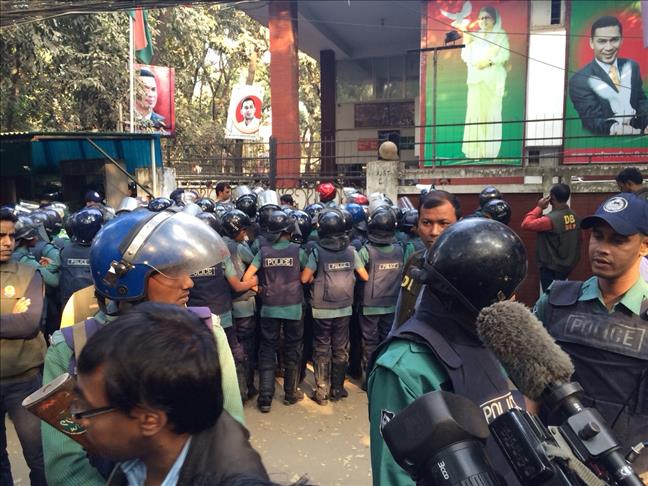
Police banned all rallies Monday and maintained a heavy street presence with checkpoints throughout Dhaka.
More than 100 police officers, dressed in riot gear, were also stationed outside the office of Bangladesh Nationalist Party leader Khaleda Zia and trucks filled with cement and bricks were used to block routes.
Zia’s supporters staged an attempt to leave the office compound, where she was since Saturday, but were blocked by the police, who used pepper spray to subdue them.
Zia, speaking to reporters and supporters from behind the compound's gates, accused the government of detaining her, though the government claimed that the police cordon was to provide her with security.
She said her party would blockade major transport routes until the government called fresh elections. The Bangladesh Nationalist Party has repeatedly boycotted the 2014 elections after the government refused their request for the restoration of a caretaker government system, intended to guard against vote-rigging.
"The program announced by the BNP was basically a peaceful protest about the restoration of democracy," said Mahfuz Ullah, a Dhaka-based political analyst. "The way the government handled the program was undemocratic."
He said the government should hold dialogue with opposition parties about fresh elections.
"The election has created a major wound and if you don't heal the wound, the country cannot move forward," he said.
Muntasir Mamun, a history professor at Dhaka University, blamed the Bangladesh Nationalist Party for the violence, highlighting its alliance with the Jamaat-e-Islami party.
"It is very difficult to understand this sort of day, but we are used to it," said Mamun. "The situation will not improve. This strife will go on unless the BNP believes in Bangladeshi ideals and leaves Jamaat-e-Islami, which are major Pakistani stooges."
Jamaat-e-Islami fought against Bangladesh's independence from Pakistan in 1971. Recently, a local tribunal found several leaders of the party guilty of war crimes committed during the independence war.
Mamun also said the Bangladeshi Nationalist Party demands for an unelected caretaker government were impossible because it would contradict the constitutional requirement for a democratic government.
www.aa.com.tr/en