By Hader Glang
ZAMBOANGA CITY, Philippines
The Philippine government’s chief negotiator in talks with the country’s one-time largest rebel group has said that Scotland's recent independence referendum provides lessons to be learned in the establishment of an autonomous region in the Muslim south.
"The political predicament (in Scotland) was settled through the vote.
People’s support were courted through reason and arguments,"
Prof. Miriam Coronel-Ferrer said in a press statement issued Monday to the Anadolu Agency.
"To be sure, the campaign went full swing with all the trappings of a political contest. But balloons and barn-hopping, not bombs and bullets marked the campaign,” she added.
On September 19, Scotland voted against independence from the United Kingdom in a historic referendum that had threatened a union that has lasted for 307 years.
The chief negotiator said that the peaceful process serves as an example as the Philippine Congress discusses the Bangsamoro Basic Law (BBL), on which negotiations began after the government and the the Moro Islamic Liberation Front (MILF) signed a March 27 peace deal – named the Comprehensive Agreement on the Bangsamoro.
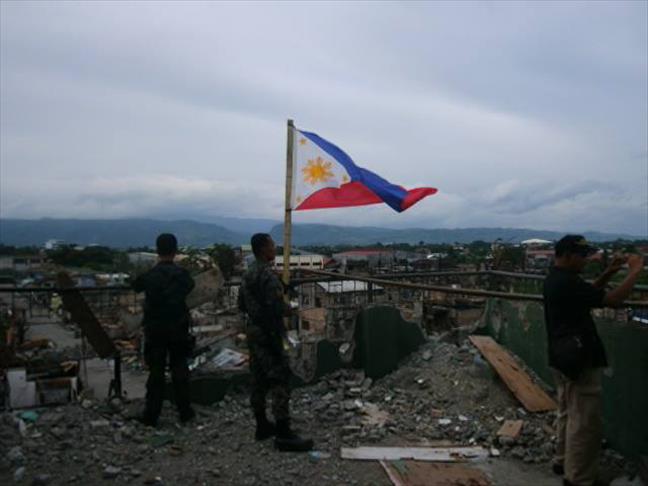
The agreement brought to a close 17 years of negotiations and ended a decades-old armed conflict in the southern area of Mindanao -- the second largest and southernmost major island in the Philippines -- while granting Muslim areas greater political autonomy.
On September 10, President Benigno Aquino III personally submitted a draft BBL to Congress leaders during a turnover ceremony at his office, the Malacanang Palace.
"More than 100,000 people had to die and millions of people [were] displaced in the course of the armed conflict propelled by Moro nationalism," Monday’s statement said, adding, “May this violence be truly a thing of the past.”
Coronel-Ferrer said that in the Scottish referendum, "nobody lost, everybody won, since the equation is not reverting to the status quo now that coexistence has been reaffirmed” before asking “Isn’t this the same win-win solution that we signed on to in the CAB?"
The result in Scotland – where 54.7 percent of the electorate voted to stay in the UK - opened the door for what Prime Minister David Cameron termed "a new and fair settlement" toward further devolution - specifically on the issues of taxation and welfare.
Coronel-Ferrer underscored that the proposed BBL “is intended to provide for more devolved powers to the Bangsamoro, in order to enable meaningful self-governance of the people in the upcoming autonomous region while remaining part and parcel of national politics and society."
www.aa.com.tr/en