By Gozde Nur Donat
ANKARA
The spreading power of the militant Islamic State of Iraq and Levant in Iraq could alter the balance of power in a region already riven by division and wracked by conflict.
The hardline militant group, commonly referred to by the initials ISIL, having taken control Tuesday of the northern Iraqi city of Mosul, headed south Wednesday and attacked parts of the city of Kirkuk and Tikrit. The same group also holds strategically important ground in the northern and eastern regions of war-torn Syria as it works toward its goal of establishing its own state. The Sunni group rose against the U.S. during the American invasion of Iraq.
Fierce clashes in some villages in the east of the Syrian city of Aleppo are continuing between ISIL and the Free Syrian Army, the moderate armed opposition in Syria.
ISIL is facing hardly any resistance as it advances through northern Iraq, local sources said.
"There is definitely a permissive environment," said Salman Shaikh, director of the Brookings Doha Center and research fellow at the Saban Center for Middle East Policy. "After years of ongoing distrust and breakdown between the central government and the local Sunni population, ISIL has managed to form a new coalition with local Sunni tribes and the Ba'ath party."
"We may well be seeing the resurgence of Sunni Baathists in this area," Shaikh said.
He said that local Sunni tribes and fallen Iraqi leader Saddam Hussein's Ba'ath Party -- a Sunni-dominated nationalist group that was in power until the U.S. invasion in 2003 -- are now united with ISIL to end the rule of Prime Minister Nouri al-Maliki, who is blamed for sectarian policies favoring Shiites.
Meanwhile, Muslim organizations called both sides for moderation. International Union for Muslim Scholars (IUMS) have called for stop immediately the clashes in northern Iraqi city of Mosul and asked Iraqi government to negotiate with the sides it is in conflict with.
"We want from Iraqi government to negotiate with the sides it is in conflict with and to stop using violence as a means of solution. Because, the history has shown us that military methods are not the solution," a IUMB statement, signed by Egyptian scholar Youssef Al-Qaradawi, said.
The Association of Muslim Scholars in Iraq (AMSI) said in a written statement: "The withdrawal of the Iraqi army under the revolutionary forces shows us the Maliki government policies went down and all young people who volunteer to take arms must join the revolutionary groups."
Maliki has promised to deliver necessary weapons and equipment, and called on citizens to fight against the militants. But there has been scant response, and Maliki has asked the Iraqi parliament to declare a state of emergency.
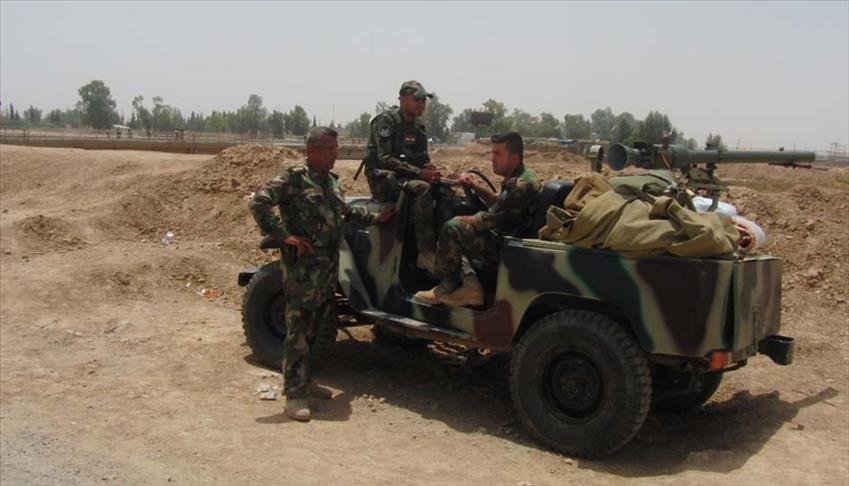
Kurdish peshmerga forces -- the army of the autonomous Kurdish region in northern Iraq -- have already said they are ready to help Baghdad against ISIL, but the Maliki government has not requested assistance.
"There are already disputed regions in Iraq between the northern Kurdish region and the Baghdad government," said Bayram Sinkaya, a Turkish academic specializing in the Middle East. "Asking for such help from the Kurdish region would mean enlarging the base of Kurdish forces in Iraq and would strengthen their position in the disputed regions."
A cross-border collaboration between Syria and Iraq-based ISIL militants is a preview of the emergence of some sort of boundary for an Islamic state aspiration stretching from eastern Syria all the way to western Iraq. ISIL may also come up against Iran, as with its latest acquisitions it draws closer to Iranian border.
"I do not think Iran would intervene directly, but would involve through supporting armed Shiite groups based in Iran to counterbalance them," Sinkaya said, expressing that ISIL advance would exacerbate the sectarian conflicts in the region.
Turkey is also among the countries directly affected from the conflict, as ISIL militants raided Turkish consulate in Mosul.
Turkish Prime Minister Recep Tayyip Erdogan chaired an emergency meeting in the Prime Ministry office on Wednesday right after the attack.
“I am sure that such de facto developments are not permitted in the region,” also said Turkish President Abdullah Gul speaking to press at Cankaya presidential palace in Ankara.
Turkish Foreign Minister Ahmet Davutoglu also cut his US visit short and is coming to Turkey because of the crisis.
www.aa.com.tr/en