By Hajer M'tiri , Ayhan Simsek and Michael Hernandez
BERLIN
Most of the dead onboard Germanwings Flight 4U 9525, which crashed in southern France, were German and Spanish, the head of the low-budget airline said Wednesday.
Meanwhile, sources from the Turkish presidency told The Anadolu Agency that President Recep Tayyip Erdogan spoke Wednesday over the phone with Spain’s King Filipe IV. Erdogan expressed his condolences to the people of Spain and the families of those killed in the crash.
Germanwings CEO Thomas Winkelmann said at least 72 Germans and 35 Spanish citizens were among the 150 passengers and crew who are believed to have perished in the disaster a day earlier.
"Support for the relatives of the passengers is our top priority,” he said at a press conference in the German city of Cologne.
"Lufthansa group has set up support centers in Dusseldorf, Barcelona, Frankfurt and Munich airports, to provide psychological support for the relatives of the victims."
He said airline officials were in close cooperation with the German Foreign Ministry to verify other nationalities, adding, "The nationality of some of the victims is still not clear, that is partly because they had dual citizenships."
He said 125 victims had been identified and two citizens each from the U.S., Australia, Argentina, Iran and Venezuela.
In Washington, the State Department confirmed that two American nationals were on the flight. Spokeswoman Jen Psaki declined their names and said that the U.S. is continuing to review its records to determine if any other U.S. nationals were aboard.
Citizens from the UK, Netherlands, Colombia, Mexico, Japan, Denmark, Belgium and Israel were also on board, said Winkelmann.
UK Foreign Secretary Philip Hammond said three of the victims were British.
Snow was hampering efforts by search-and-rescue workers on Wednesday to retrieve the bodies of the 144 passengers and six crew on board the 24-year-old aircraft flown by a subsidiary of German carrier Lufthansa, which went down in southern France after losing height rapidly from its cruising height of 38,000 feet the day before.
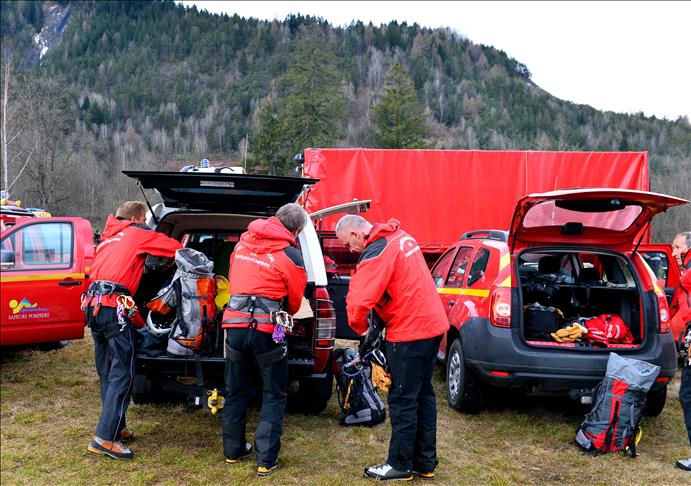
The spokesperson for the French interior ministry, Pierre-Henry Brandet, told reporters at the crash site: "It's a zone that is very difficult to access, very slippery. There was rain and snow overnight, so we need to secure the zone before the investigators begin their work."
"We are not in a race against time - we need to move forward methodically."
Brice Robin, the prosecutor of Marseille charged with investigating possible manslaughter, told reporters in Seyne-les-Alpes near the site of the crash: "The identification of the bodies will take several weeks."
"The black box, which was very, very damaged, is being examined by BEA (Bureau of Accident Investigations) experts and we hope we will receive first results in the late afternoon, but it could take several days to get all of them."
Earlier, French Interior Minister Bernard Cazeneuve said the flight recorder from the Airbus 320 had information which could be extracted, despite its damage.
Cazeneuve told French radio RTL: "The debris from the plane is spread over one-and-a-half hectares, which is a large area because the shock was significant, but it shows that the plane did not appear to have exploded."
A possible "terrorist attack" was "not a theory we are focusing on," Cazeneuve added.
French Secretary of State for Transport Alain Vidal said the aircraft's voice recorder - one of its two data recorders which are colored orange but referred to as "black boxes" - arrived Wednesday morning at the office of BEA in the French capital.
"When it comes to analyzing the sounds, it can take several weeks, but it is work that will perhaps give us an explanation," he said.
The search for the flight data recorder was ongoing, he said.
Germanwings said it would cancel some of its flights Wednesday amid reports by Der Spiegel that some pilots had refused to fly the Airbus 320 until investigations into the crash had been carried out.
However, a spokesman for the airline claimed some of the pilots' decisions were made for "emotional reasons", adding, "Some crew members did not wish to fly in the current situation, which we understand."
German weekly Der Spiegel reported Tuesday that the crashed aircraft had experienced a technical problem on its Nose Landing Door a day earlier and had to remain on the ground for hours.
Snow, rain and heavy winds were reported to be hitting the site of the crash at Meolans-Revels near the town of Barcelonnette, with bad weather forecast for the coming days which would hamper any rescue-and-recovery operations.
German authorities set up a crisis desk at Dusseldorf Airport to provide information and support to families and friends of the passengers.
A team of psychologists had been sent from France to Seyne-les-Alpes, close to the crash area, to support the families of victims arriving at the scene who were also expected to be met by French President Francois Hollande, German Chancellor Angela Merkel and Spanish Prime Minister Mariano Rajoy.
The aircraft crashed at 10:53 local time, 52 minutes after its departure from the Spanish city of Barcelona as it headed to Dusseldorf in Germany, according to Germanwings CEO Thomas Winkelmann.
“According to the information we have for the time being, the aircraft reached to its regular cruising altitude at 10:45 and after a minute it has entered into a descent, which continued for eight minutes,” Winkelmann said.
French Secretary of State for Transport Alain Vidal said: "There was a distress call recorded at 10:47 ... (which) showed that the aircraft was at 5,000 feet, in an abnormal situation and the crash took place shortly after this signal."
Pierre-Henry Brandet, French Interior Ministry spokesperson, said that the plane crashed "in a mountainous area difficult to access, at 2,000 meters above sea level."
The French union of air traffic controllers, SNCTA, announced in a statement that it had suspended strikes planned for Wednesday, Thursday and Friday given the "dramatic circumstances."
One of the reasons for the dispute was air traffic controllers' concerns over overloaded airspace.
The air disaster is one of the most tragic incidents in recent German aviation history and the first deadly crash of a Germanwings plane since the low-budget airline was founded by Germany’s largest airline in 2002.
A co-pilot and a passenger died when Lufthansa Airbus A320-200 overran a runway at an airport in Warsaw, Poland, in 1993. A total of 68 occupants survived.
The crash was also the first on French soil since July 25, 2000, when an Air France Concorde crashed into a hotel in Gonesse in the Val-d'Oise, shortly after taking off from Roissy-CDG airport, killing 13 German passengers and crew members, along with four others on the ground.