- 'The fact that they happen to have occurred in close temporal proximity is almost certainly just a statistical coincidence,' says Peter Stafford of Imperial College London
A series of strong earthquakes has struck different parts of the world within hours of each other, rattling communities from Northern California to Japan and Venezuela and prompting questions about whether the events could be connected.
However, seismologists say this is most likely just a coincidence, not evidence of any global link between the quakes.
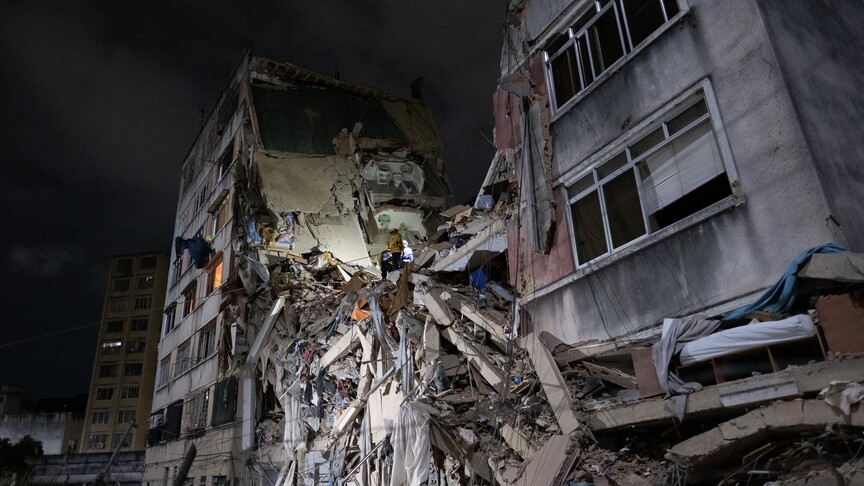
Late Wednesday, powerful earthquakes of magnitudes 7.2 and 7.5 struck Venezuela's northern Caribbean coast, causing widespread damage and triggering tsunami warnings across the region, killing at least 164 people and injuring 900 others. More casualties are feared as search-and-rescue operations are underway.
The following day, Acting President Delcy Rodriguez declared a national state of emergency, with the US Geological Survey (USGS) estimating a 42% chance that the death toll could be between 10,000 and 100,000.
Shortly after, in Japan, a magnitude 6.9 earthquake struck off the coast of Iwate on Thursday morning, according to the Japan Meteorological Agency.
The quake occurred at 7.30 am local time (2230GMT), about 42 kilometers (26 miles) from the coastal city of Kuji, at a depth of 50 kilometers (31 miles).
In the US, seismic activity was also recorded when a rural area of Northern California experienced its strongest earthquake since 1940 on Wednesday morning.
The magnitude 5.6 quake was centered about 7 miles (12 kilometers) northwest of Willits, according to the USGS.
'Statistical coincidence'
Experts say the close timing of the earthquakes is striking but not unusual given global seismic activity patterns.
Peter Stafford, a professor of engineering seismology at Imperial College London, said such events are expected to occur independently in different regions.
"California experiences 2-3 events like this every year, on average. Japan experiences an event like the recent one roughly once per year on average. These are both ballpark estimates. Rates in Venezuela are harder to constrain, but these large events occur far less frequently, more like once every 50-100 years..."
According to the expert, in each region, events like this have happened and are expected and inevitable.
"The fact that they happen to have occurred in close temporal proximity is almost certainly just a statistical coincidence."
Stafford said that the models for triggering events are usually based on concepts related to static or dynamic stress transfer, adding that the stress changes are very small when considering teleseismic distances relevant to California, Japan, and Venezuela.
He questioned that if these events are somehow related to each other through some sort of triggering process, why have there not been many other events occurring on faults that are located between these areas?
"If the statistical clustering was really due to physical processes, we would expect to see a more diffuse distribution of triggered events rather than localized instances at great spatial separation," he said.
Are powerful earthquakes increasing?
Scientists say there is no clear evidence that large earthquakes are becoming more frequent.
According to the USGS, short-term increases or decreases in seismic activity are part of normal fluctuations in earthquake rates and do not indicate an approaching major event.
The USGS ComCat earthquake catalog shows an increase in recorded earthquakes in recent years, but scientists say this reflects improved detection rather than a rise in actual seismic activity.
The National Earthquake Information Centre now locates about 20,000 earthquakes globally each year, or roughly 55 per day.
Long-term records suggest about 16 major earthquakes (magnitude 7.0 or higher) occur annually on average. However, yearly totals vary significantly, with 2010 recording 23 major earthquakes, while some years, such as 1988 and 1989, recorded far fewer than average.
Major earthquakes in modern history
According to the US Geological Survey, the strongest recorded earthquakes in modern history include the magnitude 9.5 Valdivia earthquake in Chile in 1960, which killed 1,655 people and left millions displaced.
The magnitude 9.2 Great Alaska earthquake in 1964, which triggered a tsunami and caused 130 deaths and $2.3 billion in damage, is the second most powerful one.
In 2004, the magnitude 9.1 Sumatra-Andaman earthquake in Indonesia generated a massive tsunami that killed more than 280,000 people and displaced 1.1 million across South Asia and East Africa.
The 2011 magnitude 9.1 Tohoku earthquake in Japan caused over 15,000 deaths and a nuclear disaster.
A magnitude 9.0 Kamchatka earthquake in Russia in 1952 generated a tsunami that reached Hawaii, causing over $1 million in damage.
In 2025, a magnitude 8.8 quake struck Kamchatka, Russia, which was preceded by dozens of large foreshocks, including a magnitude 7.4 jolt just a few days earlier.
More recently, the 2010 magnitude 8.8 Maule earthquake in Chile killed more than 500 people and destroyed hundreds of thousands of homes.
Other powerful earthquake events include the 1906 Ecuador–Colombia earthquake, the 1965 Alaska Rat Islands quake, and the 1950 Assam–Tibet earthquake, all of which caused massive destruction.