Europe can do more in refugee crisis: Greek charity
'Since Greece, with its huge financial crisis, welcomed all these people, why can’t the rest of Europe do the same?'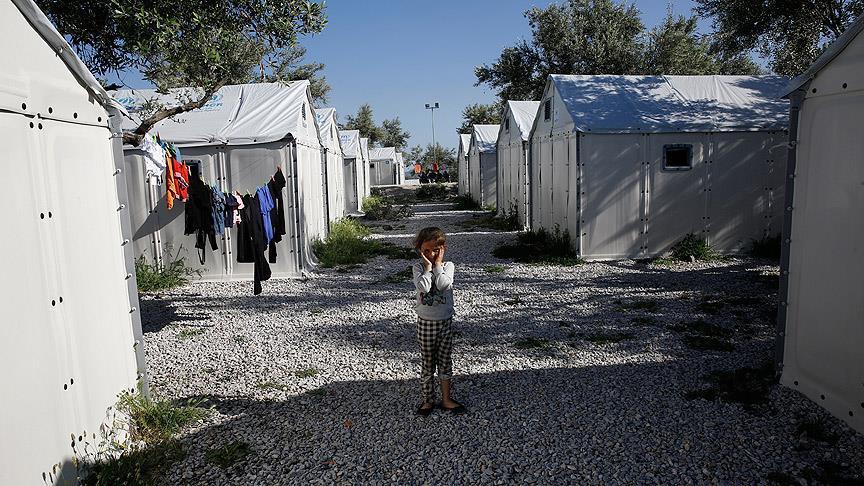
LESBOS, Greece
If Greece alone can host thousands of Syrian refugees despite a financial crisis, then the other European countries can definitely do the same, according to the spokesperson of a Catholic charity in Greece.
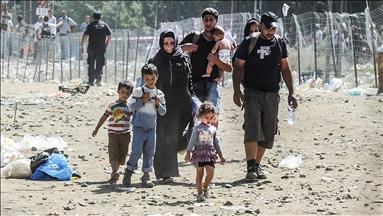
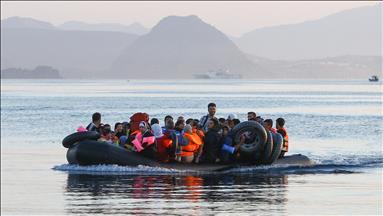
Official Greek data suggest that over 7,000 refugees are currently staying on the Greek islands, with some 3,000 staying at the Moria camp on Lesbos alone.

“Since Greece, facing a huge financial crisis for the past eight years, has managed to welcome and support all these people, why can’t the rest of Europe do the same?” said Maristella Tsamatropoulou, spokesperson for Caritas Hellas, the Catholic charity in Greece, in an interview with Anadolu Agency.
Tsamatropoulou said sending the refugees back is not a good solution. Neither is “not supporting them in the best manner that we can”.
“They are fleeing war and persecution. They have already spent a lot of money and risked their lives crossing the Aegean Sea,” she said, adding that Caritas Hellas has been active at the Moria detention facility for almost seven months.
Calling the situation in Moria “really tough” and “deteriorating,” Tsamatropoulou said about 200 at-risk refugees are currently staying at a hotel on the island.
“At this hotel, there are 200 guests, as we call them. This hotel is a part of a project run by Caritas Hellas but funded by Caritas Switzerland, Germany, and Austria,” she said, adding that the “guests” were chosen on the basis of vulnerability.
“That means families with children, elderly people, chronically sick patients, disabled people, generally whoever needs our hospitality.
“More than half of them are children. Most of them are Syrians here, except for one Afghan and one Iranian,” she said, adding that they are hosting a total of 400 people together with two hotels in Athens.
“We collaborate with the UNHCR, MSF [Doctors Without Borders], Red Cross, and other NGOs to decide who needs to be hosted in our hotels. So we go and pick them from the camps.
“Since November 2015, when we launched this project, in the beginning, we were accommodating them for a couple of nights and they were continuing their journey in transit. Now that the borders are completely closed, we tell them they can stay until they have another choice or are relocated and attend a family reunification program,” she said.
Hotel guest Ahmet Ibrahim, 37, said that he arrived on the island 45 days ago, after first having fled from Syria to Turkey, and stayed there for about a month.
"We don’t have enough money to stay at a hotel or anywhere else. The borders are closed and we’re stuck here. We have relatives in Switzerland and we have applied for relocation. But only God knows when we will get a reply. I am worried for the future of my kids,” he said.
Another guest, Ossama Hatir, a 31-year-old radiologist from Aleppo, echoed similar sentiments.
“I have three young daughters. My wife and I lived in Turkey for two years together with our girls. We came to Lesbos 41 days ago,” he said.
"We have relatives in Denmark. We applied to go there. We are comfortable here, but we have no idea when we will go or how. We are worried and waiting”.
Over 177,000 migrants or refugees have crossed into Greece and Italy since the beginning of 2016, according to the International Organization for Migration (IOM).
Of the 177,207 migrants that have already have crossed the Mediterranean this year, 153,362 reached the Greek islands as of April 13, while 23,170 landed in Italy. Another 648 migrants landed in Spain, while 28 landed in southern Cyprus.
During the same period, at least 732 migrants and refugees lost their lives trying to cross the Mediterranean, with the Eastern Mediterranean route between Turkey and Greece continuing to be the deadliest, accounting for 375 migrant deaths.
Arrival numbers have fallen since the signing of a recent readmission agreement between Turkey and the European Union under which those arriving on the Greek islands are sent back to Turkish territory.
According to the IOM, a total of 429 men, women and children arrived in Greece over the period of April 8-14, which was less than a third the daily average over 2016’s first 100 days in January, February, and March.
The IOM also noted a significant drop in arrivals in the first half of March (19,323) compared with the first half of this month: 1,903 – a decline of 90 percent.
Lesbos remains the main landing point, with more than half of the refugees arriving on the island, while the rest go to Chios, Samos, Leros, Megisti, Kos, Rhodes, and Kalymnos.