By Hassan Isilow
PRETORIA, South Africa
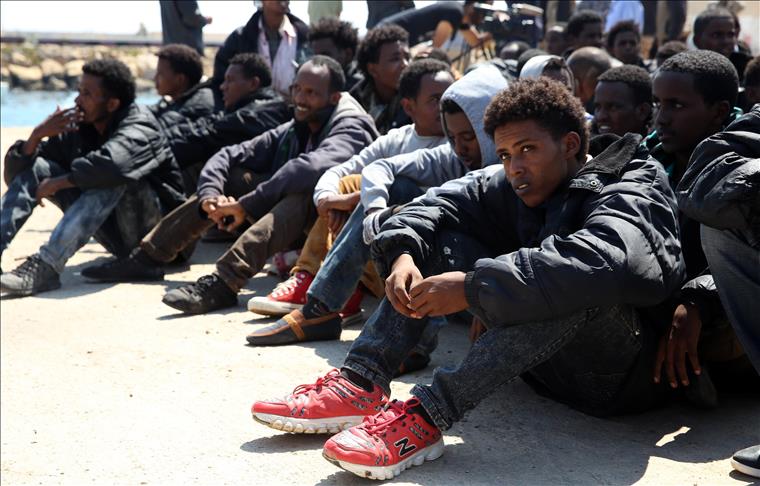
A group of tired-looking men and women can be seen lining up outside a reception center for refugees in South African capital Pretoria.
They are part of the hundreds of refugees and migrants who undertake risky journeys each month from across Africa in hopes of finding asylum in relatively well-off South Africa.
Most of them leave their home countries without proper travel documentation, depending instead on human smugglers who help them negotiate their way through various borders and reach their final destination.
“It was a very difficult – and expensive – journey for me and my four friends, as we did not have any documents,” 22-year-old Somali refugee Mustafa Hussein told Anadolu Agency.
While in Kenya, Hussein and his friends were introduced to a man who said he would help them cross the five national borders between Kenya and South Africa.
“He demanded $1,500, saying most of this money would go to police and immigration officers at various border crossings,” Hussein recalled.
The following morning, he and his friends – along with several refugees en route to Tanzania – were bundled into a mini-bus.
“Whenever we approached a border post, the man would ask us to get out of the vehicle and walk several kilometers in the bush until we crossed the border,” Hussein told Anadolu Agency in Pretoria.
Hussein recalled how, when they finally reached Zambian capital Lusaka, the smuggler checked them into a hotel before disappearing with all their personal belongings.
“We were stranded in Lusaka and had to resort to a local mosque for assistance,” he said.
One week later, another smuggler helped them cross the Limpopo River, which at one point runs along the border between Zimbabwe and South Africa.
Known for its powerful current and strong waterfalls, the river has seen many migrants mauled by crocodiles.
“Life in Somalia is too dangerous – that’s why we take such enormous risks,” 18-year-old Somali refugee Noor Salaat told Anadolu Agency in Pretoria.
- Sexual exploitation, xenophobia
Many female refugees and migrants who attempt to make the journey alone, meanwhile, complain of sexual exploitation by the smugglers who claim to be helping them.
“I couldn’t pay any more money while on my way from Mozambique, so the smuggler demanded sex,” one traumatized female Burundian refugee told Anadolu Agency on condition of anonymity, adding that she had no other choice but to give in to his demands.
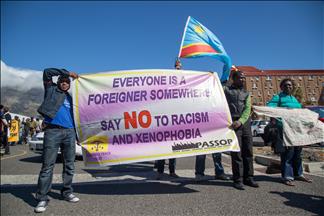
Meanwhile, despite a recent spate of attacks on immigrants in South Africa, the country nevertheless remains a destination of choice for many refugees and would-be migrants.
Earlier this year in Durban and Johannesburg, mobs of South Africans attacked foreign migrants who they accused of committing crimes and stealing jobs from native South Africans.
Seven people lost their lives in the violence, prompting hundreds of immigrants to flee the country in fear for their safety.
- Hope
Prof. Loren Landau of the African Center for Migration and Society, an NGO, told Anadolu Agency that, despite South Africa’s recent brush with xenophobia, the country still offered hope to many refugees.
“Even when people are hostile, you can still find work here,” he said, noting that South Africa provided refugees with a number of rights.
He also said many refugees saw South Africa as a country in which they could obtain documentation and from where they could apply for asylum in western countries.
Signatory to several UN conventions on refugees, the South African government provides refugees and asylum seekers with permits allowing them to work, study and access some public services.
In most other African countries, by contrast, refugees are usually confined to camps and forbidden from seeking employment or starting businesses.
Roughly two million migrants and refugees currently live in South Africa, most of whom hail from Zimbabwe, Mozambique or Malawi. There is also a sizeable refugee community from West Africa, East Africa and the Horn of Africa region.
Notably, in South Africa’s impoverished townships, most businesses are owned by Somali, Ethiopian or Bangladeshi refugees.
The Somali Community Board of South Africa, for its part, says it discourages Somalis from attempting to make the perilous journey to South Africa.
“Those who want to come here should get passports and visas,” group chairman Amir Sheikh told Anadolu Agency.