By Max Constant
BANGKOK
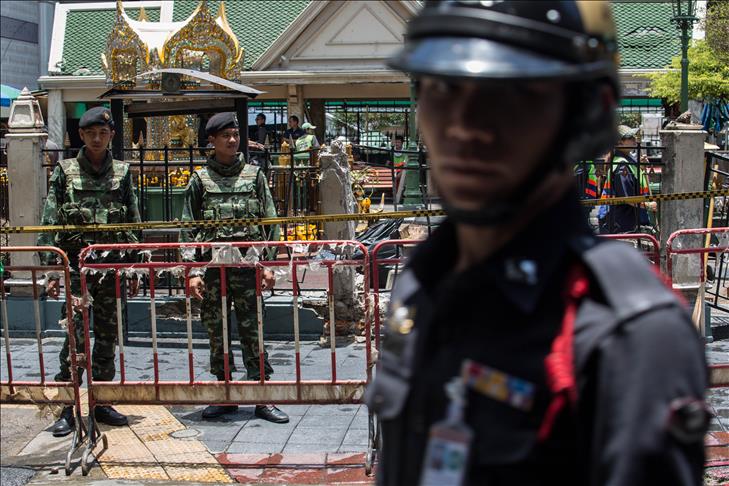
Human rights groups are nervous at speculation linking last week’s bombing in Bangkok to Thailand’s deportation of Uighur, telling Anadolu Agency on Wednesday that the future of those from the Turkic Muslim group who remain in the kingdom should have been secured long ago.
Philip Robertson, the Asia deputy-director for Human Rights Watch - while stressing that any links between the blast in which 20 people died and the Uighur issue were purely hypothetical - underlined that the central issue is that the 109 Uighur who were detained in Thai detention centers until July "should have never been sent to China."
"We know that they face torture and unlawful detention [in China]... Thailand went ahead despite advice from many people that they should not do it."
He underlined that Thailand would have to deal with any consequences of that.
Last July, Bangkok deported the 109 Uighur – 85 men and 24 women - to China, despite their wishes to travel to Turkey - which has a history of accepting the Turkic ethnic group as its own.
Prior to the deportation, 180 Uighur women and children had been separated from a group of 349 and sent, according to their wishes, to Turkey.
A further group of eight women and children were also sent to Turkey, as a chorus of protests by international organizations and foreign governments against Thailand's decision to send the second group to Beijing grew.
Anger at Thailand's move has been none more fervent than in Turkey, where a group of people, among them members of pro-Uighur organizations, ransacked the Thai consulate in Istanbul on hearing of the move.
The consulate was subsequently closed for more than a week.
On Monday, Anthony Davis, a well-respected security consultant for IHS Jane's Defense - which offers coverage and analysis of global military and commercial defense activity - told journalists at the Foreign Correspondents Club of Thailand that one of the most likely scenarios for the Bangkok blast was a link to some violent groups sympathetic to the Uighur cause.
The suggestion comes with Thai police at a loose end in their investigation, with little but an artist's sketch of the suspected bomber and some grainy closed circuit television images to go on.
Davis suggested that the most likely scenario was that a Turkish organization called the "Gray Wolves" was behind the attack, which he described as a "pan-Turkic, extreme right wing, fascist group."
The movement Davis refers to could be one of the many nationalist outfits that existed in Turkey in the 1960s and 1970s that described themselves as "Gray Wolves."
They did not, however, consider themselves fascist, instead describing their leanings as "Turkish nationalist."
On Wednesday, Robertson was prepared to hypothesize on the "possible" motivation.
“Some of the deported Uighur [to China] were brothers or husbands or fathers of women and children who went to Turkey. You are talking about terminally separated families... It makes some people very angry in Turkey.
"Everything has consequences.”
In July, visibly taken aback by the international backlash for shipping the 109 to China, Thailand's junta leader-cum-Prime Minister General Prayuth Chan-ocha told local media that the 52 Uighur who remain in Thai detention centers would be sent to Turkey if “they were innocent.”
China's state news agency Xinhua reported in July that the ministry of public security has claimed that many of the 109 Uighur were "on their way to Turkey, Syria or Iraq to join jihad."
Turkish Foreign Ministry Spokesperson Tanju Bilgic has called the allegations "ridiculous."
"This is not an allegation to even answer; it is laughable," he told media in July.
The very mention of "innocence" raised speculation that any such call was being led by China, Bangkok appearing to fall over itself to strengthen economic and diplomatic ties with Beijing in an effort to address its economic woes.
The Thai economy has been in decline since massive anti-government protests in 2014 culminated in a coup in May of that year. Falling exports, poor economic decisions by the military appointed-government, and a slowdown in the Chinese economy – the main export market for Thai products - has seen Thailand's economic and social development board revise its growth prediction for 2015 from 3-4 percent to 2.7-3.2 percent.
Other comments by junta members have also done little to dampen speculation that Thailand is prepared to compromise human rights principles for the sake of its economy.
In August - during a visit to the Kingdom by China's Foreign Minister Wang Yi - Thai counterpart General Tanasak Patimapragorn told journalists during a press conference to welcome Beijing's minister: “If I were a woman, I would fall in love with His Excellency.”
Patimapragorn has since been replaced at the ministry by a professional diplomat.
On Wednesday, an analyst on Muslim issues in Thailand told Anadolu Agency that “while it remains unclear if transnational jihadists are responsible for the Bangkok blast, it is a safer option for Bangkok to send the remaining Uighur to Turkey.”
She added that the Thai government could always say that its decision was purely based on humanitarian grounds, and an obligation to uphold international law - "which makes it look good."
"But, it will [then] owe Beijing an explanation,” added the analyst, who did not want to be identified due to the sensitivity of the issue.
Meanwhile, the 52 Uighur - a majority of whom are male - remain detained at immigration detention facilities in Thailand’s southern province of Songkhla.
They have all said they want to go to Turkey.
In July, Turkey's Bilgic underlined that Turkey would be more than happy to host them "if they come," saying that the country had never refused any guest "who had come to its door."