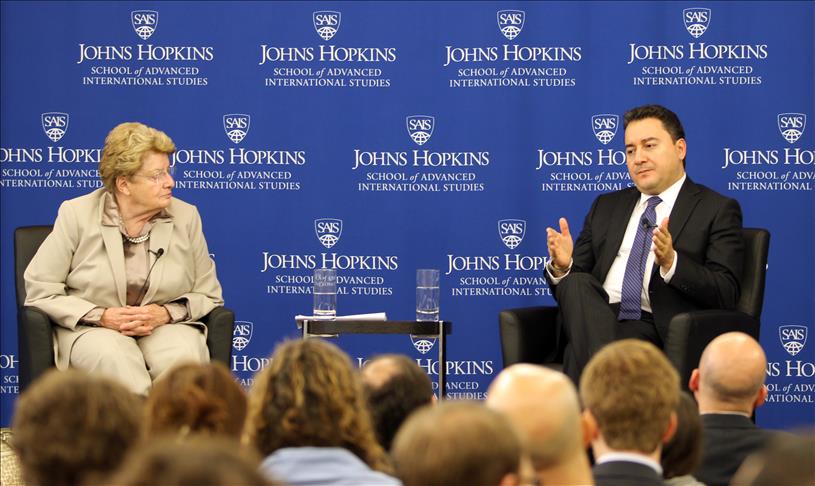
WASHINGTON (AA) – Speaking at Johns Hopkins Univeristy-SAIS Thursday, Turkish Deputy Prime Minister Ali Babacan outlined Turkey’s economic and social transformation over the past eleven years.
He noted the advances Turkey has made in developing a strong private sector, and implementing several democratic reforms, most recently the government’s announcement of a democratization package.
“When you talk about democracy, the quality of democracy is very important,” said the Deputy Prime Minister.
-Babacan: Gezi Park protests not to blame for fluctuations in Turkish market
Remarking on the economic impacts of the summer protests that swept through several Turkish cities, Mr Babacan said that global economic factors were to blame for the fluctuations in the Turkish economy.
He said that the US Fed’s tapering process, which started earlier in May, of limiting purchases of government assets and raising interest rates had wide-ranging effects felt across the globe, and certainly in Turkey.
“Our Gezi events started at the end of May. So in a way market volatility and our social volatility were happening at the same time, and most people attributed to what was going on in our markets was due to protests on the streets. But when you look at Brazil, India, their markets were also going through some volatility as well,” said the Deputy Prime Minister.
He added, “The impact of the Gezi Park events on our economy has been quite limited. Most of the impact was coming from markets going on globally.”
Still, Mr Babacan confirmed that some of the legitimate aspirations voiced during the protests are being addressed.
“Our support from the people of the country is now at 50 to 53 percent. […] But still we are the government of the whole country, and we have to take into account the real aspirations of our whole society. And that is actually one of the reasons why the Prime Minister announced a new democratization package. It’s not the first one, it’s not going to be the last one.”
-EU ascension in Europe’s Court
Commenting on Turkey’s ascension to the European Union, Mr Babacan said that Turkey must ultimately wait for the EU to be ready to accept it.
“After the 2008-2009 crisis, from now on, the questions is not about when Turkey is going to be ready for European Union. It is more about when European Union is going to be more ready for Turkey.”