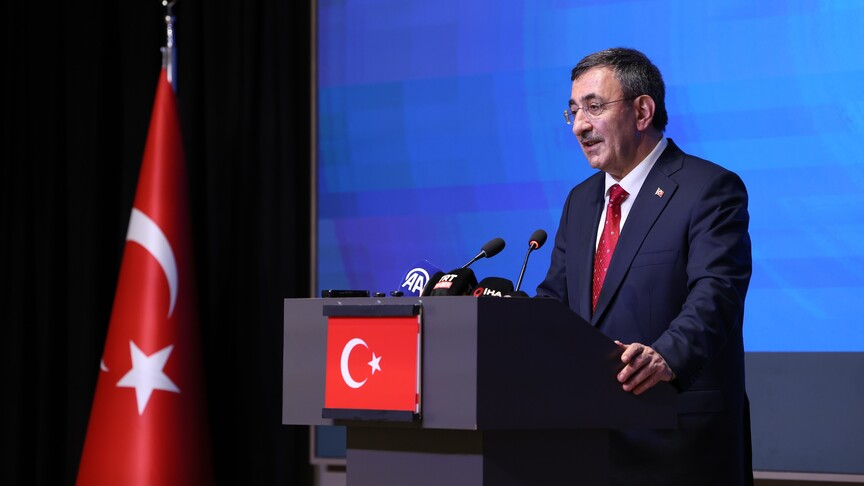
Turkish Vice President Cevdet Yilmaz said Türkiye must maintain a strong domestic defense industry to pursue an independent foreign policy, arguing that countries relying on foreign military capabilities cannot make fully sovereign strategic decisions.
"If you are going to pursue an independent foreign policy, you must have a defense industry. If you ensure your security with instruments provided by others, you cannot pursue an independent foreign policy," Yilmaz said during a live interview with 24 TV on Sunday.
Speaking on global developments, Yilmaz said the world is undergoing a period of transition marked by shifting power balances, weakening international institutions, growing conflicts and heightened uncertainty.
He said NATO has also been affected by these developments, recalling previous claims that the alliance was experiencing "brain death."
"However, the latest NATO summit showed that this is not the case. NATO, in a sense, demonstrated that it is regaining momentum with the Ankara summit," he said.
Yilmaz noted that European countries have significantly increased their focus on defense, pointing to the EU's €800 billion ($911 billion) SAFE program as well as rising national defense expenditures across the continent.
NATO summit demonstrates alliance unity
Yilmaz described the NATO summit in the Turkish capital Ankara as a success, saying the participation of all allied leaders demonstrated the alliance's ability to convene effectively.
He said the gathering reflected a renewed balance between Europe and the US within NATO, adding that Europe's role within the alliance is expected to continue expanding.
"It has now become clear that the European pillar will continue to grow stronger. Europe is moving toward sharing nearly half of the burden, even if it has not yet reached the level of the United States," he said.
Defense industry gains recognition
Yilmaz said the NATO summit also highlighted the growing importance of the defense industry, noting that the Defense Industry Forum was officially incorporated into the summit for the first time.
He said Türkiye had benefited from entering the defense industry sector early under the political leadership of President Recep Tayyip Erdogan.
According to Yilmaz, more than 80% of the equipment used by the Turkish Armed Forces is domestically produced, while Türkiye ranks as the world's 11th-largest defense exporter and is expected to enter the top 10 in the near future.
He said defense exports exceeded $10 billion last year and have surpassed $11 billion over the latest 12-month period.
Yilmaz also emphasized the sector's young workforce.
"We employ around 100,000 people, and the average age of employees is 34. When you look at the West, the average age is above 50. Therefore, the future belongs to us. The future belongs to Türkiye," he said.
NATO chief praised summit organization
Yilmaz said NATO Secretary General Mark Rutte personally praised Türkiye's organization of the summit.
"Let me share what Secretary General Rutte told me personally: 'The next host country has a very difficult job. You have set the bar very high,'" he said.
He added that the summit enhanced Türkiye's international visibility and strengthened its global prestige through the coordinated efforts of numerous institutions and officials.
Yilmaz also described 2026 as a "year of summits" for Türkiye, citing the Antalya Diplomacy Forum, the upcoming Organization of Turkic States Leaders' Summit, and the COP31 climate conference.
He said hosting major international meetings on security, diplomacy and environmental issues reinforces Türkiye's position as a central global actor.
Turkish-made commemorative gifts
Responding to questions about Turkish-made firearms presented as commemorative gifts bearing the names of participating leaders, Yilmaz said some countries were unable to take the gifts home because of their domestic legislation.
"As far as I know, some countries could not take them due to their internal legal regulations. This was a security summit, so the gift was related to that theme," he said.
He also praised the Presidential Complex in Ankara, saying its facilities played a critical role in hosting the summit and impressed visiting delegations.
Yilmaz said the event concluded successfully, with leaders, journalists and support staff expressing satisfaction with the organization.
"It was a highly successful summit without any incidents," he said.
US sanctions and F-35 issue
Commenting on US President Donald Trump's remarks regarding sanctions on Türkiye and the possible delivery of F-35 fighter jets, Yilmaz reiterated Ankara's opposition to sanctions among NATO allies.
"There should be no sanctions among allies, nor should there be trade restrictions. Unfortunately, Türkiye has faced both overt and covert sanctions and obstacles," he said.
He argued that those restrictions had ultimately strengthened Türkiye's domestic defense capabilities.
"We have reached the point where we export to countries that once imposed restrictions on us. Products we once could not buy despite offering payment are now products we sell to others," he said.
Referring to Trump's position, Yilmaz said the US president had clearly stated: "We cannot impose sanctions on our friends."
He also highlighted the relationship between Trump and Erdogan.
"I believe the relationship he has established with our president is important. He has demonstrated a very harmonious approach. He has great respect for our president and has expressed this repeatedly.
"He has already made his political will clear. We will all follow the next stage together, but now the ball is in the hands of the US administration. They will certainly do what is necessary. When journalists asked our president about this issue, he said: 'Keep watching us.' Therefore, there will certainly be progress," Yilmaz said.
Defense spending linked to sovereignty
Addressing future defense policies, Yilmaz said increasing global risks have led to higher military spending worldwide.
"Why is defense spending increasing so much around the world? Because risks are rising, both regionally and globally. These are not times when you can rely on the goodwill of others or on international institutions and rules. You must strengthen your own capabilities," he said.
He added that Türkiye's investment in the defense industry is directly tied to its pursuit of an independent foreign policy.
"When I speak of independence, I do not mean isolation. I mean having the ability to make your own decisions and participate in these processes on your own terms. Fortunately, Türkiye has reached that point," he said.
Yilmaz also stressed that investments in the defense sector contribute to building a knowledge-based, high-value economy capable of generating broader social prosperity.
Mehter band reflected Türkiye's heritage
Asked about the symbolic significance of welcoming summit participants with the Ottoman military band, Mehter, Yilmaz said the performance reflected Türkiye's historical legacy and national identity.
"It showed how deeply rooted our state is, how historic our army is, and that our country represents a great civilization today. It was a meaningful event that expressed our self-confidence and identity," he said.
He added that acknowledging Türkiye's historical heritage enhances international respect.
"Countries that deny their past or lack historical roots do not receive much respect. But if you are a country with a deep-rooted history and accumulated civilization, it commands greater respect. Fortunately, we have such a civilization and such a history, and we had the opportunity to reflect that," Yilmaz said.