Ankara
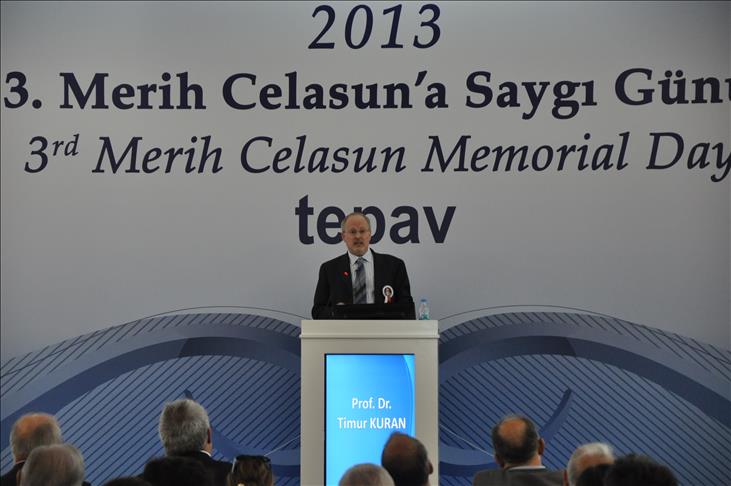
Professor of Economics Timur Kuran said on Monday that Islamic waqf (foundation) system, as the basis of today’s economy in the Middle Eastern countries, should be adapted to democracy to eradicate the widespread problems of corruption, nepotism, and also those resulting from the system of succession.
Timur Kuran, a professor of Economics and Political Science, and Gorter Family Professor of Islamic Studies at Duke University, gave on Monday a memorial lecture with his presentation “Institutional Roots of Authoritarian Rule in the Middle East: Political Legacies of the Islamic Waqf” on Merih Celasun Memorial Day held at TEPAV (Economy Policy Research Foundation of Turkey) Conference Room in Turkish capital Ankara.
Kuran stated that the ongoing political problems in the Middle Eastern countries, as seen in the Arab uprisings, have roots in the Islamic waqf system.
Stressing the significance of non-governmental organizations in the politics and economics of a democratic state, “Non-state actors affect state capabilities by contributing to political checks and balances,” told Kuran.
Waqfs, noted Kuran, regarding the current political effects of Islamic waqfs, violate the rule of law and are the underlying reason for the weak NGOs in the Middle Eastern countries.
Kuran pointed out that the other problems caused by Islamic waqfs are the disregarded role of providing social service, nepotism, widespread corruption and the decreased trust in such institutions.
Today’s modern waqfs are different from Islamic waqfs as they now serve as an agent of development and democratization, said Kuran.
“As the waqf system constitutes the basis of the economic system in today’s Middle Eastern countries, their structure should also be adapted to democracy to eradicate the accompanying problems of corruption and nepotism, and those resulting from the system of succession,” added Kuran.
Merih Celasun Memorial Day is organized by TEPAV to commemorate Professor Merih Celasun, passed away in 2004, who during his professional carreer at the State Planning Organization (DPT), Ankara’s Middle East Technical University and Bilkent University, provided solutions to the structural problems of Turkish Economy with his studies on economic policy driven by scientific thought.
The third event held this year also involves a “Merih Celasun Memorial Lecture” given by leading academics of the world, “Merih Celasun Memorial Speeches” and “Merih Celasun Award Ceremony.”
The winner of the 2nd TEPAV Merih Celasun Award was announced as academicians Murat Kirdar, Meltem Dayioglu and Ismet Koc for their article "The Effects of Compulsory Schooling Laws on Teenage Marriage and Births in Turkey."