ISTANBUL
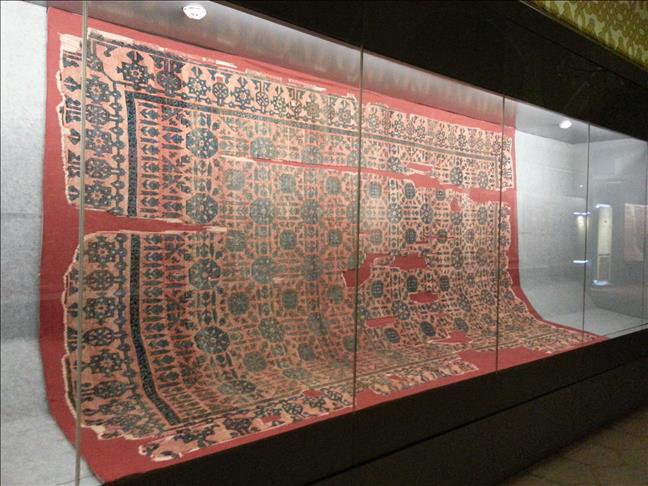
“Carpet is Turkic people’s gift to the world,” says Serpil Ozcelik, the manager of the CarpetMuseum that hosts one of the richest rug collections around the globe.
The museum opened its door on 15 November 2013 after 2 years of renovation on a historical building near to the Hagia Sofia, Istanbul. The museum has 806carpets in total; 394 of them are fit for exhibition while rest of them is for reserved for research.
“The museum has performed necessary cleaning and conservation to exhibit those rugs. We have 46 rugs in exhibition right now,” Ozcelik said, adding conservation of those rugs also helps them to bequeath those historical carpets to future generations as well.
Officials collected rugs from various mosques under the supervision of the Directorate General of Foundations. Ozcelik noted that those carpets were best examples of its class since they were donated by wealth people to acquire merits in a religious sense.
“In my view, those carpets are priceless. I can find similar motifs in modern carpets. But I will not be able to find rugs that were hand crafted in 14th or 15th centuries.” Thus, official will switch most of carpets annually and will perform necessary preservation not to avoid decaying. “It is also important to changecarpets to keep attention of visitors. If I exhibit all my collection in one time, the attention will fade away,” Ozcelik said. She also noted she is thinking of foreign exhibitions in coming years.
The oldest known hand crafted carpet is the famous so-called Pazyryk Carpet, dating back to the 5th century BC. It was decorated with reindeer and soldiers riding horse. Similar motifs can be seen atcarpets hand crafted during the Anatolian Seljuk, the Anatolian beyliks and the early Ottoman era.
“During the Ottoman era, we also began to see geometrical figures,” Ozcelik said. When asked whether figures also reflects of its time, she responded positively, adding that motifs related to power were more widespread when the Ottoman Empire enjoyed unchallenged times. She also noted figures also represents weavers’ aspiration and passions. “For example, if we see house figures, it may mean that weaver misses her house. If we see scorpion motif, it reflects fear of that particular animal.”
Apart from the Carpet Museum in Istanbul, there is one similar museum in Iran.
englishnews@aa.com.tr