By Ben Tavener
SAO PAULO
The construction company behind the Arena São Paulo stadium that will open this year's World Cup was given an ultimatum Wednesday to implement four emergency safety orders to allow a partial suspension on work at the site to be lifted.
Earlier this week an inspection by fire services, ordered after a fatal accident on Saturday, found 26 irregularities and work was halted on part of the stadium.
A local public prosecutor asked fire services to provide a shortlist of top-priority emergency measures that needed be taken to get the stadium back on track, in response to which four major demands were set out.
In an interview with GloboNews, prosecutor José Carlos de Freitas warned that if steps were not taken, “that partial ban on these areas, in theory, could extend to even when the stadium is officially open or mid World Cup.”
Odebrecht, the construction company, vowed to carry out necessary actions and the authorities will reassess the site next week.
Delays and safety concerns at the Arena São Paulo, also known as the Arena Corinthians or the Itaquerão, were already proving to be the biggest headache for tournament organizers FIFA, the Fédération Internationale de Football Association.
- To the wire
The stadium's revised delivery schedule is for mid-April, but construction overseers had already admitted work will not be completely finished by then.
But this was further complicated by Saturday's tragedy where a worker fell eight meters while working on the stadium's temporary stands. He later died of his injuries.
Fábio Hamilton da Cruz became the third person to perish at the stadium, after two men died in November when a crane maneuvering a section of roofing collapsed.
There have now been eight deaths at World Cup stadiums in the country.
Some have expressed concerns that construction is being rushed to meet deadlines and safety concerns, even after the two November fatalities, have been left lacking.
Two other stadiums, in Curitiba and Cuiabá are also way behind schedule, however Cuiabá's Arena Pantanal was officially opened Wednesday, 71 days before the start of the tournament and just hours before its first test match.
Curitiba's Arena da Baixada has now held its first game, albeit with just a fraction of seating areas open.
- Beset by problems
The run-up for the World Cup, which should have been a time of growing expectation for the “Land of Football,” has been beset by major delays, budget overruns, and a slew of scaled-down or scrapped infrastructure projects
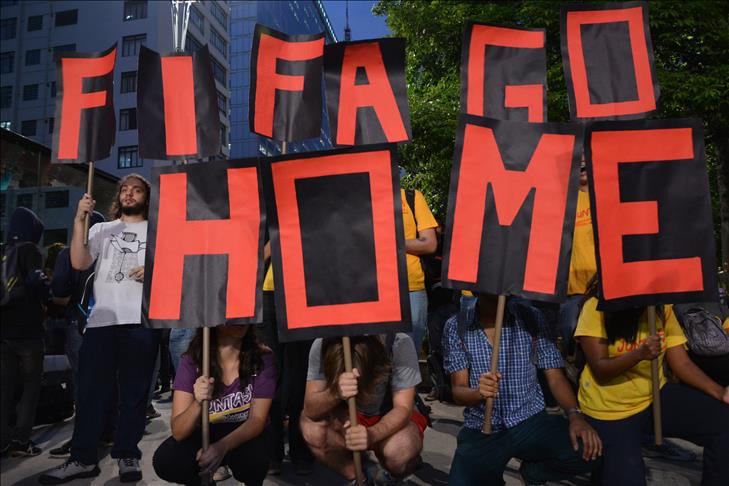
Although smaller than those seen last June during the Confederations Cup, street protests have also continued and a major demonstration is planned for opening night in São Paulo.
The government had promised a swift response to any vandalism or other violence and police have undergone special training for general crowd control, protests and riots.
New loosely-worded “anti-terror” legislation being rushed through parliament to target potential troublemakers has been criticized by civil rights groups as too general and unnecessary.
There has also been particular concern at some World Cup stadiums over temporary structures for security and hospitality.
Work to install a telecommunications network required by the sports broadcaster and other media has not even begun in São Paulo, reports say. The network should have been in place 90 days before the start of the tournament for testing.
Despite recently saying that it was confident the remaining unfinished work on stadiums would be ready in time, FIFA has now ordered all stadiums not to stage matches after May 20, according to Globo sports news.
Five-time World Champions and gunning for a record-extending sixth title, Brazil has already announced a six-week hiatus in its football championship from June 1 while the World Cup, last held in the country in 1950, is being held.
englishnews@aa.com.tr