WASHINGTON
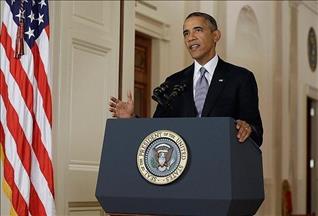
In a televised national address on Wednesday U.S. President Barack Obama laid out his strategy to fight and take out Islamic State (IS) militants in Syria and Iraq.
Obama said that the U.S. would expand the scope of its airstrikes in Iraq beyond protecting U.S. nationals and humanitarian facilities.
He said an additional 475 U.S. troops would be deployed to train and advise Iraqi forces, but would not take a combat role.
The president also noted that they would support the Syrian opposition and carry out humanitarian missions in the region for the people who have been displaced by IS.
Obama called on the Congress to approve more sources to support the Syrian rebels. While Obama welcomes congressional approval he has the power to act without it.
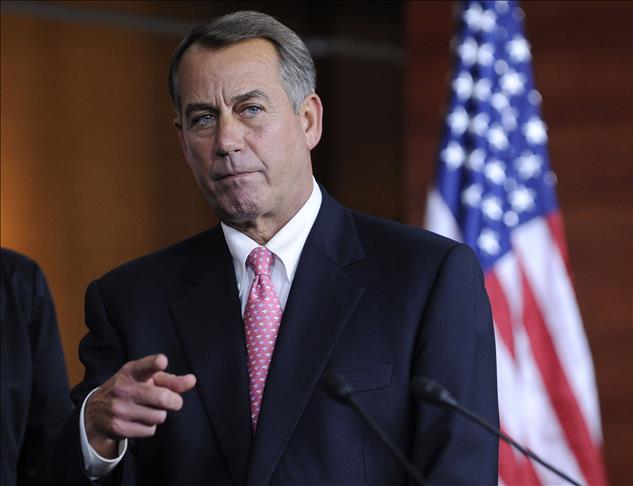
John Boehner, the Republican House Speaker, criticized President Barack Obama for waiting so long to set out a strategy.
"The President has finally begun to make the case the nation has needed him to make for quite some time," Boehner said. "A speech is not the same thing as a strategy, however. While the president presented a compelling case for action, many questions remain about the way in which the president intends to act."
The Republican leader said that it would be a long time before trained Iraqi forces and Syrian fighters would be effective in defeating the insurgent group.
Republican Senator, John McCain, speaking on Fox News called Obama's a "half measure," which he is concerned will only make the group stronger "and will not lead to its destruction" however, he conceded that it is better than doing nothing.
"He [Obama] described the correct goal – to degrade and ultimately destroy ISIS," McCain said. "However, the President’s plan will likely be insufficient to destroy ISIL, which is the world’s largest, richest terrorist army."
Republican California Representative Buck McKeon echoed McCain's concerns saying that Obama's plan didn't go far enough.
"I believe that many of the elements [Obama] advocated are important and I support them," he said. "However, they are not enough to achieve his own stated goal of defeating ISIL."
Republican and Democrate senators alike criticize Obama for not seeking congressional approval for the authorization of military force against the militants.
Republican Senator Bob Corker said; "I believe the president is exercising poor judgment by not explicitly seeking an authorization from the Congress where consensus can be reached around a substantive plan of action and support can be built for an operation that he has described will take several years," he said.
Democrat Senator Mark Udall also agreed with Corker and noted that "any expanded U.S. military role beyond airstrikes in the fight against ISIL in Iraq must be approved by the Congress."
Democrat Senator Tim Kaine from Virginia, who has consistently called for congressional authorization for the strikes, agreed.
"I disagree with the president's assertion that he has all necessary legal authority to wage an offensive war against ISIL without congressional approval," he said in a statement.
Dianne Feinstein, Democratic chair of the Senate Intelligence Committee, said that she fully supports Obama’s effort against IS.
"I applaud him for recognizing the seriousness of the threat and for going on the offense against this threat," she said. "Now that a strategy has been outlined, it is critical that Congress and the American people come together in solidarity to support the president and our armed forces."
Newt Gingrich, the former Republican speaker of the House, also praised Obama's speech saying: "I think this was the most explicitly pro-American speech of his presidency."
Saxby Chambliss, the top Republican on the Senate intelligence committee, also favored Obama's strategy.
"Tonight, the president has announced the United States' willingness to lead a coalition to destroy ISIL, and I support these efforts," he said.
www.aa.com.tr/en